

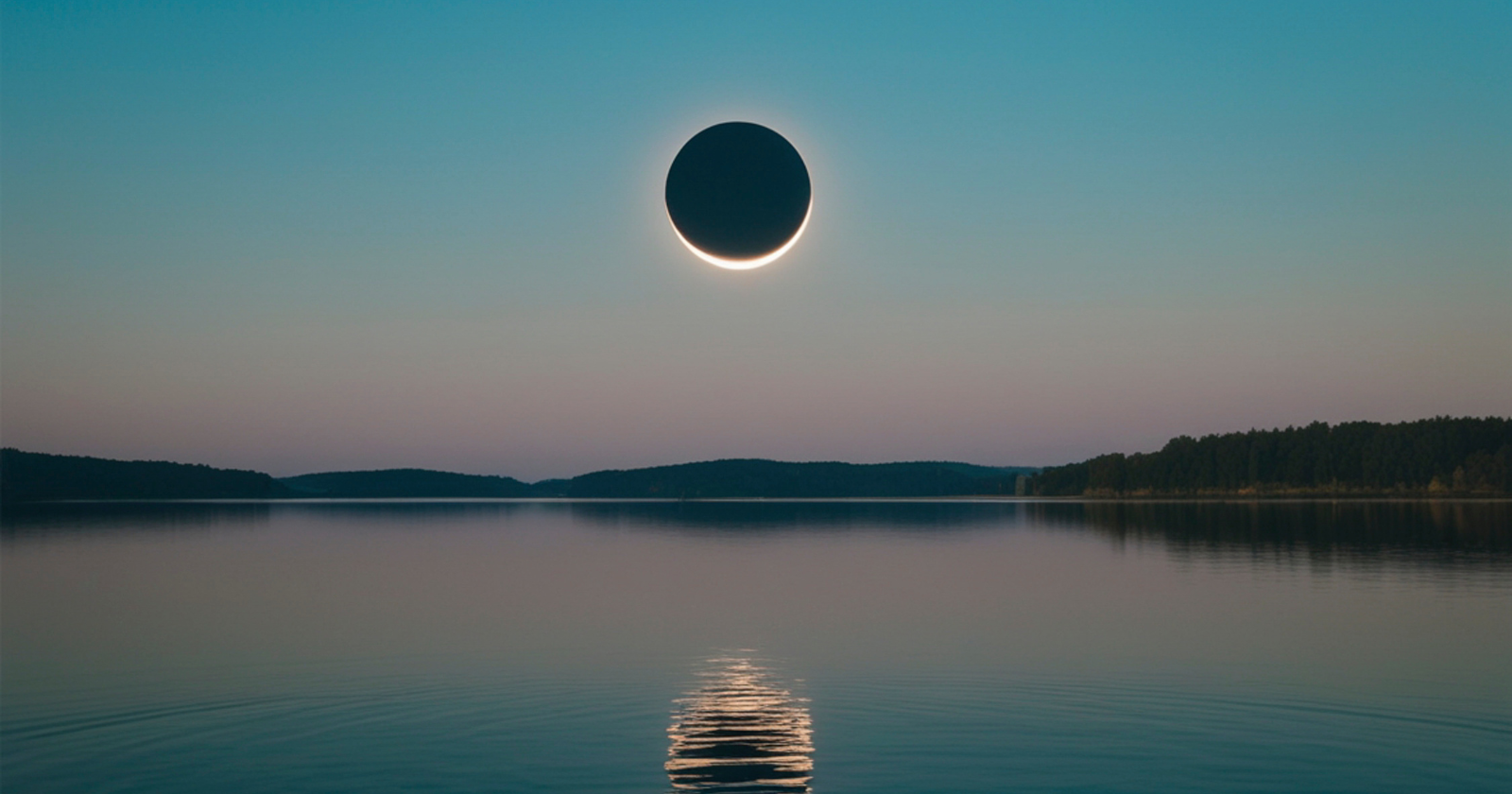
At about 5:48 in the afternoon, Reykjavík time, on Wednesday, August 12, the Sun will disappear.
Not permanently. Not partially. For approximately 60 seconds, the Moon will pass directly between the Sun and Iceland’s capital, and the sky over the city will turn dark enough to see stars. Elsewhere along a narrow curved path across the North Atlantic — through eastern Greenland, western Iceland, northern Spain, and a small corner of Portugal — the same thing will happen at slightly different local times. Off the west coast of Iceland, the eclipse will hit its maximum duration of 2 minutes and 18 seconds.
For the first time in 28 months, since April 2024, the Moon’s shadow will actually touch the Earth. And that same night, once the Sun has gone down and the shadow has moved on, the sky above much of the Northern Hemisphere will host the peak of the Perseid meteor shower — under the darkest possible conditions, because the eclipse itself only happens during a new moon.
The eclipse path
The Moon’s shadow will touch down at sunrise in northern Siberia, near the North Pole. From there it will race southeast at approximately 3,400 kilometres per hour — the speed of the umbra, the specific inner shadow where the Sun is completely blocked — sweeping across an 293-kilometre-wide track that traces a curved line across the top of the world and down into western Europe.
Greenland’s east coast catches the shadow first, giving cruise ships anchored in Scoresby Sund some of the earliest viewing on the planet. From there the umbra crosses the Denmark Strait, passing over western Iceland including Reykjavík and the Snæfellsjökull glacier. The maximum duration of totality, 2 minutes and 18 seconds, occurs over open water just west of the Icelandic coast.
The shadow then races across the Atlantic and reaches northern Spain in the early evening, close to sunset. This will be the first total solar eclipse to touch mainland Spain in over a century, and Spanish authorities are expecting significant crowds along the specific band running from Galicia across to Aragón and Catalonia. The umbra departs the Earth just east of the Balearic Islands.
Total transit time from first landfall to final departure: approximately 96 minutes. The Moon’s shadow will spend a little more than an hour and a half physically present on the planet’s surface.
What people outside the path get
Almost the entire Northern Hemisphere will get some form of partial eclipse.
The proportion depends on how close a viewer is to the path of totality. Dublin will see 94% of the Sun covered. Oslo will see 83%. London will get a deep partial. Continental Europe will see substantial coverage. Farther afield — Alaska, northern Canada, the northern United States, West Africa — the coverage decreases with distance from the path, but any location that can see the Sun during the eclipse window will see the Moon take some visible bite out of it.
Even 20% coverage is genuinely noticeable if you know to look. Light quality shifts. Shadows sharpen. Ambient sounds change as birds and insects respond to the false dusk. NASA’s guidance for the event includes safety warnings that will apply to hundreds of millions of people who will be seeing a partial eclipse without necessarily realising in advance that they are inside its footprint at all.
Certified eclipse glasses are required for any partial-eclipse viewing. Ordinary sunglasses are not adequate. Regular telescopes and cameras, without proper solar filters, will cause instant retinal damage if used to look at the Sun.
The Perseid coincidence
The specific reason August 12, 2026 is exceptional is what happens after the Sun goes down.
Total solar eclipses can only occur during a new moon — when the Moon is between the Sun and Earth with its dark side facing us. This means that every total eclipse comes with the darkest possible night sky on either side of it. Usually this is incidental. This year, that darkness happens to coincide with the peak night of the Perseid meteor shower.
The Perseids are the strongest reliable meteor shower visible from the Northern Hemisphere. Earth passes through the debris trail of Comet Swift-Tuttle every August, and the small particles from that trail burn up in the atmosphere at rates that can exceed 100 meteors per hour under ideal conditions. Under normal August moonlight, roughly half of these meteors get washed out. Under the new-moon conditions of August 12-13, essentially all of them will be visible to a viewer under dark skies.
This is the specific alignment Sky & Telescope has called a “rare double-header” — the first time in recent memory that the Perseids have peaked under both a new moon and on the same 24-hour period as a total solar eclipse. The specific combination will not recur on this scale for years.
Why the timing is genuinely rare
Total solar eclipses happen somewhere on Earth roughly every 18 months, on average. The Perseids peak every August. Both events happen on their own schedules and only rarely coincide.
For the two to align on the same calendar date requires the Perseid peak, which is fixed by Earth’s orbit through the Swift-Tuttle debris field, to fall on a day that also happens to be a new moon and also happens to have a total solar eclipse visible somewhere on Earth. The mathematical odds of that specific triple alignment are small enough that August 12, 2026 is the only date in the current decade when it occurs.
The next total solar eclipse after this one is in August 2027 — a substantially longer 6.5-minute event that will cross Spain, North Africa, and the Middle East, and which is already being planned for by eclipse-chasers around the world. That event will not coincide with the Perseid peak. Nor will most future eclipses. This specific alignment is a genuine one-off in the current viewing window.
What to do about it
For anyone in the path of totality — parts of Greenland, western Iceland, or northern Spain — the recommendation is straightforward: be outside, with certified eclipse glasses, at the specific local time totality begins. Even 60 seconds inside the Moon’s shadow is a genuinely different experience from watching a partial eclipse. The corona becomes visible. The temperature drops. The horizon lights up 360 degrees like a distant sunset. Stars and planets appear in the middle of the afternoon. Even people who have travelled specifically to see totality often describe it as unexpectedly overwhelming.
For anyone outside the path but in the partial-eclipse footprint — most of the Northern Hemisphere — the recommendation is to check local coverage, plan for safe viewing, and be outside for the specific local window when the Sun will be visibly reduced.
For anyone with a dark sky and no interest in the eclipse: the night of August 12-13 is likely to be the best meteor-watching night of the year. Lie flat, look up, wait for your eyes to adjust, and be prepared for the possibility of seeing more Perseids in a single hour than most people see in a lifetime.
The Moon’s shadow will touch the Earth on Wednesday. That night, the shooting stars will follow it.
