

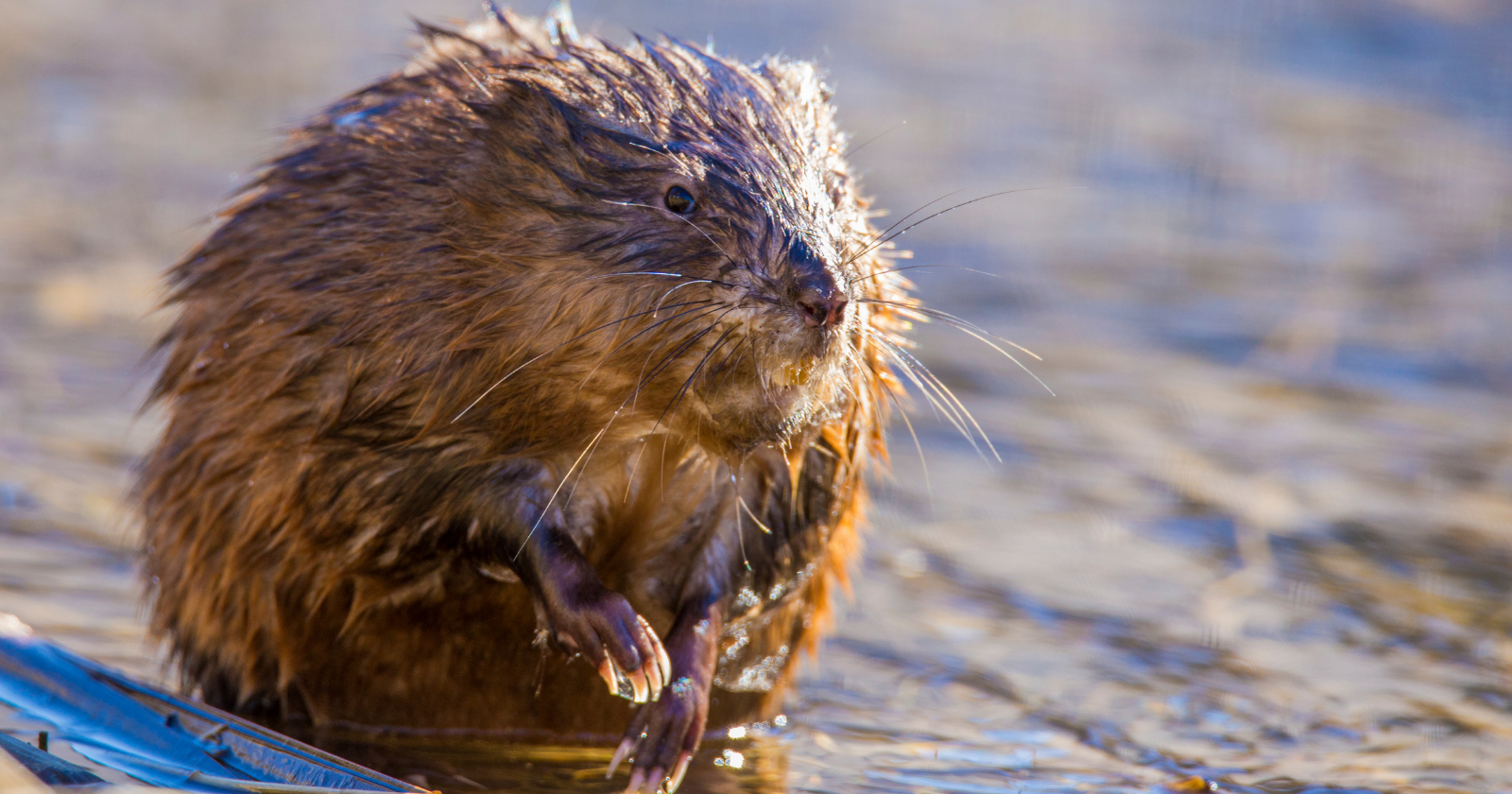
The muskrat is not a dramatic animal. It is a semi-aquatic rodent the size of a small cat, a builder of humble lodges, a chewer of reeds — the beaver’s unglamorous cousin.
Which makes it the strangest possible protagonist for one of the largest range expansions any mammal has managed in recorded history. Every muskrat in Europe, and most of the millions across northern Asia, traces to a single afternoon’s whim on an aristocrat’s estate.
Five rodents and a prince
In 1905, Prince Colloredo-Mannsfeld returned to Bohemia from a hunting expedition to America — Alaska, by the usual account — with souvenirs: a handful of live muskrats, two males and three females surviving the journey.
He released them into ponds on his estate at Dobříš, some 40 kilometers southwest of Prague, reportedly with an eye on the animals’ valuable fur as a sideline income. By one account the muskrats were at first fed grain and carrots like park exhibits.
They did not stay for the feeding. The ponds drained into streams, the streams into rivers, and a muskrat is a superb swimmer with a settler’s temperament: young animals disperse every year, following waterways to unclaimed territory, raising several litters a season when they find it.
By 1914 — nine years after the release — muskrats had colonized the whole of Bohemia, an estimated two million animals. Central Europe’s naturalists were already using the word calamity.
The walking-pace conquest
What makes the muskrat invasion a scientific classic is how measurable it was.
Because the animals damaged dikes and canal banks, European authorities mapped their advance obsessively, and later ecologists mined those records to compute the actual speed of a mammal invasion. The answer, for the first decades: the front advanced on the order of 10 kilometers a year — slower once mass trapping began, faster along rivers. Literally a walking pace, sustained for generations, in every direction at once.
The muskrat became a textbook organism for invasion biology; the mathematics of spreading populations was tested against its front lines. And the front kept moving. The Bohemian population rolled into Germany, Austria and Switzerland, later merging with populations from fur-farm escapes in France and Belgium. Deliberate fur introductions carried the species to Finland in the 1920s and, on an enormous scale, across the Soviet Union from 1928 onward, where it was seeded from eastern Europe to Siberia and Central Asia, reaching China, Mongolia — and Japan, which acquired its own naturalized population on Honshu.
A century after Dobříš, the muskrat’s Old World range was larger than its native North American one.
Why everyone traps them
The trouble with a muskrat is where it digs. The animal burrows into banks from below the waterline, and the banks of Europe are not wild riverbanks; they are dikes, levees, canal walls and railway embankments — infrastructure with water on one side.
A muskrat colony can honeycomb an earthen flood defense until it slumps, which is why the animal is taken most seriously in the country with the most to lose. In the Netherlands, where much of the nation sits below sea level behind engineered banks, muskrat control is a permanent public service: hundreds of professional trappers, year-round, removing tens of thousands of animals annually, with a stated national ambition to push the muskrat back to the border. Belgium, France and Germany run their own programs, and since 2017 the EU has listed the species as an invasive alien of Union concern, banning its keeping or release outright.
The one clean victory belongs to Britain. Muskrats escaped from fur farms there in the late 1920s, multiplied along Severn-country rivers, and triggered a national eradication campaign; by 1939 Britain had wiped them out entirely — one of the very few times any country has fully reversed an established mammal invasion, and proof of how narrow the window is: everywhere else, the moment passed.
The experiment, read back
Strip the story to its design and it is almost laboratory-clean. Five animals. One pond system. One decision, taken by one man, with no permits, no forecast and no concept that a forecast might be needed — 1905 predates invasion biology entirely.
The output: a continent and a half occupied, a permanent multi-national trapping industry, a species that now ranks among the most widespread mammals on Earth outside humanity’s camp followers — all of it, in Europe at least, plausibly descended from three females.
The prince wanted fur and a touch of the American wilderness on his ponds. He got the wilderness. It left within the year, at three miles per hour, heading everywhere, and 120 years later the Netherlands still employs several hundred people to argue with his souvenir.
