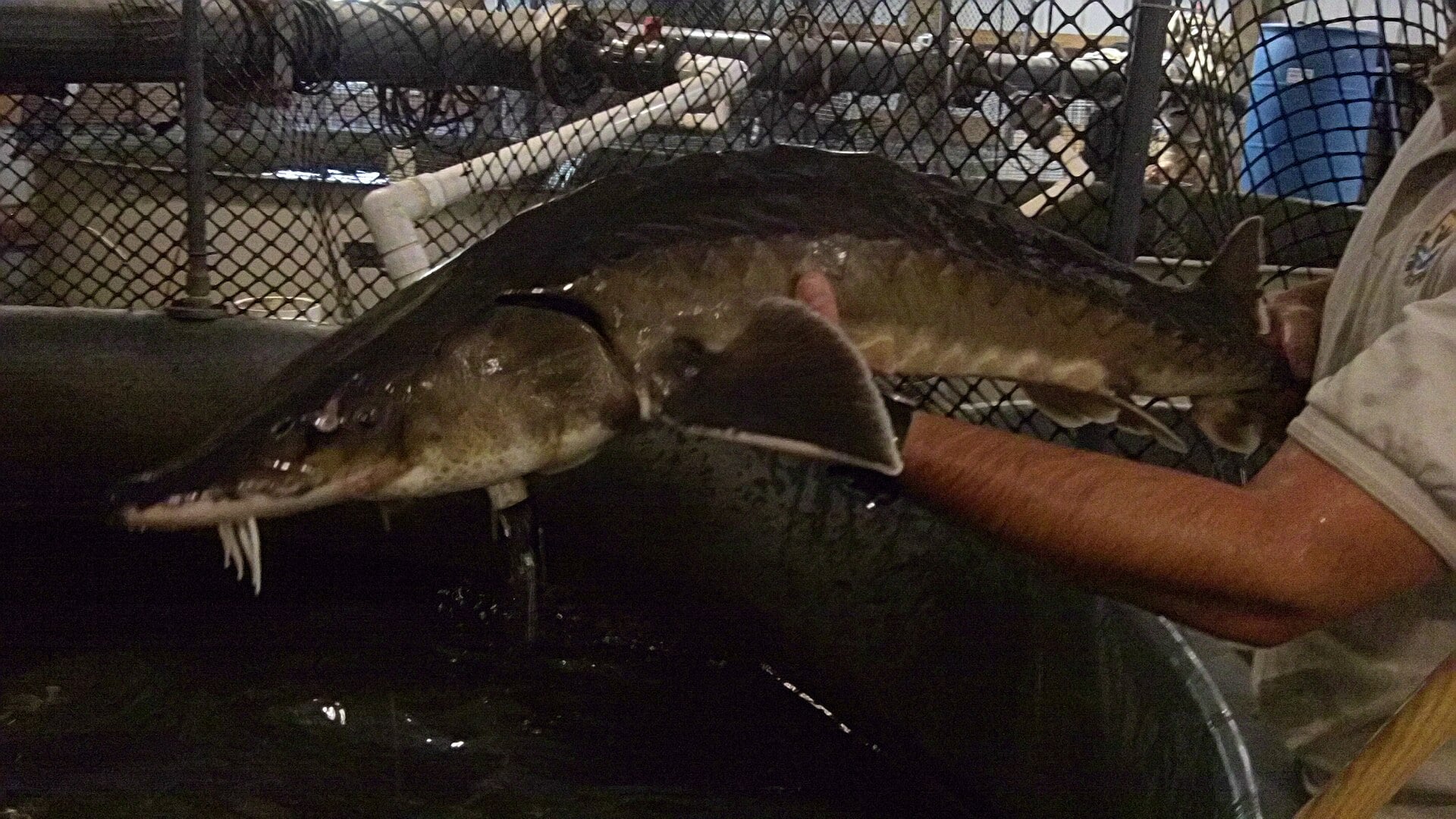
A coastwide index of Atlantic sturgeon abundance has been rising steadily since 2013, the Atlantic States Marine Fisheries Commission found in its 2024 stock assessment update, published in August 2024.
The update extends the commission’s 2017 benchmark assessment with data from 2016 to 2022. It combines nine fishery-independent surveys into a single index of relative abundance, which the commission describes as variable from 1990 to 2022.
The composite index had a 100 per cent probability of being above its 1998 value, the year a coastwide moratorium on Atlantic sturgeon fishing took effect, and showed a statistically significant positive trend over the time series. The probability that total mortality exceeded the assessment’s threshold was less than 2 per cent.
Several states had closed their Atlantic sturgeon fisheries in the mid to late 1990s. New York imposed its own statewide moratorium in 1997.
The increase appears as a steady upward trend in the composite index. Most of the nine individual surveys showed either no trend or an increase. The commission still rates Atlantic sturgeon as depleted relative to historic levels, both coastwide and in every regional population it assessed.
That term covers more than the directed fishing that ended in 1998. The commission said the term acknowledges bycatch mortality, ship strikes and reductions in productivity from habitat loss. Bycatch in other fisheries, for which data begin in the 2000s, has generally been decreasing in recent years, the update said, except for estimates from gill nets in the federal observer programme.
Results for individual populations were more mixed. The New York Bight and Carolina indices had average probabilities of 59 per cent and 77 per cent of sitting above their reference year values. The other three populations came in below 50 per cent, with the Chesapeake Bay lowest at 27 per cent. The Gulf of Maine had a 56 per cent probability that total mortality exceeded the threshold.
The Hudson River, part of the New York Bight population, is presumed to be one of the two healthiest Atlantic sturgeon populations in the United States, alongside the Altamaha, according to the New York State Department of Environmental Conservation’s species status assessment for its 2025 State Wildlife Action Plan.
The same document reports that the department has monitored juvenile Atlantic sturgeon in the Hudson since 2004 and built a relative abundance index from fish aged about one to six years. The trends in that survey were initially positive but have declined in recent years, the assessment says.
A New York juvenile survey covering 2004 to 2022 is one of the nine indices in the commission’s coastwide composite. Genetic work on more than 500 juvenile and subadult sturgeon caught at Haverstraw Bay between 2017 and 2022 assigned the majority to the Hudson River population. The commission said this indicates the long-term survey data collected at Haverstraw Bay primarily reflects demographic trends in the Hudson River population.
Earlier estimates cited by the department put the Hudson’s spawning population at about 870 adults a year, against 343 for the Altamaha. A study published in 2020 and cited in the commission’s update used side-scan sonar and acoustic telemetry to estimate the Hudson’s 2014 spawning run at 466 fish, with a 95 per cent confidence interval of 310 to 745.
The commission said that once reported spawning intervals are taken into account, the 2014 estimate appears similar to the earlier total adult population estimate.
Atlantic sturgeon were listed under the Endangered Species Act in February 2012. The New York Bight, Chesapeake Bay, Carolina and South Atlantic populations are designated endangered. The Gulf of Maine population is designated threatened. The species was reported present in 32 US rivers, with spawning in at least 14 of them, according to figures from 1998 cited in the New York assessment.
The Hudson’s Atlantic sturgeon are distinct from the river’s shortnose sturgeon, a separate species. On 27 June 2025 the department announced a study, coauthored by the US Geological Survey, that estimated the Hudson’s shortnose population at nearly 70,000, a figure that does not describe Atlantic sturgeon numbers.
The coastwide moratorium is meant to stay in force until each spawning stock has at least 20 protected year classes, a point the New York assessment says could take 40 years.
Sources: