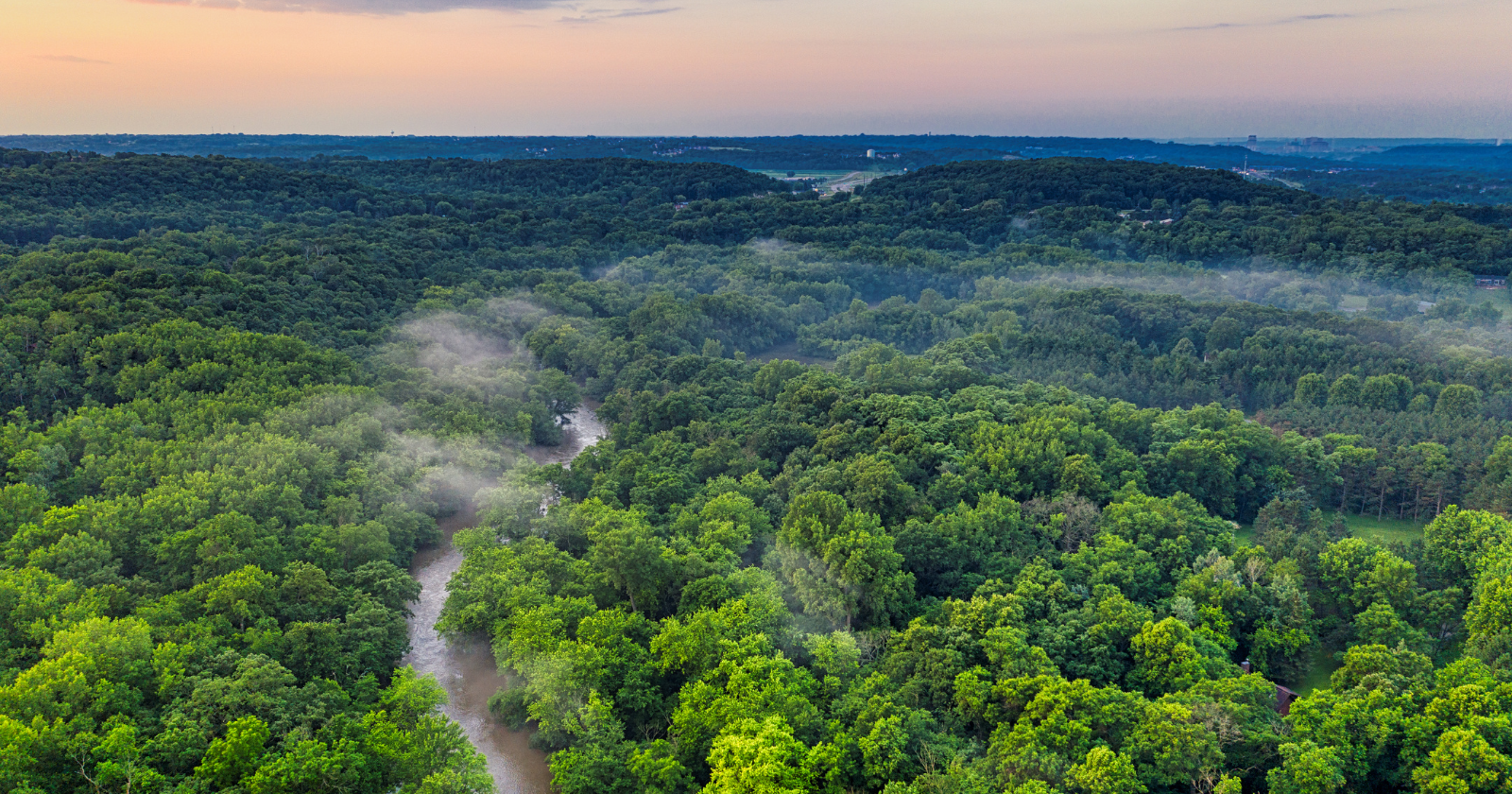
Try to picture, for a moment, the sheer physical scale of what a single large tropical tree does over the course of a day. Water rises out of the soil through the roots, moves up the trunk through millions of narrow tissue channels, spreads out through the branches, and exits through microscopic pores on the underside of each leaf. This is called transpiration, and every plant on Earth does some version of it. But an average mature tree in the Amazon rainforest transpires somewhere between five hundred and one thousand litres of water per day. One tree. That is roughly the volume of a domestic water tank, released into the air, every twenty-four hours, by one plant.
Then multiply that by the number of trees in the Amazon.
The current best estimate is that the forest as a whole releases between fifteen and twenty billion tonnes of water into the atmosphere every day. That figure is worth pausing on because it puts the whole system into a specific perspective. The Amazon River itself, the largest river on Earth by volume, discharges approximately seventeen billion tonnes of water into the Atlantic Ocean per day. The atmospheric flux from the forest, on the current measurements, roughly equals or exceeds the river.
The trees, as a system, are moving as much water into the sky as the greatest river on the planet is moving into the sea.
What happens next
According to the encyclopaedic record of the flying rivers phenomenon compiled on Wikipedia, drawing on peer-reviewed research from Brazil’s National Institute for Space Research (INPE) and the National Institute of Amazonian Research (INPA), the water vapor released by the forest is picked up by the trade winds that blow steadily from the Atlantic Ocean toward the west across the entire tropical zone of South America. The vapor mixes with the incoming maritime moisture from the ocean, condenses partially into rainfall, and lands again on the forest, which absorbs it and transpires it again. The cycle repeats itself an average of five to six times as the moisture crosses the Amazon Basin from east to west.
The process has a name in the scientific literature, which is atmospheric moisture recycling. What Brazilian climatologists have called it, more evocatively, is the flying river.
By the time the moisture-loaded air reaches the western edge of the Amazon, it has accumulated more water vapor per cubic metre than almost any other atmospheric flow on the planet. What stops it from continuing west is the Andes, a wall of mountain rising to more than six thousand metres directly in the path of the trade winds. The Andes force the moisture-laden air upward, where it cools, condenses, and falls as rain. Some of it falls on the eastern slopes of the Andes themselves, which is why the western fringe of the Amazon is one of the wettest places on Earth. The rest is deflected southward.
That deflected river of vapor is what waters most of southern South America.
If you find this interesting, check out our video on how the Sahara feeds the Amazon:
Where the water actually goes
According to a 2023 Mongabay interview with Dr Antonio Nobre, formerly of the National Institute of Amazonian Research and one of the leading scientific proponents of the flying rivers concept, the southward-deflected moisture stream from the Amazon accounts for a substantial fraction of the annual rainfall in every major agricultural region of the southern half of South America. Bolivia. Paraguay. Argentina. The Brazilian states of Mato Grosso, Mato Grosso do Sul, Goiás, Minas Gerais, São Paulo, and the whole southern agricultural belt that produces most of Brazil’s soybeans, cattle feed, coffee, and sugar cane. The rain that falls on those farms, on the current atmospheric modelling, has in many cases evaporated off a tree in the Amazon rainforest a few days earlier and travelled two or three thousand kilometres through the atmosphere to arrive at the field.
The specific number varies by region and by season, but the current best estimates from Brazilian atmospheric science suggest that if the Amazon rainforest stopped functioning as a moisture pump tomorrow, most of Brazil’s agricultural heartland, which currently produces roughly seventy per cent of the country’s economic output, would become substantially drier over the following few years. Northern Bolivia and southern Peru would lose more than seventy per cent of their annual precipitation. Northern Argentina and Paraguay would experience desertification of a kind that neither country has seen in modern history.
Whole national economies, in other words, are quietly being watered by trees they do not own, in a country they cannot control, via a mechanism most farmers in the affected regions have never heard of.
Why this matters right now
According to a 2022 peer-reviewed study published in Nature Communications on Amazonian terrestrial water balance, using satellite observations of water vapor isotopes to independently verify the moisture recycling estimates, the specific volume of water the Amazon returns to the atmosphere each day is dependent on the forest itself being there in functioning form. Cleared forest does not transpire. Pasture does not transpire. Soy fields transpire, but at a small fraction of the rate a mature closed-canopy forest does. And on the current deforestation trajectory, approximately one million square kilometres of the southern and eastern Amazon have already been converted from forest to agricultural land over the past sixty years, which is about a fifth of the total area of the original forest.
The atmospheric consequence of that conversion is already measurable. The southern Amazon has been experiencing longer dry seasons for at least the past three decades. Rainfall records in Bolivia and Paraguay have shown increasing variability. Southern Brazil has been experiencing droughts of a duration and severity that its water infrastructure was not designed to handle. The scientific term for the threshold beyond which the forest would no longer generate enough recycled moisture to sustain itself is the tipping point, and current estimates place it somewhere between twenty and twenty-five per cent forest loss. The southern Amazon has already crossed the lower end of that range.
What the flying rivers concept has done, quietly and over the past twenty years of research, is turn what looked like a local environmental question about one country’s rainforest into a continental question about the water supply of half a dozen national economies. The trees are not, on the accumulated evidence, a scenic backdrop. They are a functioning part of a hydrological system that a large fraction of South American agriculture cannot survive without, and they are the specific part of that system currently being cleared at the fastest rate.
What is worth sitting with, at the end of all this, is the specific unfamiliarity of the whole arrangement. Rivers, in the ordinary sense, flow on the ground and belong to the country they run through. The rivers this piece has been describing flow through the air, belong to nobody, cross national borders at will, and are being switched off, quietly and by degrees, by the same species that has spent most of the last few centuries assuming they were not there in the first place.
Kiran Athar is not a climate scientist or a hydrologist. She writes about the natural world, science, and the ordinary corners of life where the two intersect, drawing on peer-reviewed research and primary-source scholarship.