
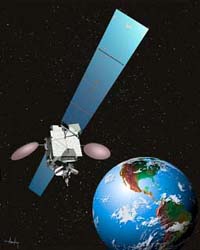
Congestion at the core of the Internet has end users looking for ways to get their information from the edge of the web without any lag time. An emerging trend for satellite services is to deliver content to the edge of the network where there is no delay.
According to new strategic research from Frost & Sullivan, (www.frost.com), World Broadband Satellite Equipment Markets, this market generated $103.3 million in revenues in 1999. This number is projected to nearly double to $198.3 million in 2000. By the end of the forecast period, Frost & Sullivan projects the market to reach $1.2 billion by 2006.
“Virtually every company in the satellite industry is developing products and services aimed at tapping into the Internet market,” says Frost & Sullivan analyst Jose del Rosario.
The advent of two-way technology is expected to pave the way to dramatic growth in the CSM industry. This new technology will provide instant infrastructure that satellite technologies can deliver.
“The introduction of two-way terminals has proven to be in high demand based on order placed in 1999 and early 2000,” says del Rosario. “Specifically for e-commerce applications.”
While the opportunity is there, the broadband satellite equipment market faces stiff competition from terrestrial-based solutions. T1, ISDN, DSL and cable modems are standard modes of Internet connection and have a strong hold in business and residential markets.
“In the U.S., terrestrial-based competition may nullify the advantages presented by satellite-based delivery,” says del Rosario. “Digital Island, SightPath and others are offering caching and content delivery either to the edge of the network or to enterprise customer directly.”
Frost & Sullivan presents the 2000 Marketing Engineering Awards to companies that have worked hard to make a positive contribution to the world broadband satellite equipment industry. The Technology Leadership Award is presented to Hughes Network Systems, a subsidiary of Hughes Electronics Corporation. The Product Innovation Award is presented to Gilat Satellite Networks, LTD.
Companies participating within this industry are: Adaptive Broadband Corporation; Advanced Wireless Technologies; Antenna Technology Communications, Inc ; Broadlogic; Caldera Systems, Inc.; Channel Master, Inc.; Codan; Comatlas-VLSI; Combox; Comlink, Inc.; Communicado Data, Ltd.; CPI-Communications and Power Industries ; Dassault Automatismes et Telecommunications; Datron/Transco Inc.; DiviCom, Inc.; Echostar Data Networks (formerly Media4) ; Edgix Corporation; EMS Technologies, Inc.; Fantastic Corporation; Flash Networks; Fourelle Systems, Inc.; Gilat Satellite Networks; Globalcomm Systems, Inc.; Global Telemann Systems; Harmonic Data Systems, Inc.; Helius, Inc.; Hughes Network Systems, Inc.; IDB Systems; International Communications Products, Inc.; International Datacasting Corporation; IST Korea; Kathrein Werke AG; KenCast, Inc.; KiSS Nordic AS; KVH Industries, Inc.; Logic Innovations, Inc.; Lucent Technologies (formerly Xedia); L3 Communications Corporation; Main Data; Menicx International; Mentat, Inc.; Micronik Multimedia; Mindport; Mitec Telecom, Inc.; NDS, Ltd; NEC America Satellite Communications Group; Nera Telecommunications; Norsat International, Inc; Nortel Networks; NSI Communications; Nuera Communications, Inc.; OnSat Network Communications, Inc.; OrbLynx, Inc.; Pace Micro Technology PLC; Pacific Softworks, Inc.; PentaMedia; Philips Digital Video Systems; PlanetWeb, Inc.; Prodelin Corporation; RAD Data Communications; Radyne Comstream Corporation; Raytheon Company; Satellite Terminal Access; Sagem Sat; Samsung Electronics America, Inc.; Sattel Global Networks; Scientific Atlanta, Inc.; SeaTel, Inc.; SCS; Shiron Satellite Communications Ltd; SierraCom, Inc.; SkyServ, Inc. (formerly InterCache); SkyStream Network; SpaceBridge Networks Corporation, Inc.; SpyGlass, Inc.; SSE Technologies, Inc.; Stanford Telecom, Inc.; StarBurst Software; StarGuide Digital Networks, Inc.; STM Wireless, Inc.; Strong UK; Tandberg Television ASA ; Thomcast Communications, Inc.; Titan Corporation; UEC Technologies; VertexRSI; VertexRSI; Viasat, Inc; Visiosat-MAEC; WAVO Corporation and X.com Multimedia Communications.
