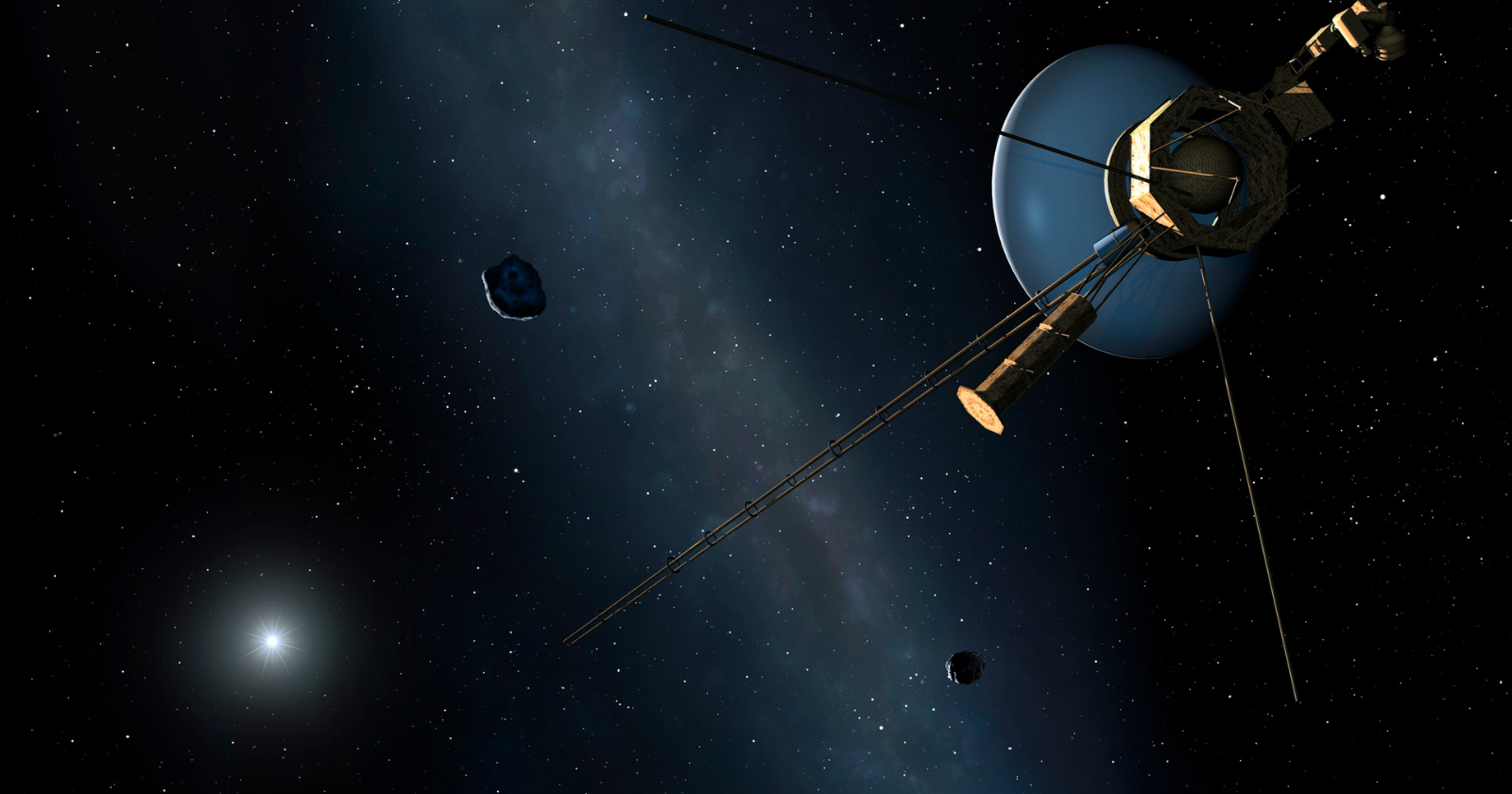
Picture a one-litre milk carton sitting on your kitchen counter. That is, in volume terms, roughly all the plutonium-238 dioxide fuel carried aboard each Voyager spacecraft when it left Earth in 1977: a little over 13 kilograms of ceramic nuclear fuel divided among three radioisotope thermoelectric generators. Forty-eight years later, that single carton’s worth of material is the only reason humanity is still hearing from a machine 25 billion kilometres away.
It is a fact worth sitting with. Voyager 1 is now roughly 170 astronomical units from Earth, far enough that a radio command takes about 23 hours to arrive. The probe is travelling at roughly 61,000 kilometres per hour. It will cross the one-light-day mark this November. And the entire 49-year saga, from the Jupiter flyby in 1979 to the heliopause crossing in 2012 to the cooling, dimming spacecraft now reporting from interstellar space, has been powered by a ceramic nuclear heat source smaller than a household appliance.
Why plutonium-238 and not anything else
The choice of fuel was made in the early 1970s and has not been seriously challenged since. Plutonium-238 has a half-life of 87.7 years, which is the engineering sweet spot. Shorter-lived isotopes burn out faster than a deep-space mission can afford. Longer-lived ones decay too slowly to produce useful heat per kilogram. Pu-238 also has the unusual property of being a nearly pure alpha-emitter, meaning its radiation is absorbed almost entirely by a few millimetres of material, which keeps shielding mass low and protects sensitive instruments from interference.
The number that matters most is its specific power. Each gram of Pu-238 releases about 0.56 watts of thermal power as it decays, glowing a dull red on its own. Multiply that by 4.5 kilograms per generator and three generators per spacecraft, and you have around 2,400 watts of thermal output per generator at launch, or roughly 7,200 watts of heat for each Voyager.
That heat does not power the spacecraft directly. It has to be converted.
The trick that turns heat into a signal
The Multi-Hundred Watt Radioisotope Thermoelectric Generators on each Voyager use a phenomenon called the Seebeck effect, discovered in 1821, in which a temperature difference across a junction of two dissimilar materials produces a voltage. Stack enough of those junctions and you have a working power supply with no moving parts and nothing to break.
Each Voyager RTG contains 312 silicon-germanium thermoelectric couples. The hot end runs at about 1,000 degrees Celsius, fed directly by the decaying plutonium pellets. The cold end sits at about 300 degrees Celsius, radiating waste heat into the vacuum through external fins. The temperature differential pumps electrons across the junctions, producing about 157 watts of electrical power per generator at the start of the mission. Across all three RTGs, that gave each Voyager about 470 watts of electricity at launch, or roughly enough to run a desktop PC.
The conversion is not particularly efficient. About 6.5 percent of the thermal output becomes useful electricity. But efficiency is the wrong yardstick for a spacecraft that has to operate for decades in environments where every alternative power source fails. Solar panels are useless past Saturn. Chemical batteries die in months. The only competing technology is a full nuclear reactor, which is heavier, more dangerous, and more complex by orders of magnitude.
The slow fade
An RTG loses power for two reasons. The first is the Pu-238 itself decaying away, which under the 87.7-year half-life works out to a decline of about 0.79 percent in thermal output per year. The second, and historically larger, contributor on Voyager has been the gradual degradation of the silicon-germanium thermocouples, which lose efficiency as their crystal structure changes under prolonged high-temperature operation.
Combined, the two effects strip about 4 watts of electrical output from each Voyager every year. After 49 years, that compounds into a brutal arithmetic. Each spacecraft now produces less than half its original electrical power, leaving engineers with razor-thin margins between keeping the radio alive and tripping the under-voltage fault-protection system that would force the probe into a recovery mode from which it might not return.
That is exactly the situation Voyager 1 faced in late February. During a routine roll manoeuvre, its power level dropped unexpectedly close to the fault-protection threshold. On April 17, 2026, mission engineers at JPL shut down the Low-energy Charged Particles experiment, an instrument that had been operating almost continuously since launch. Of the ten science instruments Voyager 1 carried at launch, only two remain operating: the magnetometer and the plasma wave subsystem.
The team has a more aggressive plan in reserve. Informally called “the Big Bang”, it would swap several powered devices on each spacecraft simultaneously, replacing some with lower-power alternatives in a single coordinated operation. Tests on Voyager 2, which has slightly more power margin and is closer to Earth, are scheduled for May and June this year. If they succeed, Voyager 1 will receive the same treatment no earlier than July, and there is a chance the Low-energy Charged Particles experiment could be switched back on.
What the signal looks like by the time it gets here
The Voyager radio transmitters operate at about 23 watts, roughly the electrical power of a small refrigerator bulb. They beam toward Earth through a 3.7-metre high-gain antenna at around 8 GHz. By the time that signal crosses 25 billion kilometres of vacuum and reaches the Deep Space Network’s 70-metre dishes in Goldstone, Canberra, and Madrid, its power has fallen to less than an attowatt, a billionth of a billionth of a watt. Recovering anything readable from a signal that faint requires cryogenically cooled amplifiers, extraordinarily narrow bandwidth filters, and decoding algorithms that have been refined over decades.
None of which would matter if the lump of plutonium had stopped giving off heat.
Why this matters for everything coming next
Pu-238 is not mined in useful quantities for space missions; it has to be manufactured. The United States stopped producing it in 1988 and spent the next quarter-century slowly running through stockpiled material. NASA and the Department of Energy restarted domestic production at Oak Ridge National Laboratory in the 2010s, but output remains modest, currently measured in hundreds of grams per year against future mission needs measured in kilograms.
That supply constraint is now actively shaping mission planning. Dragonfly, the rotorcraft heading for Titan, will use a Multi-Mission RTG. The proposed Interstellar Probe, which would launch in the mid-2030s and travel further faster than either Voyager, would need a substantial Pu-238 charge of its own. Any sustained programme of outer planet exploration depends on the production line at Oak Ridge keeping pace.
The deeper lesson of Voyager is not really about plutonium. It is about what becomes possible when an engineering team accepts that some problems have no clever workaround, and the only honest response is to choose the right material, build the right structure around it, and let physics do its slow work for half a century. A milk carton’s worth of nuclear fuel, 312 thermocouples, a 23-watt radio, and a willingness to wait. That is the entire architecture of humanity’s most distant signal. It will keep arriving, fainter every year, until somewhere in the 2030s the last instrument finally goes dark and the silence on the other end becomes permanent.