
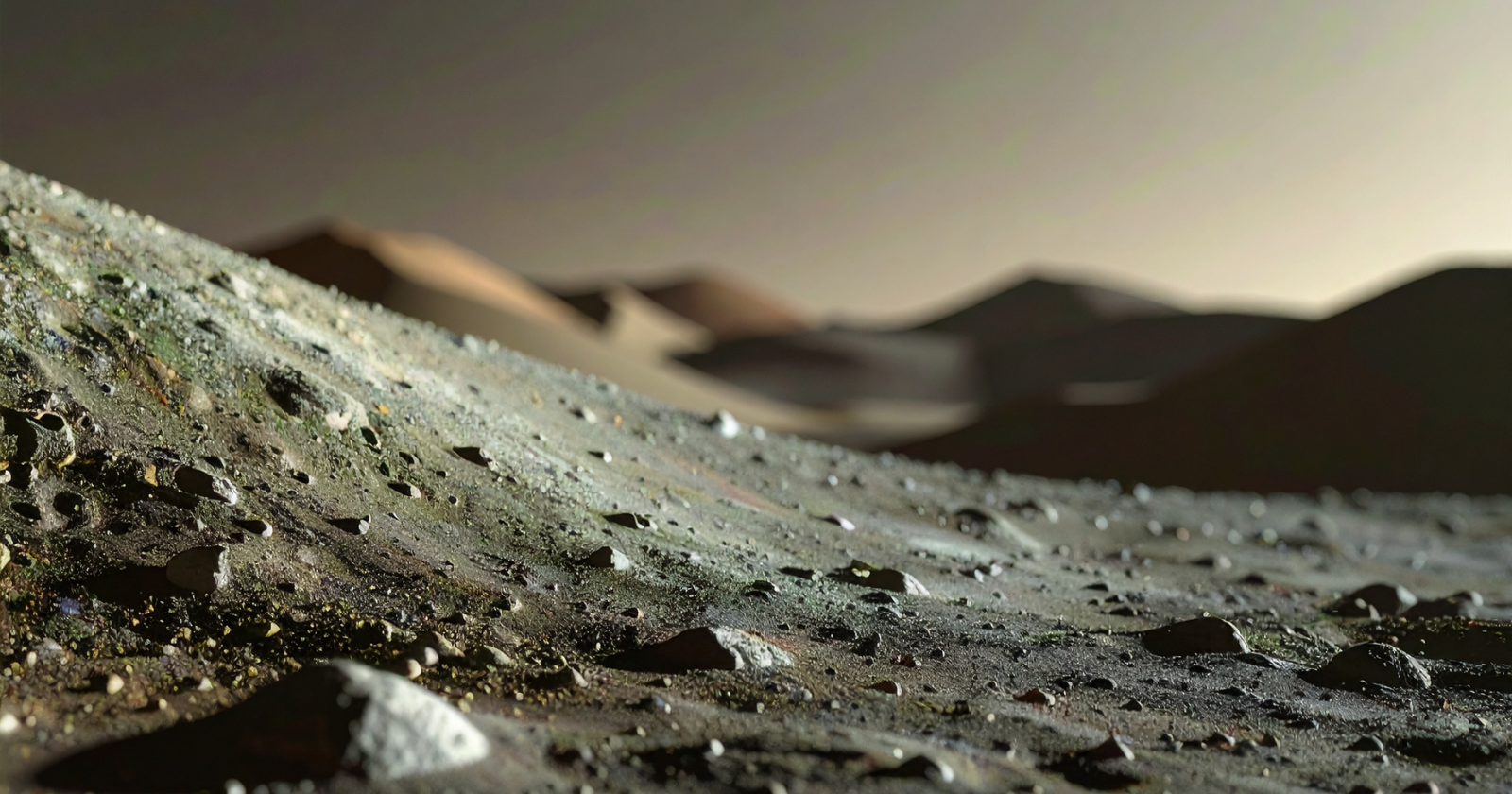
The first thing Harrison Schmitt noticed when he climbed back into the Apollo 17 lunar module in December 1972 was the smell. Spent gunpowder. Then his eyes started watering, his throat itched, and within minutes Harrison “Jack” Schmitt, one of the last two people to walk on the Moon, was sneezing into his helmet ring. He had no idea he was allergic to the place he had just spent 22 hours exploring.
Fifty-four years later, that single moment is still shaping almost every engineering decision NASA makes about returning to the lunar surface. The reason is buried in the geology of what Schmitt brought back inside his suit: a fine grey powder so abrasive that it can saw through Kevlar, so electrostatically sticky it bonds to glass like a magnet, and so jagged on a microscopic scale that its particles look less like sand than like shattered windshield. Lunar dust is, quite literally, sharper than broken glass, and it is forcing the agency to rethink hardware design from the joints of a spacesuit to the seals on a habitat hatch.
Why the Moon’s dust is unlike anything on Earth
Every grain of sand you have ever stepped on has been rounded by something. Wind, water, freeze-thaw cycles, the simple chemistry of an oxygen-rich atmosphere. Earth’s surface particles are sculpted by erosion processes that smooth their edges over geological time.
The Moon has none of that. No atmosphere worth the name, no liquid water, no weathering. What it does have is roughly four billion years of micrometeorite bombardment, each impact shattering volcanic rock and glass into progressively finer fragments while leaving every freshly exposed edge razor-sharp. The result is a powder where roughly 10 to 20 percent of grains are smaller than 20 micrometres, fine enough to pass through most filters, and where every one of those grains is a freshly fractured shard.
NASA’s Charles Buhler, who runs the Electrostatics and Surface Physics Laboratory at Kennedy Space Center, describes the material as resembling glass that has been smashed and never weathered. The dust is also rich in silicate, the same mineral family that causes silicosis in terrestrial mine workers, and the lower lunar gravity allows particles to remain suspended much longer than they would on Earth, giving them more time to find their way into lungs, joints, and seals.
What it did to Apollo
The Apollo crews encountered the problem firsthand and underestimated it badly. According to lunar geologist Larry Taylor, the dust on Schmitt’s mission was abrasive enough to wear through three layers of Kevlar-like material on his boots after just three moonwalks. The same particles gummed up the rotary joints on the suits to the point where Schmitt struggled to move his arms, destroyed the vacuum seals on sample return containers, and shorted electrical connections inside the lunar module.
The health effects were not minor either. According to a peer-reviewed review published in 2023, all 12 Apollo moonwalkers experienced some degree of dust exposure inside their vehicles after EVA, with symptoms ranging from sinus irritation to eye inflammation. Subsequent toxicology work has shown that lunar dust simulant can cause cell death and DNA damage in cultured human lung tissue, a finding that has elevated dust mitigation from a nuisance issue to a flight-safety requirement.
The hardware problems multiply
For Apollo, the dust was a 22-hour problem. For Artemis, which is designed to support stays measured in days now and eventually months, the same particles become an existential one. NASA engineers have catalogued the failure modes in detail.
Solar panels lose efficiency as a thin charged layer accumulates on their cover glass, a particularly serious problem during the 14-day lunar night when stored power is the only thing standing between equipment and freezing failure. Thermal radiators, which depend on a precise ratio of solar absorptivity to infrared emissivity to dump heat, get coated and start running hot. Optical surfaces (camera lenses, helmet visors, navigation sensors) lose contrast and resolution. Mechanical bearings and pressure seals, the parts of any spacecraft most vulnerable to particulate intrusion, simply grind themselves apart.
Kristen John, the Lunar Surface Innovation Initiative technical integration lead at Johnson Space Center, has noted that the finest grains are smaller than the human eye can resolve, which means a contaminated surface can look perfectly clean while still carrying enough particulate to seize a mechanism.
NASA’s response: a portfolio of mitigation programs
Because no single technology can address every failure mode, NASA has built a portfolio approach. The standard governing it, NASA-STD-1008, was published in 2021 and defines the dust environments that any piece of Artemis hardware must be tested against before it flies.
The most mature mitigation technology is the Electrodynamic Dust Shield, or EDS, which Buhler’s team at Kennedy has been refining since 2004 from a concept first proposed in 1967. The shield embeds transparent electrodes into a surface and uses a travelling electric field to lift charged particles off and push them away. EDS panels were tested in the vacuum of low Earth orbit aboard the International Space Station in 2019, embedded in glass, polyimide, and prototype spacesuit fabric. In 2025, EDS technology was demonstrated on Firefly Aerospace’s Blue Ghost Mission 1, where NASA reported that it successfully removed real lunar regolith from glass and thermal radiator surfaces.
A separate effort, Lunar SCRUB (Surface Cleaning Robotic Unit with electron-Beam), is being developed under a NASA contract by Colorado-based Orbital Mining Corp and Space Dust Research and Technologies. It uses a focused electron beam to electrically destabilise the bond between dust and surface, dropping particles off solar panels and other flat geometries within seconds. Phase one testing wrapped earlier this year at the Colorado School of Mines, with a possible 1.3 million dollar phase two demonstration in a NASA vacuum chamber to follow.
Other programs in the pipeline include Hermes Lunar-G, a partnership with Texas A&M that studies how regolith behaves in partial gravity using suborbital flights aboard Blue Origin’s New Shepard, and the Lunar Dust Distributor at Johnson, a device that evenly coats simulated regolith onto test articles so engineers can evaluate seals, fabrics, and coatings under realistic contamination loads.
Redesigning the suit itself
The Apollo spacesuits used Beta fabric as their outer layer, a fiberglass weave chosen primarily because the lunar module ran on pure oxygen at 4.8 psi and needed nonflammable materials. It was never designed for dust resistance, and it showed.
The Axiom Extravehicular Mobility Unit, or AxEMU, the suit Axiom Space is building under a 228.5 million dollar NASA task order for Artemis III, treats dust as a primary design driver rather than an afterthought. The architecture is rear-entry, which keeps suit-doffing geometry away from the heavily contaminated lower body. The mobility bearings are dust-tolerant, allowing the kneeling and walking motions Apollo astronauts could not perform in their stiffer suits. Disposable outer coverings are being developed to take the brunt of the abrasion and be discarded before ingress, and Axiom has partnered with Oakley to develop visor coatings that draw on the optics company’s experience with motocross and mountain biking environments where particulate scratching is the dominant failure mode.
A cross-cutting constraint
What makes lunar dust unusual as an engineering problem is that it does not respect program boundaries. The same particles that threaten an astronaut’s lung lining also threaten the bearings on a rover, the radiator on a habitat, the solar array on a power station, and the optics on a science instrument. NASA’s Game Changing Development program has explicitly classified dust mitigation as a cross-cutting capability, meaning that essentially every piece of Artemis hardware now has to pass through some form of regolith-tolerance review before it is cleared to fly.
The lesson the agency seems to have taken from Apollo is that lunar dust is not a problem you solve once. It is an environmental constant, like vacuum or radiation, that imposes design penalties on everything it touches. Schmitt’s sneezing fit, in retrospect, was the cheapest warning the program will ever get.
