
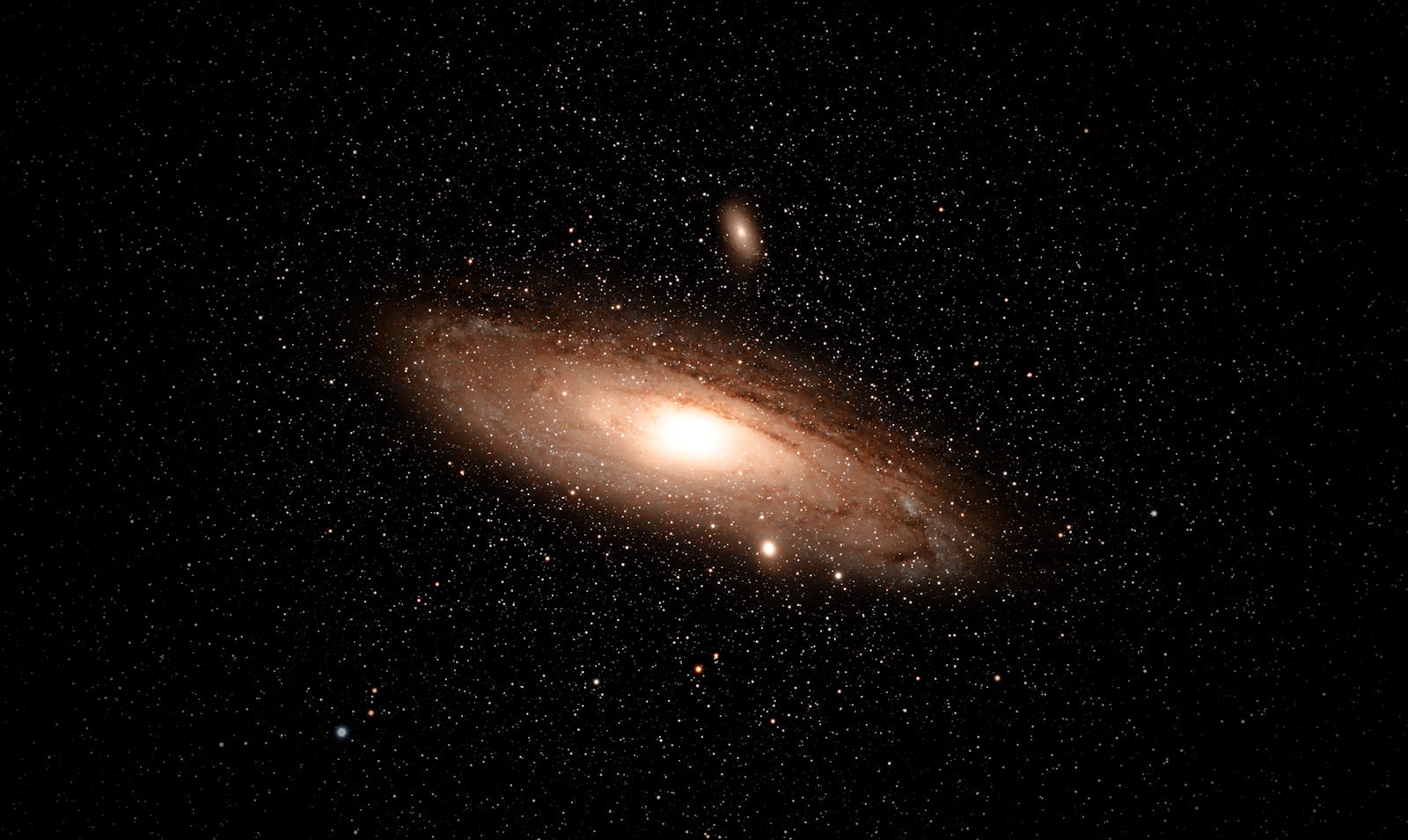
Astronomers using the James Webb Space Telescope have found a massive galaxy in the early universe that simply refuses to spin — and its existence pokes a serious hole in the standard textbook timeline of how galaxies grow up. The object existed when the cosmos was less than 2 billion years old, yet already shows the hallmarks of a fully matured “slow rotator,” a class of galaxy that astronomers previously thought required roughly ten billion years and dozens of mergers to produce. In other words, this galaxy looks like something that shouldn’t exist for another 10 billion years.
The finding, reported by Phys.org, marks one of the strongest direct tests yet of whether the rotational properties of galaxies match what cosmological simulations predict — and the answer, in this case, is that they don’t.
A galaxy that grew up too fast
This galaxy is no minor object. It contains several times as many stars as the Milky Way, ranking it among the most massive galaxies known in the early universe. It has also stopped forming new stars — already “red and dead,” in the parlance of extragalactic astronomy — at an epoch when most galaxies were still busily assembling themselves.
Mass and quiescence alone would be unusual. Add the lack of rotation, and the object becomes a real problem for theory. Slow rotators in the nearby universe are typically the descendants of giant elliptical galaxies that have weathered a long history of mergers, gradually scrambling the orderly spin of their stars into more random orbits.
The galaxy showed no evidence of rotation, which was surprising and very interesting to the research team.
Why rotation matters
The way a galaxy spins is a fossil record of how it was built. Disk galaxies like the Milky Way rotate coherently because they assembled from gas that settled into a flattened, spinning structure. Elliptical galaxies that grew through repeated collisions tend to rotate more slowly, with stellar orbits pointed in many directions.
Finding a non-rotating, quenched, ultra-massive galaxy when the universe was barely a tenth of its present age suggests that some mature dynamical states can be reached extraordinarily quickly. The research team studied three galaxies of similar age with JWST: one rotating, one kinematically “messy,” and one which showed no rotation at all.
One big collision, not many small ones
The standard recipe for producing a slow rotator involves dozens of mergers stacked across cosmic time. The early universe simply hasn’t had enough time to run that recipe. So the team proposes a shortcut: a single, head-on collision between two galaxies rotating in opposite directions, which would cancel out their angular momentum in one violent event.
Evidence for that scenario comes from excess light visible off to one side of the galaxy, consistent with debris from a recent major merger that hasn’t fully settled. If correct, the picture is striking — a single catastrophic event producing, in a few hundred million years, a structure that nearby slow rotators take roughly ten billion years to build.
A small sample with big implications
Three galaxies is not a population study. But the discovery is a proof of concept: JWST can now resolve internal stellar motions in galaxies seen as they were more than 11 billion years ago, opening a window that simply did not exist before. The same techniques have already shown unusual rotational properties to be central to other early-universe puzzles, including the suggestion that the mysterious “little red dots” detected by JWST may form inside dark matter halos in the lowest 1% of the spin distribution.
Some simulations predict that there will be a very small number of these non-rotating galaxies very early in the universe, but they expect them to be quite rare. The question is whether “rare” matches what JWST is about to find as it looks at more objects.
If non-rotating early galaxies turn out to be more common than predicted, simulations of structure formation will need adjustment — possibly in how they handle the timing and geometry of major mergers, possibly in their treatment of feedback mechanisms that quench star formation. If they remain rare, this galaxy becomes a curious outlier rather than a paradigm shift.
What comes next
The team plans to expand its sample using ongoing JWST surveys. Spectroscopic follow-ups can sharpen estimates of the galaxy’s stellar age, metallicity, and merger history, while deeper imaging may confirm whether the off-center light really represents merger debris or something else entirely.
Rewriting the timeline
If a galaxy can reach a dynamical end-state in a few hundred million years that the textbooks assign to ten billion, then the textbook timeline of galaxy maturation is wrong — at least for some objects. The implications run deeper than a single odd galaxy. The mass-assembly clock, the merger-rate clock, and the star-formation-quenching clock are all assumed to tick at roughly the same cosmic pace. This object suggests at least one of them can run an order of magnitude faster.
That changes what counts as a plausible progenitor for today’s giant ellipticals. It changes when the universe could first host the kinds of dense, dispersion-supported stellar systems that anchor galaxy clusters. And it changes the meaning of “early” itself: if maturity is reachable in the first 2 billion years, then the line between an embryonic universe and a structurally complete one sits much earlier than astronomers had drawn it. This galaxy, in a single object, compresses 10 billion years of expected evolution into a fraction of that — and that compression is the discovery’s real weight.
Photo by Yihan Wang on Pexels
