
The satellite industry is collapsing the wall between Earth observation and communications, and the result is reshaping how data moves from orbit to end users. Operators that once specialized in either bandwidth or pixels are now building integrated multi-layer architectures that combine sensing, connectivity, processing and distribution across geostationary, low Earth orbit and very low Earth orbit.
The shift is less about satcom companies competing head-on with imagery providers and more about who controls the pipes that move sensor data to the ground. SpaceNews reporting on the convergence trend highlights that data relay networks, inter-satellite links and shared ground infrastructure are emerging as the connective tissue that lets imagery reach defense planners, autonomous-vehicle fleets and real-time analytics users in seconds rather than hours.

The convergence thesis
Industry observers have framed the dynamic plainly. The most immediate convergence between satcom and Earth observation is happening through data relay and data transport, with connectivity operators positioning themselves as the backbone that moves EO data faster, more securely and with lower latency.
That backbone role is more defensible than direct competition with established imagery players. Building a sensing constellation from scratch is expensive and slow. Owning the network that every imagery operator needs to reach customers is a different kind of business — one that compounds with each new sensor launched into orbit.
The broader pattern is the emergence of integrated, multi-layer data architectures combining sensing, connectivity, processing and distribution. The phrase is dry. The implications are not.
Space42 and the UAE play
The clearest example of the convergence sits in Abu Dhabi. Space42 was formed by merging Yahsat’s geostationary communications business with Bayanat’s geospatial analytics, creating an operator that holds both ends of the data chain. The company deployed its first synthetic aperture radar satellite in 2024 and recently expanded its Foresight LEO imagery constellation to five spacecraft, with two more SAR satellites from Iceye scheduled to join in 2027.
The financial picture is mixed. Space42’s Smart Solutions business unit has experienced revenue challenges, even as the company continues to invest in fleet expansion. This points to the awkward middle period operators face when transitioning from legacy services to integrated architectures that have not yet matured into recurring revenue.
Japan’s $230 million bet
Sky Perfect JSAT, Japan’s dominant satellite operator, is taking a different route to the same destination. Aviation Week reported the company signed a $230 million deal for 10 Planet Pelican high-resolution optical satellites, slated to launch to LEO in 2027. The constellation will form the basis of an in-house intelligence business, giving the satcom operator direct exposure to defense and government imagery markets that have grown rapidly amid heightened geopolitical tension in the Indo-Pacific.
Buying a fleet from Planet rather than building one is the telling choice. Sky Perfect JSAT does not need to become an imagery manufacturer. It needs imagery flowing through its existing customer relationships and ground infrastructure.
Inter-satellite links as the enabler
None of this works without optical inter-satellite links. The technology lets satellites pass data laterally in orbit instead of waiting to dump it over a ground station, cutting latency from tens of minutes to near real time.
The architectural shift is significant. With inter-satellite links across the constellation, the bottleneck disappears, and data captured by cameras and sensors can be transmitted instantly across the network in orbit, enabling near real-time delivery to users on the ground. Open Cosmos is developing ConnectedCosmos, a sovereign broadband constellation designed to integrate with its OpenConstellation Earth observation infrastructure.
The technology is moving from demonstration to operational deployment. Spire Global UK recently launched a Scottish-built satellite carrying an optical ISL payload aboard SpaceX’s Transporter-16 mission, with backing from the European Space Agency and the UK Space Agency. The stated aim was to significantly reduce data latency between satellites.
Why defense buyers are driving the shift
The military market is the gravitational force pulling the architecture together. Battlefield commanders want imagery while it still matters. A SAR pass that takes 40 minutes to reach an analyst is operationally useless against a moving target.
The U.S. Space Force has organized itself around exactly this demand. Space Systems Command rebranded its commercial services office as the Commercial Space Office, consolidating procurement of satcom, imagery, weather data and space domain awareness under a single roof. The office’s leadership has emphasized that commercial capability available right now could be put into warfighters’ hands, and that integration into the architecture should happen in peacetime so the services can be exercised in war games.
Tactical ISR and space domain awareness have been identified as growth areas. Both depend on rapid data movement, not just sensor quality. A government customer that wants imagery within minutes of collection is implicitly buying a network, not a satellite.
The European replenishment cycle
Europe’s largest converging operator is Eutelsat, which has ordered 440 OneWeb satellites from Airbus to replenish the LEO broadband network it inherited through its 2023 merger. The order locks in capacity for the next decade and provides the connectivity layer that any future imagery hosting or data relay business would ride on.
Space Compass, the joint venture between NTT and Sky Perfect JSAT, signed a contract in March for its first commercial geostationary optical data relay satellite. GEO relay platforms sit above LEO imagery constellations and ferry their data continuously to the ground, removing the need for sensors to fly within range of a ground station to download.
Hosted payloads and software-defined networks
Two technical developments are accelerating the convergence. Hosted payloads let imagery sensors fly on satellites primarily designed for communications, sharing power, mass and downlink. Software-defined networking platforms let operators reconfigure how bandwidth is allocated between sensing and connectivity in flight, rather than locking each satellite into a single mission.
The combination blurs the boundary between operator categories. A satcom company hosting an imagery payload and routing its output through inter-satellite links is, functionally, an Earth observation operator. The reverse is also true.
For more on how onboard processing fits into this picture, see Space Daily’s coverage of Comsat Architects and Ubotica Technologies deploying AI in orbit, which addresses the processing layer of the same multi-tier architecture.
What it means for the next five years
The convergence reshapes how investors should value satellite operators. Pure-play imagery companies face pressure to secure relationships with connectivity providers or risk being commoditized as sensor suppliers. Pure-play satcom operators face pressure to either acquire imagery exposure or carve out a defensible role as the data transport layer.
Sovereignty concerns add another dimension. Governments increasingly want imagery and connectivity from operators headquartered within their own borders or trusted alliances. That tension favors regional integrators like Space42 in the Gulf, Sky Perfect JSAT in Japan and Eutelsat in Europe, each of which can offer a national or bloc-level alternative to U.S. providers.
The 2027 deployment cluster — Space42’s additional SAR satellites, Sky Perfect JSAT’s Pelican fleet, and the maturation of optical ISL networks — will be the first real test of whether integrated multi-layer architectures deliver the latency advantages their proponents promise. Until then, the convergence remains a thesis backed by capital commitments and procurement reorganizations.
The pipes are being laid. What flows through them is the next question.
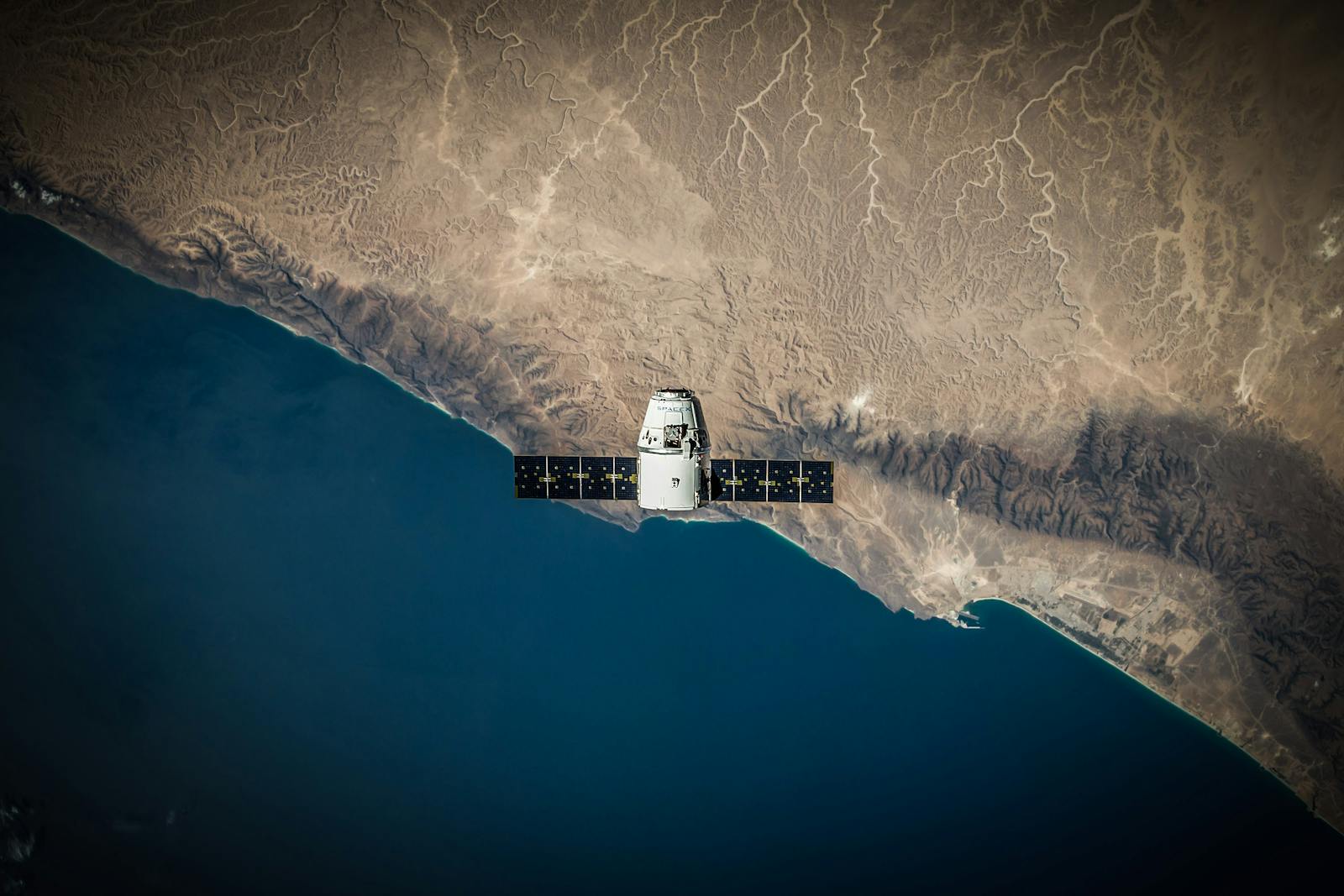
Photo by SpaceX on Pexels
