

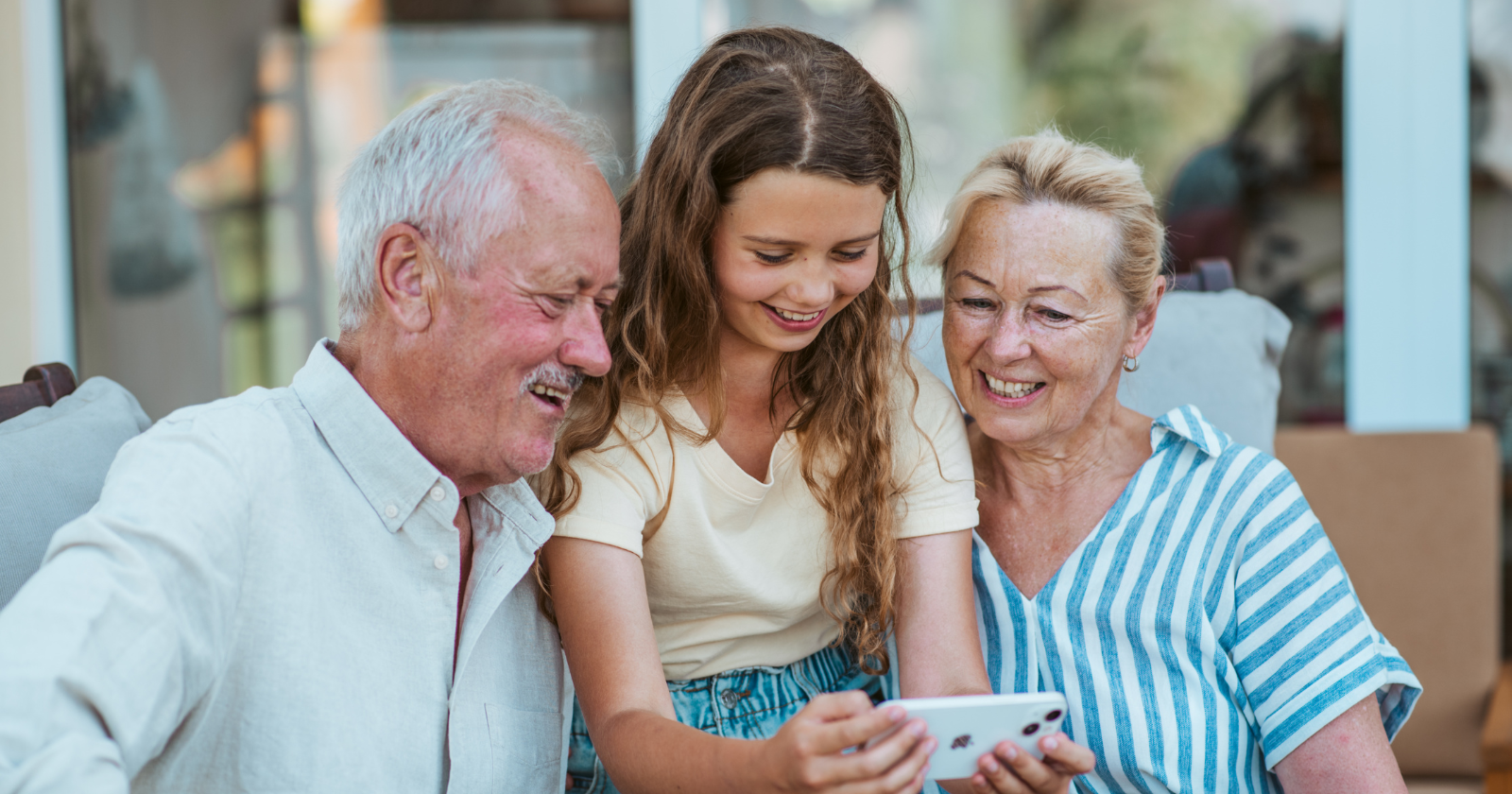
There’s a memory I have from when I was about eight years old.
I was sitting in my grandfather’s garage in suburban Melbourne. He was tinkering with something, a lawnmower or a bike, I can’t remember now. I’d been hanging around him because my brothers were doing something I wasn’t part of, and he’d given me a small job to help with. At some point during the afternoon, he stopped what he was doing, looked at me properly, and asked what I thought about something I’d mentioned in passing earlier.
I don’t remember the topic. I remember exactly how it felt to be asked.
It felt the way being seen feels when you’re not used to being seen. I was the youngest of three boys, the quiet one, the observer. Adults didn’t usually direct questions at me and wait, in silence, for the answer. They asked the rhetorical kind, the polite kind, the kind that doesn’t really expect a kid to say anything interesting. My grandfather asked the other kind. He stopped working and waited.
That moment, more than thirty years ago now, is one of the clearest memories I have from my childhood. Not because anything dramatic happened. Because someone took me seriously when I wasn’t expecting to be taken seriously, and a small switch flipped inside me that’s never quite turned off since.
This is a piece about why that kind of moment matters so much, and why the grandparents who can deliver it end up loved in a way no amount of presents or theme parks ever produce.
What kids actually register
We tend to assume that what kids enjoy and what kids remember are the same thing. They aren’t.
Kids enjoy the obvious stuff. The toys, the trips to the zoo, the ice cream at strange hours, the chaotic houses where rules go soft. They light up when grandparents do these things. The lighting up is real. It just isn’t the same as being formed by something.
What kids remember, in the deep way that lasts decades, is being treated as a real person.
Most of childhood, even in loving homes, involves being slightly invisible. You’re talked about in the third person while sitting in the room. Your opinions are filed under “cute” rather than “interesting.” Your questions are answered with the version adults think you can handle, not the version that’s actually true. You’re loved, often deeply, but you’re rarely consulted.
The adult who breaks that pattern, who treats a child as someone worth listening to, becomes lodged in that child’s memory in a way no other relationship quite replicates. The kid doesn’t have the language to describe what’s happened. They just know that this particular person makes them feel like more of a person, and they want to be around them.
In my experience, this is almost always a grandparent or a great-aunt or some other adult slightly outside the parent role. Parents are often too busy running the operation to slow down and ask the question. Grandparents, if they’re paying attention, have time and stillness that parents don’t.
The grandparents who got it right
I had two grandfathers and two grandmothers, all pretty different from each other. Looking back as an adult, I can see clearly which ones grasped this and which ones didn’t.
My maternal grandfather, the one in the garage, was probably the strongest example. He was a quiet man, working-class, not given to long speeches. But when he spoke to you, he spoke to you as if your answer mattered to him. He’d ask what you thought of a book he’d seen you reading. He’d ask what you wanted to be when you grew up, and he’d actually listen, and he’d follow up. If you said something interesting, he’d remember it and bring it up the next time you visited. None of this felt strategic on his part. It seemed to be just how he was wired.
I remember telling him once, at maybe nine, that I’d been reading something about the war he’d fought in. Most adults would have nodded and changed the subject. He sat with me at the kitchen table for an hour and told me what it had actually been like. Not the sanitized version. Not the heroic version. The version with cold and fear and boredom in it. He treated me as someone capable of receiving what he was actually saying.
I remember almost nothing about the gifts he gave me at Christmas. I remember that conversation in detail.
My other grandmother was the opposite kind, and I don’t say this unkindly. She loved us and she meant well. But her version of grandparenting was performance-based. The big visits. The expensive presents. The orchestrated outings. She’d ask the standard adult questions (“how’s school?”) and accept the standard kid answers (“fine”) without ever pressing past the surface. We loved her because she was our grandmother. We didn’t form with her. There’s a difference.
As I got older, I realized I had no idea what she actually thought about anything. We’d spent dozens of weekends in her house and I couldn’t have told you her opinions on her own life. She hadn’t asked us much, so we hadn’t asked her much, and the relationship stayed pleasant and shallow for forty years.
What being taken seriously does to a kid
There’s a thing that happens to a child who’s been treated as a real person by an adult, and it’s hard to describe to anyone who hasn’t experienced it.
It plants a small piece of evidence inside them. The evidence says: my thoughts are worth hearing. My opinions matter. I’m not just a small thing being managed by big people.
This piece of evidence becomes one of the foundational stones a person builds their adult sense of self on. Kids who never get this evidence have to construct it from scratch much later in life, often with significant effort and sometimes with the help of a therapist. Kids who get it once or twice, from one or two adults, carry it forward as something they don’t have to manufacture.
I’ve talked about this before but the early experiences that shape adult psychology aren’t usually the dramatic ones. They’re the small ones, repeated. The accumulated experience of being asked real questions and given real answers does something durable to a kid. It tells them, at a level deeper than thought, that they’re a participant in life, not just a recipient of it.
The grandparent who can offer that experience is offering something more valuable than any toy or any trip. They’re offering an experience of being treated as a co-equal in the human conversation, often before any other adult has thought to do that.
What the right grandparent actually does
If you sat down with the grandparents I’m describing and asked them what they were doing, most of them would shrug. They’d say something like, “I just like talking to my grandkids.” They wouldn’t have a theory about it. The behavior comes from genuine interest, not from a parenting philosophy.
But if you watch closely, the pattern is fairly specific.
They ask questions that aren’t generic. Not “how’s school?” but “what’s the most boring class you’ve got and why?” They listen to the answer without interrupting or correcting. They treat the kid’s reply as the real answer, not as a starting point for an adult lecture. They share things from their own life that the kid wouldn’t usually be told. They don’t speak in the special voice adults reserve for children, the slightly higher pitch, the unnaturally cheerful cadence. They talk to the kid the way they’d talk to a friend.
Most importantly, they’re patient. A child who’s not used to being taken seriously will fumble around when they suddenly are. Their answers will be inarticulate. They’ll say something half-formed and trail off. The wrong adult will jump in, finish their sentence, redirect. The right adult waits. They let the kid land their thought, however wobbly, and respond to whatever the kid actually said.
This is exhausting to keep up if you’re not naturally inclined toward it. The grandparents who do it are usually doing it because it’s just how they engage with people, regardless of age. They aren’t lowering themselves to the child. They aren’t elevating the child artificially. They’re meeting them where they are, with respect.
What this looked like in my house growing up
The contrast between my two grandfathers shaped, I think, how I ended up writing for a living.
My maternal grandfather, the garage one, would ask me what I’d been reading and then ask me to explain it to him. Not as a test. He genuinely wanted to know what was in the book. I remember at twelve trying to articulate something I’d read about Buddhism, badly, while he listened with this calm attention that made me feel like I was an authority on something even though I clearly wasn’t. The patience of his listening forced me to clarify my own thinking. He was teaching me, without intending to, how to translate something interior into something speakable.
Decades later, that’s the entire job I do for a living. Translate interior things into speakable things. Take vague feelings and turn them into clear sentences. I don’t think it’s a coincidence that I learned to do this in conversation with someone who waited for my real answer instead of accepting my filler one.
My paternal grandfather was a kinder, gentler man, but he didn’t engage like that. He’d give us money. He’d take us to lunch. He’d ruffle our hair. We adored him in the way kids adore a generous old man who lights up when he sees them. But the conversations stayed at the surface, and so did the relationship. When he died, I cried and grieved him like any grandson would. The grief was real. It was also less internal than the grief I felt years later when my other grandfather died, which felt like losing a person I’d actually been known by.
Both of them loved me. Only one of them really saw me. That distinction, which I couldn’t have articulated at ten, became extremely clear by thirty.
The Buddhist version of this
There’s a teaching I’ve come to value about presence, and how rare it actually is.
Most of the time, even when we’re physically with someone, our attention is somewhere else. Planning, judging, half-listening, waiting for our turn to speak. True presence, the kind where you’re actually with the person in front of you, is something most adults give to almost no one, and almost never to children.
A child can feel the difference between an adult who is present and an adult who is performing presence. The cues are subtle but unmistakable. The eye contact. The pauses. The way the question is asked. The way the answer is received.
The grandparent who delivers real presence to a child is offering them, possibly for the first time, the experience of being fully attended to by an adult. In Buddhist terms, this is a small but significant transmission. The child learns, by experience rather than instruction, what real listening feels like. They carry that template forward, often without realizing it, into the relationships of their own adult life.
It’s not a coincidence that the kids who got this kind of attention from at least one adult tend to grow into adults who can offer it to others. The pattern propagates. So does the absence of it.
Final words
If you have grandchildren, or you’re going to, here’s what I’d offer.
The temptation will be to compete for their love through the obvious channels. The bigger present. The more exciting outing. The most relaxed rules. These things will work in the short term. The kid will leave your house happy. They will remember almost none of it as adults.
What they’ll remember is whether you treated them as a real person.
Did you ask them questions you actually wanted the answers to? Did you wait for the answers? Did you tell them things from your own life that grown-ups don’t usually tell kids? Did you take their thoughts seriously, even the half-formed ones? Did you make them feel, in your presence, like more of a person than they felt elsewhere?
If you did, you’ll be the grandparent they think about for the rest of their lives. Not because of anything you bought them. Because of what you confirmed about them. That they were worth listening to. That they had something to say. That an adult, fully formed and serious about the world, considered them a participant in it.
Most kids never get this from anyone. The ones who do, usually from one specific adult who saw them, never quite forget it.
Be that adult, if you can. It’s the cheapest, rarest gift in the world.
