
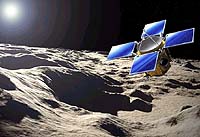
NEAR Shoemaker has been configured by mission controllers to begin collecting and recording information from the surface of Eros.
NEAR Mission Operations Manager Robert Nelson said the team is also sending commands to prevent the rest of the spacecraft from sending data to its onboard recorder, since the only reliable telemetry link is through NEAR Shoemaker’s low-gain antenna.
“Now that we have landed, collection and recovery of critical gamma-ray data is our primary objective,” he said.
NEAR Shoemaker’s historic Feb. 12 touchdown on Eros turned out to be a mission planner’s dream – providing NEAR team members with more scientific and engineering information than they ever expected from their carefully designed series of descent maneuvers.
The spacecraft gently landed at 3:01:52 p.m. EST, ending a journey of more than 2 billion miles (3.2 billion kilometers) and a full year in orbit around the large space rock.
Mission operators say the touchdown speed of less than 4 miles per hour (between 1.5 and 1.8 meters per second) may have been one of the slowest planetary landings in history, and they now have a better picture of what happened in the moments after the landing.
What they originally thought was a bounce may have been little more than short hop or “jiggle” on the surface; the thrusters were still firing when the craft hit the surface, but cut off on impact; and NEAR Shoemaker came down about 650 feet (200 meters) from the projected landing site.
NEAR Shoemaker snapped 69 detailed pictures during the final three miles of its descent, the highest resolution images ever obtained of an asteroid. The camera delivered clear pictures from as close as 394 feet (120 meters), showing features as small as 1 centimeter across.
Images also included several things that piqued the curiosity of NEAR scientists, such as fractured boulders; a football-field sized crater filled with dust; and a mysterious area where the surface appears to have collapsed.
