

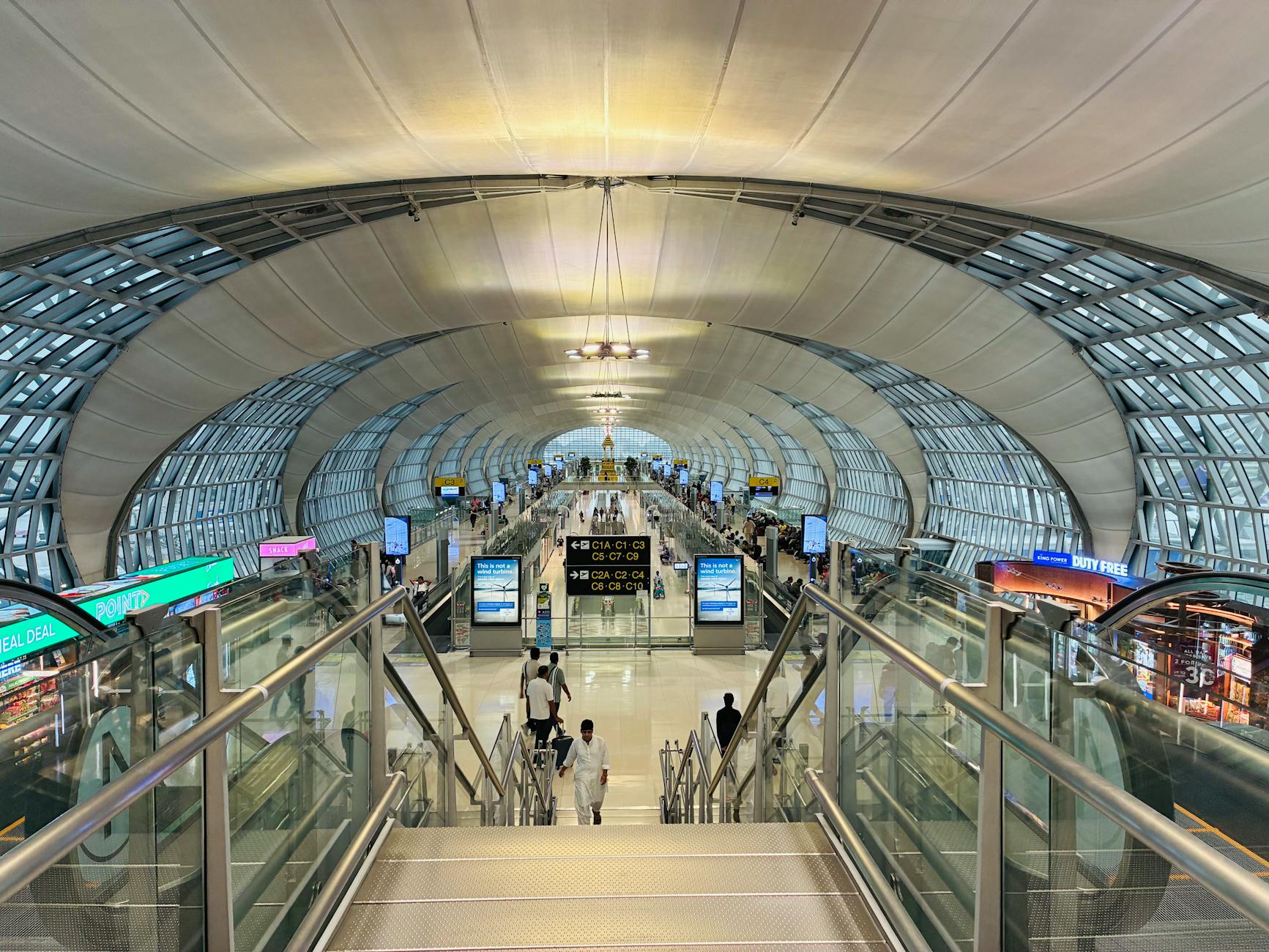
The three-hour buffer has nothing to do with TSA lines. I’ve watched people I love arrive at Reagan National at 4:30am for a 7:45am domestic flight, and when I ask them why, they give me logistics — traffic, security, the unpredictable Metro — but none of those answers explain the low-grade vibration running through them the night before, the packed bag by the door at 9pm, the third check of the passport that is still exactly where it was on check two. What they are defending against is not a missed flight. It is the specific, almost physical dread of being the person who held everyone up, lost the reservation, broke the chain, caused the problem that rippled outward.
I know this because I married one. I became friends with several more. And eventually, I recognized the pattern in myself, though mine expressed itself in Senate hearing preparation rather than airport arrival times — the same machinery, different terminal.
Most people read the early-arriver as cautious, maybe a little neurotic, fundamentally well-adjusted. The popular framing treats it as a personality quirk, one of those harmless eccentricities that makes someone endearing. That reading misses what’s actually happening. The three-hour buffer is a coping mechanism with a long memory, and it was installed in childhood by a very specific set of conditions that most people who exhibit it have never connected to the behavior itself.
The job they were given before they could refuse it
During early childhood, often between ages five and ten, these people were assigned a role. Sometimes it was explicit — an older sibling asked to watch a younger one, a child of divorce handed the emotional management of one parent, a kid of an anxious mother tasked with reassuring her. More often it was implicit, absorbed through a thousand small moments in which the child noticed that the adults around them were not fully in charge of the situation, and someone had to be. Often, that someone became the child.
What gets built in that period is not a fear of disaster. It is a fear of being the cause of disaster. The distinction matters. A person afraid of disaster is afraid of the world. A person afraid of causing disaster is afraid of themselves — afraid of their own capacity to forget, overlook, miscalculate, or simply fail to anticipate. That fear doesn’t go away when the child grows up and leaves home. It goes looking for situations that resemble the original conditions: high stakes, multiple people depending on the outcome, narrow margins for error, and a clear identifiable person who would be blamed if something went wrong.
Airports are a near-perfect replica. You have a deadline that cannot be negotiated. You have other people (travel companions, people waiting at the destination, whole downstream schedules) whose day depends on your execution. You have a chain of dependencies — ID, boarding pass, bag weight, security, gate — each of which could fail. And you have an unambiguous version of failure: the closed jet bridge, the plane pulling back without you. For someone whose nervous system learned early that their job was to prevent the worst outcome for everyone involved, this is not a travel scenario. It is the exact emotional terrain of childhood, reproduced at scale.
Developmental research suggests that children aren’t born with perfectionism — they develop it in response to environments where love, approval, or safety appear contingent on performance. A piece in how perfectionism begins in early childhood notes that the child learns that being reliable is the price of admission. What the research is less vocal about is how that price keeps getting paid, decade after decade, long after the original transaction closed.
What the buffer is actually buffering
The three hours are not for the flight. They are for the margin of safety the child never had. When you grow up in an environment where something small could cascade into something large — a forgotten permission slip, a bad grade, a parent’s bad mood — you learn to pad every transaction with time you don’t need. The padding is the point. It is the felt sense of control that the buffer creates, not the buffer itself.
I watched my wife do this before a flight to visit her sister last spring. She packed the night before. Then she re-packed at 5am. She checked the weather at the destination, not because it would change what she wore, but because checking was the ritual. She arrived at the airport with enough time to eat a full breakfast at a sit-down restaurant inside the terminal, read a book, and still board in the first group. When I asked her if she felt relaxed, she paused and explained that she didn’t feel at ease—just that nothing had gone wrong yet.
That sentence has stayed with me. Nothing has gone wrong yet. It is not the sentence of someone enjoying a buffer. It is the sentence of someone still waiting for the other shoe, still scanning the horizon, still running the program that says something will go wrong and it will be traceable to a decision you made or failed to make. The buffer doesn’t stop the scanning. It just gives the scanning a place to happen that doesn’t actively make things worse.
This is the part the conventional wisdom about “travel anxiety” misses completely. These people are not anxious about flying. Many of them love flying, love travel, love the specific sensory experience of being in an airport. What they are anxious about is their own potential to be the weak link in a system that depends on multiple people executing correctly. The anxiety precedes the flight and outlasts it. The flight is just the stage on which it becomes visible.
The quiet connection to ADHD and other hidden wiring
Part of what complicates the picture is that a meaningful slice of people who present as hyper-prepared are also neurodivergent in ways that went undiagnosed in childhood. Psychology Today has covered the link between high-functioning anxiety and ADHD, noting that many children who appear anxiously perfectionistic are actually running sophisticated compensation strategies to cover for executive function differences they’ve been told are character flaws. The three-hour buffer, viewed this way, is not just an emotional accommodation. It is a practical one. If you have ever left your wallet at home, locked yourself out of the car, forgotten the date of something important — and if, as a child, those lapses were met with shame rather than help — you will build structures that prevent those lapses from ever happening again. You will over-engineer. You will arrive early.
The cost of this is rarely discussed. It is tempting to see the early-arriver as someone who has solved a problem. They haven’t. They have contained it. The containment requires ongoing energy, and it comes out of the same reserve that other parts of their life need. The sustained, quiet vigilance that produces a smooth travel day produces exhaustion by the time they reach the hotel. They nap. They don’t know why they’re so tired — nothing happened, the flight was uneventful, everything went fine. That is exactly why they’re tired. Keeping nothing from happening is work.
Why the adult can’t just talk themselves out of it
A common response, usually from a partner or friend who doesn’t share the pattern, is some version of: Partners or friends often point out the rational reality: arriving an hour early would be fine, the flight wouldn’t leave without them, and nothing bad happens when timing is tighter. But this rational argument misses the point entirely. The person arriving three hours early is not making a statistical argument about missed flights. They are honoring a much older contract, one in which their worth was bound up in being the person who didn’t let anyone down.
Psychologists who study adult children from chaotic or dysfunctional families describe this as a persistent pressure to be perfect that doesn’t respond to logic because it wasn’t built with logic. It was built in the body, through repeated experiences of what happened when things went wrong. You cannot argue someone out of a somatic memory. You can only help them notice it, name it, and sometimes, slowly, build experiences that contradict it.
This is why I’ve come to understand the buffer as something closer to a survival strategy that has outlived its original purpose but still does meaningful work. I’ve written before about how the people who seem unusually calm in a crisis are often not calm at all, just very practiced. The early-arriver is the pre-crisis version of the same person. They are not responding to a crisis. They are preventing one, constantly, in advance.
What the pattern costs
There is a particular exhaustion that comes from being the person who never loses the passport, never forgets the reservation, never shows up without the confirmation number pulled up and ready. It is the exhaustion of being reliable in a world that has taken your reliability as evidence that you don’t need anything. The people around you will travel with you because it’s easier. They will stop checking their own details because they know you’re checking yours and theirs. And slowly, the asymmetry will become the shape of the relationship. You are the one who anticipates. They are the ones who arrive.
This is not just a travel pattern. It is a template that shows up in careers, friendships, marriages. The same nervous system that arrives three hours early also answers work emails on vacation, remembers every birthday, and defends other people’s mistakes while privately relitigating its own for weeks. The airport is just where the pattern becomes legible because the stakes are compressed into a visible timeline.
I don’t think the answer is to stop arriving early. For many people, the buffer is genuinely useful, and trying to strip it away without addressing what built it produces a different, worse anxiety. The answer, if there is one, is smaller. It is to notice the feeling beneath the behavior. To name the fear of being the cause. To sit, for a few minutes, in the specific discomfort of having been assigned a job at age seven that you never agreed to and have been doing for thirty years without a review.
And maybe, on the next trip, to let someone else hold the boarding passes. Not because you’ve stopped caring. Because you’re practicing the experience of a world that keeps running when you’re not the one holding it up. That experience has to be built in small increments, and it has to be felt, not reasoned. The three hours will still be there when you need them. They don’t have to be the only thing standing between you and the person you were afraid of becoming — the one who let everyone down.
