


The person who handles the emergency room phone call without her voice cracking, who drives the family to the hospital while everyone else weeps in the back seat, who calls the insurance company the next morning and speaks in complete sentences — that person is not calm. She is performing a kind of work so old and so practiced that it has stopped looking like work. What reads as composure is usually a learned immobility, the psychological equivalent of a muscle that locked into place so long ago she cannot remember holding it.
Most of the language we have for this comes from wellness culture, which insists that equanimity under pressure is a skill you earn through meditation, therapy, and a disciplined nervous system. The conventional wisdom says the steady ones have simply done the work. They’ve regulated. They’ve healed. They’ve become, in the language of the era, resilient.
That framing collapses the second you ask the steady person what they felt in the moment. Most of them will tell you they felt nothing. Not peace. Not grounded presence. Something flatter. A kind of narrowing in which the crisis stopped being an experience and became a set of tasks. That is not regulation. Regulation implies an emotion was present and skillfully managed. What these people describe is an emotion that never arrived in the first place — or arrived so briefly it was metabolized before anyone noticed, including them.
This is what this essay is about: the confusion between being regulated and being conscripted. Between having feelings you can ride and having learned, very early, that feelings were a luxury assigned to someone else in the house.
The household where panic was already taken
In a certain kind of childhood, panic is a finite resource. There is only enough of it to go around for one person in the room, and that person is almost always an adult — a parent whose mental illness makes every Tuesday a possible unraveling, a caregiver whose drinking turns the kitchen into a weather system, an older sibling whose medical needs swallow the family’s oxygen, a household organized around the volatility of someone who cannot tolerate anyone else’s distress on top of their own.
In these houses, a child learns quickly that her fear is not a signal that summons help. It is an additional problem. Her tears do not produce comfort; they produce overwhelm in the adult, which produces rage or collapse, which produces more threat. So she does the calculation, not consciously but completely, and concludes that her feelings are more dangerous expressed than contained. She stops expressing them. Eventually she stops registering them at all.
This is not resilience. It is a kind of triage performed on the self. The Iowa State developmental researcher Carl Weems has argued that our memory and perception of early trauma evolves over time, reshaped by cognitive development and subsequent experience, which is part of why people who grew up this way often cannot name what happened to them until well into adulthood. The pattern is legible before the story is.
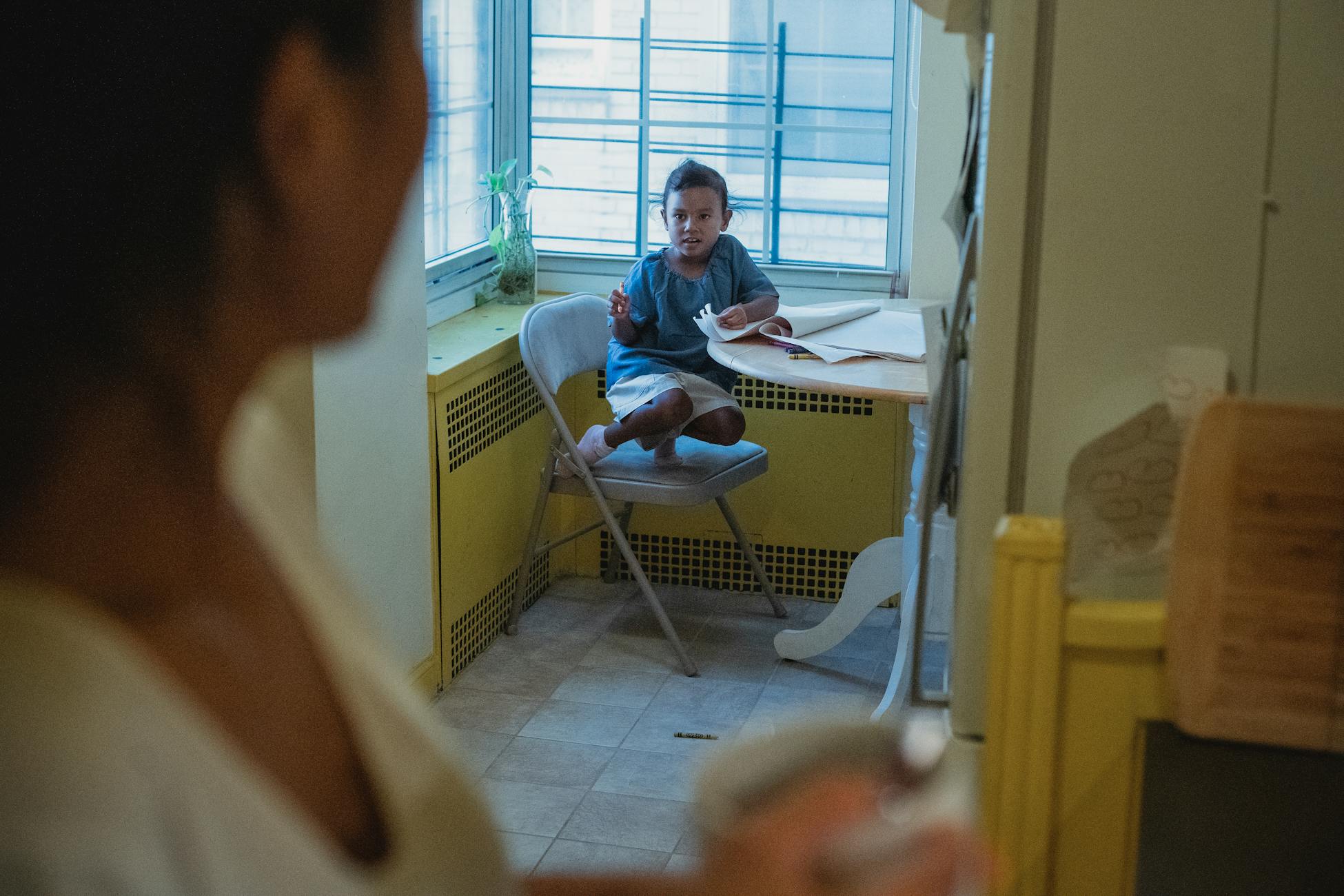
What looks like steadiness and what it actually is
The tell is in the body after the crisis ends. The genuinely regulated person comes down from a stressful event with something recognizable as relief — a breath, a softening, an appetite that returns. The person operating from childhood conscription comes down differently. She doesn’t come down. She moves to the next task. When there is no next task, she becomes strange to herself. The quiet after the emergency is harder than the emergency was. Her hands shake in the parking lot three hours later for reasons she cannot locate. She develops a headache that lasts four days. She picks a fight with her partner over something that does not matter.
Psychologists working in complex trauma have been tracking this pattern for decades. Research on C-PTSD and other long-arc trauma responses has described exactly this profile: high functioning under acute stress, followed by dysregulation during periods of safety. The body doesn’t know what to do when the threat lifts, because the threat lifting was never the point of the skill. The skill existed to survive the threat continuing.
The distinction lives entirely in what happens between crises. Regulation is renewable. Conscription is depleting. The regulated person grows stronger across a lifetime of hard moments. The conscripted person grows quieter, more remote, more confused about what she wants, less able to locate the part of herself that would know.
The person everyone calls in the emergency
You know this person. You may be this person. She is the one her siblings call when a parent is dying. She is the one friends text when their marriage is imploding at 2 a.m. She is the one the office routes the client breakdown to. Her phone is full of people who love her in a very particular way: they love the version of her who shows up when the ceiling is falling, and they have not asked, in years, whether she would like to be known outside of those rooms.
I’ve written before about patience as a strategic suppression rather than a temperament, and the crisis-calm pattern is its closer, more dramatic cousin. Both are skills that look like virtues from the outside and feel like absences from the inside. The patient person has learned that her frustration costs her. The calm person has learned that her panic costs everyone. Both have optimized themselves out of emotions that other people are permitted to have freely.
The adverse childhood experiences literature gives us some architecture for this. Children exposed to household dysfunction, parental mental illness, substance abuse, or chronic unpredictability develop coping mechanisms that persist well into adulthood and alter not only behavior but stress physiology. The ACE research doesn’t romanticize these adaptations. It names them as costs. The child who learned to stay calm while her mother raged developed a nervous system that cannot easily access its own alarm. That is an injury, even when it is also useful.

Why the adaptation is so hard to see
Part of what makes this pattern invisible, even to the people living inside it, is that it gets rewarded. Constantly. At work, in friendships, in families of origin that continue to run on the same operating system. The calm one is trusted. The calm one is promoted. The calm one is told, often, how lucky her partner is to have her. Nobody in her life has any incentive to examine whether her calm is a symptom rather than a gift, because her calm is making their lives easier.
Recent work on how childhood adversity shapes brain and behavior has been clear that these adaptations are not character. They are plasticity responding to environment, often in ways that trade long-term flexibility for short-term survival. The child who suppressed fear to avoid escalating a volatile parent did not choose a coping style. She developed a brain that could not, as easily as other brains, do the thing she was avoiding.
There is also a social cost to examining this. The calm person is often told, when she begins to crack or to name what she went through, that she is being dramatic. Rewriting history. Ungrateful. The people who benefitted from her steadiness — including, sometimes, the parents whose volatility created it — tend to respond to her emerging narrative with disbelief or injury. How the rest of the world reads her distress is, as some researchers have noted, itself shaped by what observers know about her history. A person whose childhood is not visible looks, from outside, like someone simply losing her composure for no reason.
What the body keeps that the story forgets
The research on trauma and relationships consistently finds that the emotional blueprint from childhood shows up most loudly not in the crisis itself but in how we view ourselves, others, and the world during ordinary life. The conscripted-calm person often cannot tolerate rest. Stillness feels like threat. Free time produces a low, ambient dread. She fills her calendar. She volunteers. She becomes the person who handles other people’s emergencies partly because other people’s emergencies are, neurologically, more familiar to her than her own quiet Saturday.
Her partners sometimes describe her as closed, or far away, or strangely absent in the moments when the relationship is going well. This confuses her, because she is trying. She is, she believes, present. What she doesn’t yet know is that her nervous system has organized itself around threat, and when there is no threat, there is nothing for her to attach to. Safety is the condition she never learned to inhabit. She learned, instead, to be the condition that made other people feel safe.
The part almost no one explains clearly
Here’s what happens when a person like this begins to see the pattern. She does not, at first, become calmer. She becomes worse at the thing she was best at. The skill degrades because the skill was running on a foundation she is finally willing to examine, and the examination weakens it. She starts to feel panic in small moments — a missed email, a tense conversation, a parking ticket — and does not know what to do with it because panic was never her assignment. She often concludes she is getting sicker. She is not. She is getting closer to the emotional range other people have always had.
This is the part almost no one explains. Recovery from this particular adaptation does not look like becoming more composed. It looks like becoming more porous, more reactive, more occasionally overwhelmed. The regulated life is not the unflappable one. It is the one in which flap is permitted, metabolized, and moved through. She is learning, at thirty-five or forty-five or sixty, what she should have been allowed to learn at six: that her distress is information, not damage, and that the people around her can survive seeing it.
What I’ve written before about boundaries applies here too. The first taste of the healthier thing does not feel like health. It feels like betrayal of the self that kept everyone alive. Which is why so many people who grew up as the calm one stay calm forever. The cost of learning to panic — and of trusting that someone will stay — is higher, in the nervous system’s accounting, than the cost of continuing to carry everyone else through every crisis for the rest of her life.
The woman on the phone with the insurance company the morning after her mother’s stroke, the man who organized his father’s funeral without crying, the friend who has taken every 2 a.m. call for fifteen years — they are not the strong ones. They are the ones who were handed a job too early and were never told they could put it down. The kindest thing anyone can do for them is to stop congratulating them for the job, and start asking, gently, what they might be if they weren’t doing it.
