

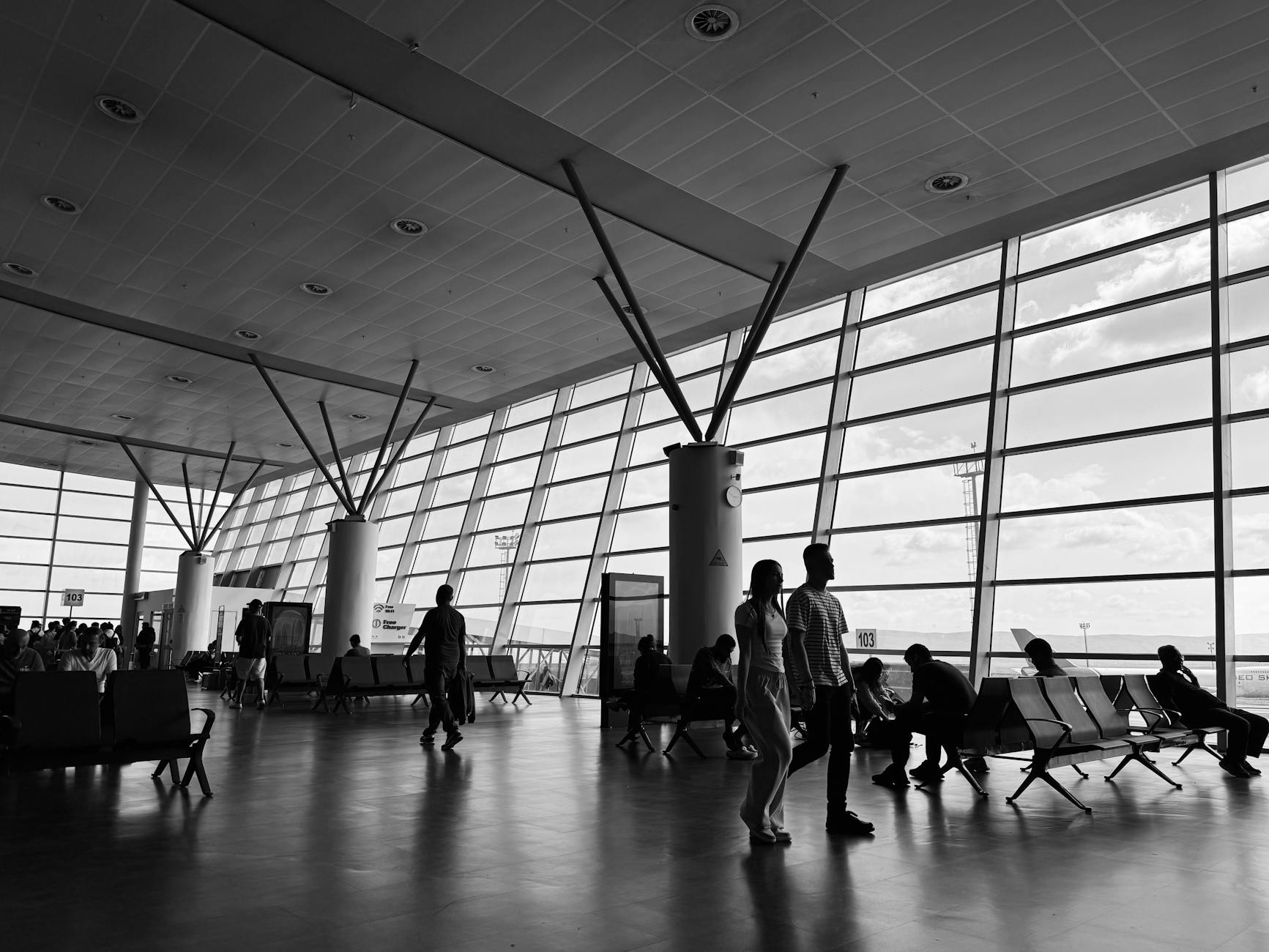
My wife’s colleague once described her husband’s airport ritual with a kind of affectionate bewilderment. He wanted to arrive three hours before a domestic flight. Three hours. For a flight to Chicago. She told the story as a joke about his anxiety, and everyone at the table laughed in the knowing way people laugh at someone else’s partner. I didn’t laugh. I knew that man, or rather, I knew the particular infrastructure running underneath him, because I’ve spent years watching people like him and, in certain moments, being one of them.
The conventional reading is that he is a nervous flyer. A catastrophizer. Someone whose amygdala runs hot and whose rational brain can’t quite override the ancient fear of falling out of the sky. That framing is comfortable because it locates the problem inside him, as a malfunction, something he could work on with breathing exercises and maybe a low dose of lorazepam. But the framing collapses the moment you ask him why he needs the buffer. The answer is almost never I’m afraid of the plane. The answer is some version of I need to know that if something goes wrong, we still have time. What you’re hearing, if you listen carefully, is not personal anxiety. It’s an inherited family role — the person who was assigned responsibility for everyone else’s margins long before they were old enough to decline the job — expressing itself in the language of scheduling.
Notice what’s missing from that sentence. The fear isn’t of crashing. The fear is of being the reason something falls apart.
The buffer is a ledger, not a symptom
There’s a particular kind of person who grew up understanding that the adults around them were not, in fact, going to catch the things that got dropped. Maybe a parent was unreliable. Maybe a sibling had needs that consumed the household’s bandwidth. Maybe the family was fine on paper but operated on a thin margin where one forgotten form or one missed appointment could cascade into a week of tension. Whatever the specifics, the child learned that catastrophe was not theoretical. It was a Tuesday afternoon when someone forgot to pick up the prescription and then everyone paid for it until Saturday.
That child develops what looks, from the outside, like unusual competence. They become the one who remembers. The one who prints two copies. The one who brings snacks for other people’s kids. By adulthood, they are the human equivalent of redundant systems engineering, and the family has quietly reorganized itself around their reliability. I’ve written before about how this reads as emotional regulation, when really it’s something closer to a job description that was handed out before the person was old enough to decline it. The three-hour buffer is an accurate reflection of how much weight this person has historically carried on travel days. They hold the passports. They know the rental car confirmation is in an email from four weeks ago. Their mother will call from the security line because she can’t figure out the TSA PreCheck thing, and their nephew will announce at the gate that he forgot his inhaler. If you have been the person solving these problems since age nine, three hours is not a margin of safety. It’s a minimum viable window.
What the research actually sees
Clinical descriptions of anxiety tend to treat over-preparation and control behaviors as symptoms to be reduced. The University of Utah’s guidance on coping with anxiety, for instance, frames chronic worry as something that takes control of a person’s life, eroding daily routines and well-being. That’s true as far as it goes. But it tends to miss a subset of people for whom the control behaviors aren’t stealing from their life — they are the life. The behaviors were adaptive before they were pathological, and for many of these people, they still are. The airport buffer isn’t robbing them of peace. It’s the thing that allows peace to exist once they’re through security.
Family systems researchers have documented how children inside emotionally imbalanced households take on specific roles to maintain equilibrium — the hero, the caretaker, the fixer, the parentified child. These roles don’t dissolve at eighteen. They calcify. The eldest daughter who managed her mother’s moods at eleven becomes the forty-year-old who manages her team’s moods at work and her husband’s moods at home and, on travel days, the entire extended family’s logistics. Understanding these family roles helps clarify what the clinical lens often misses: the role itself is the load-bearing wall, and removing it feels like watching the house come down.
The Big Five personality framework puts some of this into measurable language. High conscientiousness — the trait cluster that includes dutifulness, order, and deliberation — correlates with exactly the behaviors we’re describing. But conscientiousness on its own doesn’t explain the specific flavor we see here. Research suggests that when conscientiousness interacts with neuroticism and early family dynamics, you find a particular phenotype: the person who is not simply responsible but responsible for. Their vigilance has an object. That object is other people’s wellbeing, tracked continuously, without visible effort, the way a thermostat tracks room temperature.
The tell is in the language
Listen closely the next time one of these people explains the buffer. They will almost never say I. They will say we. We need to leave by noon. We should check in now. We don’t want to cut it close. The pronoun is the tell. The flight is not a personal event. It’s a group project, and they are the project manager, and the project manager does not get to be nervous in the way the other passengers do. A nervous flyer white-knuckles the armrest during takeoff. This person is already two moves ahead, mentally rehearsing what happens if the connection gets delayed and the rental car office closes at nine.
There’s a flatness to how they describe it, too. Not panic. Not dread. Something more procedural. They don’t say the word afraid. They say prefer. They prefer to have time. They prefer not to rush. The language has been sanded down over decades because expressing the underlying feeling — if we miss this flight, I will absorb the consequences for everyone, and I already know I will — tends to make other people uncomfortable. So it gets rephrased as a scheduling preference. As a quirk. As something their spouse rolls her eyes about at dinner parties.
Why it looks like anxiety and isn’t
This is where the avoidance framework that clinicians use starts to fray. The standard therapeutic model suggests that anxious people avoid the thing they fear, which compounds the anxiety, and treatment involves gradually approaching the feared stimulus. But the airport-early person isn’t avoiding flying. They’re flying constantly. What they’re avoiding is being the reason the trip failed. And there’s no amount of exposure therapy that addresses that, because the fear isn’t of an imagined catastrophe. It’s of a role they were assigned in childhood and have been performing, without interruption, ever since. They have an accurate risk model. They’ve seen what happens when buffers collapse. They remember the time their father had a heart incident at a layover and nobody had packed his medication in a carry-on. Their vigilance is not irrational projection. It is pattern recognition based on evidence.

I’ll add a complication. A lot of what circulates about anxiety on social media flattens these distinctions badly. Researchers at Florida International University found that people who get their anxiety information from social platforms end up less informed, not more. The viral content treats anxiety as a monolith, something you either have or don’t, something to be managed through journaling and breathwork. It misses the subset of people whose so-called anxiety is actually a hypertrophied sense of responsibility, developed in a household that required it, and now running in a life that no longer does.
The cost nobody adds up
The three-hour buffer has a price, and it’s not the time spent at the airport. It’s the fact that this person never experiences travel as someone else’s problem. They don’t get to be the one being ushered through security by a competent partner. They don’t get to arrive at the gate and find that the snacks have already been bought, the boarding passes already pulled up, the seat assignments already confirmed. They are always the one doing the ushering. At family gatherings, at work retreats, at their own children’s school trips, they are the air traffic controller. Everyone else is the plane.
I’ve written about this kind of learned refusal to need things before, and it applies here. The person who arrives three hours early has, somewhere along the way, stopped imagining that anyone else could be trusted with the margin. Not because their spouse or siblings or colleagues are incompetent, but because the cost of being wrong — the cost of trusting and then absorbing the fallout — has historically been too high. Better to just do it yourself. Better to get there early. Better to hold the passports.
On a smaller scale, you see the same phenomenon in people who arrive early to everything, not just flights. The airport version is just the most visible case, because the stakes are legible and the buffer is so long that other people notice. Most of these same behaviors run invisibly the rest of the time. The early arrival at the restaurant. The reread of the work email before sending. The mental rehearsal of the conversation before the phone call. It’s the same operating system, running constantly, and the airport is just where it runs loudest.
What would it mean to stop
I don’t have a clean ending for this, and I’m suspicious of anyone who does. The person who has been preventing disasters for decades cannot simply decide to stop, because the muscle that does the preventing is the same muscle that lets them feel safe. Ask them to arrive an hour before a flight like a normal adult and you are not curing their anxiety. You are asking them to sit with the possibility that something will go wrong and it will be, for once, not their fault and not their problem to fix.
Most of them cannot do this. Not because they are broken, but because nobody in their life has ever actually demonstrated that the plane will still take off if they aren’t the one watching the clock. The buffer will shrink when, and only when, they start to believe someone else is also paying attention. That belief takes a long time to build. It is built in small moments, over years, by the people around them noticing — really noticing — what has been carried, and beginning, quietly, to carry some of it back.
And here is the thing that makes this genuinely hard, not just psychologically interesting: the people around them have to do it without being asked. Because the person holding the passports has been trained, since childhood, to interpret the need to ask as proof that nobody was going to do it anyway. The gesture has to be unsolicited to register as real. The partner who, without prompting, checks the gate number and packs the kid’s inhaler and says I’ve got this one — that person is not just being helpful. They are doing something the clinical frameworks don’t have great language for. They are slowly, one airport at a time, retiring a role that should never have been assigned in the first place.
Until then, three hours early is not a quirk. It’s a receipt for decades of labor that nobody asked to see — but that kept everyone else’s plans, and flights, and lives, from falling apart.
