

In 2006, the International Astronomical Union held a meeting in Prague and voted to demote Pluto. Roughly 424 members were in the room when the vote happened. The world’s planetary scientists, the people who actually study planets for a living, were not consulted in any binding way. Within hours, textbooks were rewritten, classroom posters were reprinted, and a decades-old part of every kid’s solar system mnemonic disappeared.
It is time to say it plainly. The IAU got it wrong. The definition they crafted is logically incoherent, was politically motivated when it was written, has been quietly ignored by most working planetary scientists ever since, and has been further undermined by what NASA’s New Horizons spacecraft actually found when it flew by Pluto in 2015. Pluto looks like a planet, behaves like a planet, and has the geological complexity of a planet. The only thing standing between Pluto and its old status is a 19-year-old taxonomic decision that most of the field has stopped taking seriously.
This is the case for putting Pluto back.
The 2006 definition was broken on arrival
The IAU’s 2006 definition requires that a planet (a) orbits the sun, (b) has enough mass to pull itself into a roughly spherical shape, and (c) has “cleared the neighborhood” around its orbit. Pluto satisfies the first two. It fails the third because it shares its orbital region with other objects in the Kuiper Belt.
Here is the problem. None of the eight officially recognized planets fully clear their orbits either. Earth, Mars, Jupiter, and Neptune all share orbital space with asteroids, comets, and other debris. The IAU’s defenders respond that what really matters is gravitational dominance, the ability to scatter or accumulate the leftover material over time. Fine. But that test is distance-dependent.
Alan Stern, the principal investigator of New Horizons and the most consistent advocate for Pluto’s restoration, has been pointing this out for nearly two decades. In a Space.com interview, Stern noted that if you placed Earth at Pluto’s distance from the sun, Earth would also fail the IAU’s clearing criterion. Mercury, Venus, and Mars would fail too. So the IAU’s definition produces the absurd result that an object’s planet status depends on its postcode rather than its physical properties.
This is not how taxonomy is supposed to work. We do not call something a star or a galaxy or a moon based on where it happens to be. We classify it on what it is. The IAU broke that principle in 2006, and the field has been arguing about it ever since.
The vote was rushed, and not by accident
The trigger for the 2006 decision was Mike Brown’s discovery of Eris a year earlier. Eris was, at the time, thought to be slightly larger than Pluto. The IAU faced a dilemma. Either Eris had to become the tenth planet, or Pluto had to be excluded from the planetary club. Excluding Pluto was the politically simpler option, as the Philosophical Society of Washington’s 2019 debate laid out, and that is what happened.
Of the IAU’s roughly 9,000 members, only a few hundred attended the final session in Prague, and only 424 actually voted. Most working planetary scientists were not in the room. Stern has said openly that he believes the definition was engineered to keep the planet count small and memorable. Ron Ekers, the IAU president from 2003 to 2006 and the public defender of the decision, conceded in that 2019 debate that this “memorable number” reasoning was at most a joke at the time. Maybe. But the math suggests otherwise.
A 2017 paper presented at the Lunar and Planetary Science Conference, led by Kirby Runyon at Johns Hopkins, made the argument bluntly. Pluto, Runyon told Johns Hopkins Hub, “has everything going on on its surface that you associate with a planet.” The team proposed a geophysical definition that would expand the count to roughly 110 bodies in our solar system, including some large moons. That is not chaos. That is honesty.
Working scientists already ignore the IAU definition
The most damning evidence against the 2006 definition is not philosophical. It is empirical.
In a 2018 Icarus paper, University of Central Florida planetary scientist Philip Metzger and colleagues went through more than two centuries of astronomical literature and showed that the “cleared its orbit” criterion has essentially no presence in actual planetary science research. Practitioners simply do not use it. Metzger described Pluto in that work as “more dynamic and alive than Mars.”
The 2022 follow-up, also in Icarus and titled “Moons Are Planets,” went further. Metzger and seven co-authors, including Stern and several New Horizons team members, reviewed 400 years of usage since Galileo. They concluded that calling moons planets, when those moons are large and round and geologically active, is the historically dominant scientific convention. Galileo himself called the moons of Jupiter planets when he discovered them. The IAU’s 2006 definition is the recent, narrow, anomalous outlier.
Metzger has been blunt about it elsewhere. “Planetary scientists don’t use the IAU’s definition in publishing papers,” he told Science News Explores. The relevant scientific community has rendered its verdict. The IAU just has not caught up.
What New Horizons actually found
When New Horizons flew past Pluto in July 2015, the expectation was that we would see a frozen, geologically inert body, the kind of dead world that fits comfortably in the “dwarf” mental category. What the spacecraft sent back was almost the exact opposite.
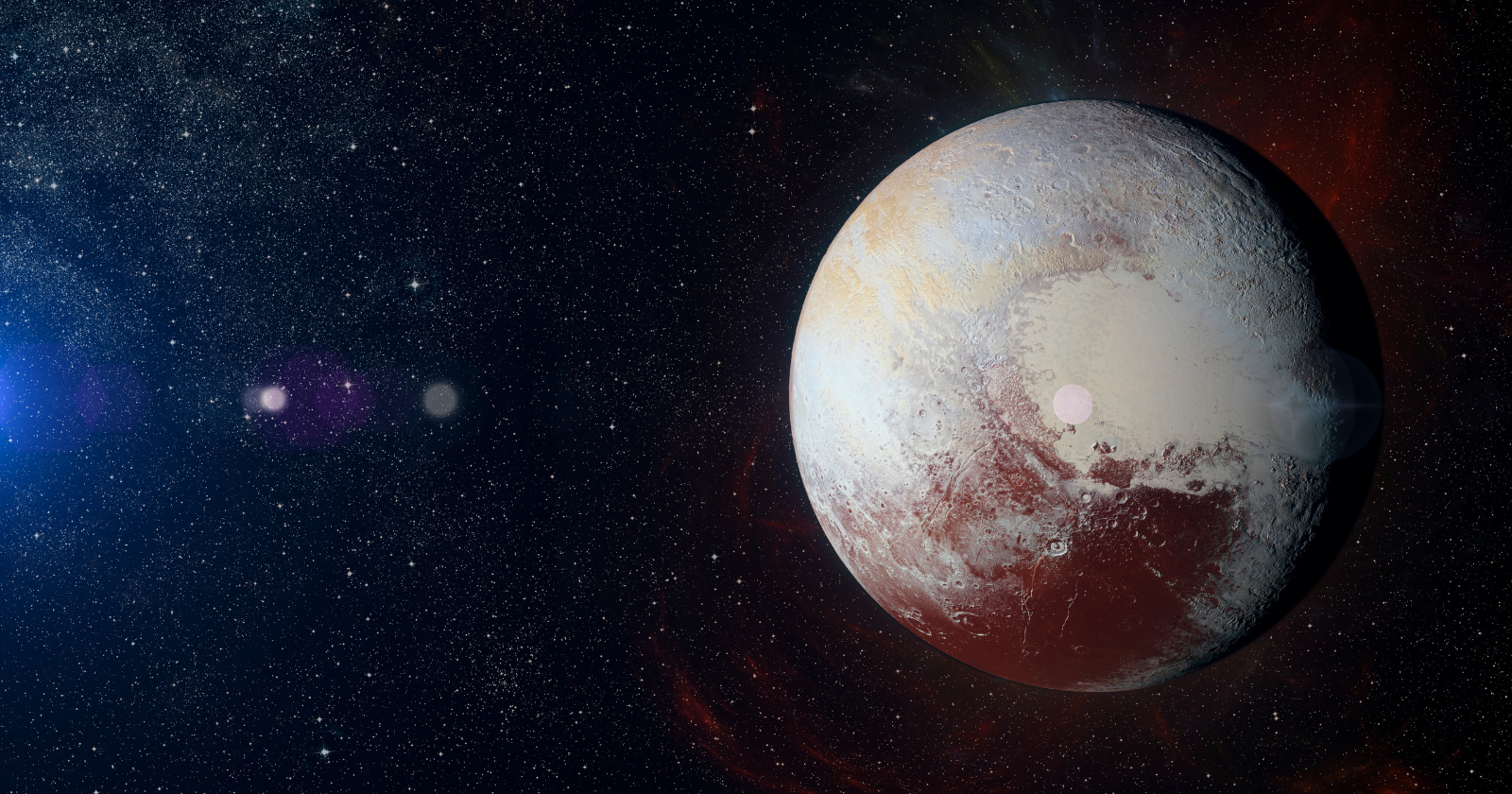
Pluto has nitrogen-ice glaciers that flow. It has mountains made of water ice that rival the Rockies in height. It has a layered atmosphere with hazes that reach more than 200 kilometers above the surface. It has at least two enormous structures, Wright Mons and Piccard Mons, that planetary scientists have identified as likely cryovolcanoes. It has a vast region called Sputnik Planitia, a Texas-sized ice plain that is so young it has essentially no impact craters at all. It has tectonic features consistent with an ongoing internal expansion.
And underneath all of that, the data from New Horizons strongly suggests a subsurface liquid water ocean, 100 to 180 kilometers thick, sitting at Pluto’s core-mantle boundary. The ocean is most likely still liquid today, kept warm by radioactive decay in Pluto’s rocky core. A 2023 study reported a possible supervolcanic eruption at a feature called Kiladze crater within the past few million years, geologically recent enough that it might still be active.
Jeff Moore, who led the New Horizons geology team, has said Pluto’s surface complexity rivals that of Mars. Mars, of course, is undisputedly a planet. If you presented Pluto’s data sheet to a planetary scientist with the name removed, they would describe a small, geologically active, ocean-bearing world with an atmosphere and a satellite system. They would not describe a non-planet.
The geophysical definition is better, full stop
Stern’s preferred alternative, the Geophysical Planet Definition, is straightforward. A planet is any body massive enough that its self-gravity pulls it into hydrostatic equilibrium, but not so massive that its core ignites sustained nuclear fusion. Above that lower bound and below the upper one, you are a planet. Where you orbit, what you orbit around, and what is near you do not enter into it.
This has three big advantages over the IAU framework.
First, it is intrinsic. A body’s planet status under the geophysical definition depends on the body itself, not on its surroundings. That matches how every other astronomical object is classified.
Second, it scales. There are now more than 5,000 confirmed exoplanets, and that number is climbing fast. Many of them orbit in systems with multiple bodies in shared regions, in resonance chains, or in environments where “clearing the neighborhood” is essentially undefined. The IAU definition simply does not work outside our solar system. The geophysical one does, immediately.
Third, it is honest about the universe we actually live in. The geophysical definition admits roughly 110 to 150 bodies in our solar system to planetary status, including Pluto, several large Kuiper Belt objects like Eris and Makemake, the asteroid Ceres, and several large moons such as Europa, Titan, Ganymede, and our own Moon. That sounds like a lot until you remember that we already have hundreds of named asteroids and tens of thousands of catalogued minor bodies. Calling 100-plus geologically active worlds “planets” does not flood the category. It populates it accurately.
Why this matters more than Pluto
The reason to fight this fight is not nostalgia. It is what is coming next.
The James Webb Space Telescope is detecting more exoplanets and characterizing more atmospheres every month. The Habitable Worlds Observatory is in development. By the late 2030s, we will be classifying potentially habitable worlds around other stars at a pace that would have been science fiction in 2006. Doing that with a definition that breaks down outside the solar system, that classifies identical bodies differently based on location, and that working planetary scientists already ignore, is going to look increasingly absurd. Better to fix the definition now than to inherit a broken one into the exoplanet era.
There is also a softer argument that matters. The 2006 demotion is the most successful piece of unwelcome science communication in a generation, in the sense that almost everyone heard about it and a large fraction of people resented it. The public attachment to Pluto turns out to be a feature, not a bug. People care about planets in a way they do not care about minor bodies. When we tell schoolchildren that Pluto is not a planet, we are not just teaching them a contested taxonomic decision. We are teaching them that science is the kind of thing that takes things away. The geophysical definition does the opposite. It expands the catalogue of worlds, and it lets curiosity follow.
Restoring Pluto
The case for Pluto’s planethood is not sentimental. It is technical, historical, and increasingly practical. The 2006 IAU definition is internally inconsistent, was rushed and politically engineered, has been quietly abandoned by most of the planetary science community, and has been overtaken by data from a NASA mission that revealed Pluto to be a geologically active world with mountains, glaciers, an atmosphere, a subsurface ocean, and probable cryovolcanoes.
Stern has said the IAU “really embarrassed themselves with this.” That is one way to put it. A more constructive way is that the IAU made a defensible decision in 2006 with limited information, and the information has since changed. The honest scientific response to changed information is to update your conclusion.
Pluto is a planet. It always was. It is time the official definition caught up with the rocks, the ice, the ocean, and the people who study them.
