
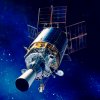

Washington, April 12, 1999 – Air Force Space Command officials have confirmed last Friday’s successful Titan IVB launch has resulted in orbiting of the Defense Support Program (DSP) satellite into the wrong orbit of the Earth. If the satellite cannot be successfully maneuvered into the proper slot, a high geostationary location some 19,000 miles high, the spacecraft will be a total loss and the mission an expensive failure.
Shriever Air Force Base spokesman said that the military was in the process of “doing everything possible to salvage this mission”, but the effects of the malfunction will be at least to degrade the orbital lifetime of the satellite, part of a global network of early warning satellites that provide the U.S. with launch detection data on missile and rocket launches.
Sensors aboard the satellite also can provide the ground with data on nuclear detonations and explosions. DSP satellites detected last summer’s nuclear tests by India and Pakistan, as well as extensive insertion data on the North Korean launch vehicle test flight.
DSP data helped U.S. officials to determine that the Korean missile did not orbit a payload of any type, and was either a failure of its upper stage or a test firing of a ballistic missile system instead.
In Friday’s launch, space officials said that the Titan IVB booster performed as expected and deposited the DSP and its attached Inertial Upper Stage (IUS) rocket motor into a parking Earth orbit. The stage then ignited and sent the DSP towards its final space destination, officials said.
Some seven hours after liftoff Air Force officials confirmed that the IUS had shut down and that the motor had seperated from the DSP, which was headed for its final orbital station.
By late Friday, Air Force officials said they had detected the DSP in the wrong location, and had calculated that it was instead in a high eliptical Earth orbit. From such an orbit, the satellite would be unable to join the other DSP craft as part of the Pentagon’s spaceborn warning system.
While officials stressed that they had no information as yet on why the satellite was in an eliptical orbit, sources said that a malfunction of the IUS “seemed to be the most likely preliminary source” of the failure.
The Titan IVB launcher cost in the range of $750 to $900 million, and the DSP another $250 million to build and fly. The final DSP is to launch aboard an Air Force EELV booster in 2001 to complete the program. The next generation of space warning satellites, the Space Based Infrared Satellite System (SBIRS) is now in development for deployment in the next decade.
The Inertial Upper Stage rocket, weighing in at about 26,000 pounds, is a Boeing-built high performance upper stage using solid rocket fuel in two stages. The first stage motor burns for about 152 seconds while the smaller second stage fires for 103 seconds. The combo can insert about 2,800 kg. into GTO using the Titan IVB.
The IUS flew first on Oct. 30, 1982 aboard a Titan 34D carrying the DSCS II military communications satellite. It has not failed while carrying a DSP. Previous IUS malfunctions have been compensated by use of a payload satellite’s onboard thrusters, a process that is now underway with this DSP mission. The Air Force said that it would be late next week at the earliest before anough data were obtained to pinpoint more specifically the cause of the malfunction.
Missile Defense Links
DSP and Related Stories at SpaceDaily
