
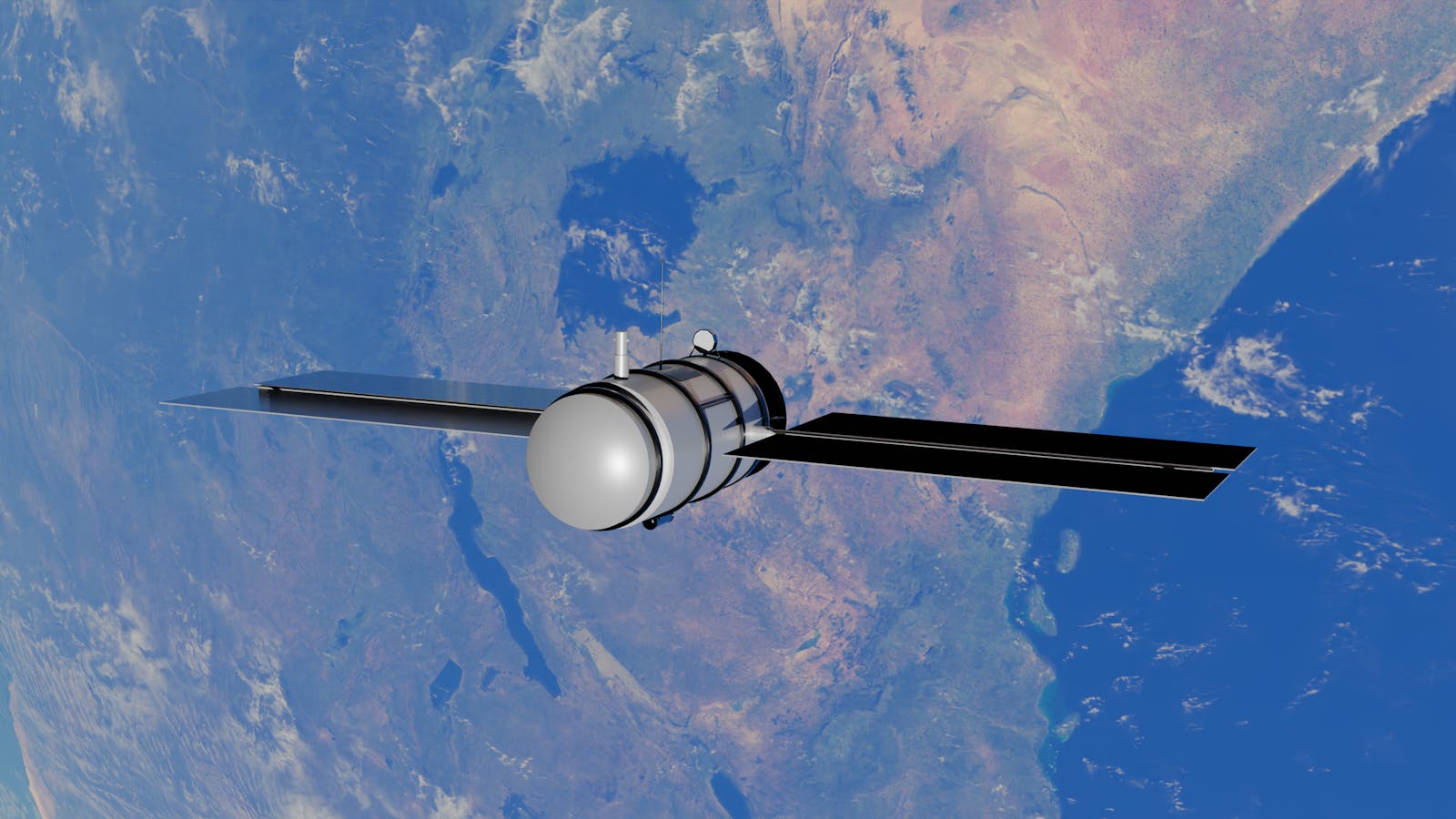
Rhea Space Activity, a Washington-based startup, has closed a $6 million Series A round to commercialize an autonomous navigation system that lets spacecraft fix their position by photographing other objects in orbit rather than relying on GPS. The funding, reported by SpaceNews, lands at a moment when the Pentagon is actively shopping for alternatives to satellite positioning signals that adversaries can jam, spoof, or destroy.
The round drew a mix of defense-adjacent and regional investors: Boston Global Space Tech Investors, Iron Prairie Ventures, Blackbird Capital Group, Purdue Research Foundation, New Mexico Vintage Fund, and SpaceFund. The investor list tells its own story. These are funds with ties to national security customers and state-level research pipelines, not generalist venture capital chasing a consumer moonshot.
What the money is buying
Rhea’s product is called AutoNav, a name borrowed from a lineage of autonomous navigation software originally developed at NASA’s Jet Propulsion Laboratory. JPL’s version of the technology is already driving on Mars, where it lets the Perseverance rover plot paths across unfamiliar terrain without waiting for commands from Earth. Rhea is adapting the underlying principle — have the machine figure out where it is by looking at what’s around it — for spacecraft and reentry vehicles.
The company’s approach uses onboard cameras to photograph moving space objects: satellites, moons, planets, asteroids, and comets. Software then matches those images against cataloged objects in the U.S. Space Force’s Unified Data Library to estimate position. According to the company, the system offers a reliable alternative when GPS and radio signals are unavailable.
The plasma sheath problem
The first real test happened on March 30, when a Rhea-built payload flew aboard Varda Space Industries’ W-6 reentry capsule. The capsule launched from Vandenberg Space Force Base on a SpaceX Transporter-16 rideshare carrying 119 payloads, according to SpaceNews reporting on the mission.
What makes Varda an unusual test partner is the physics of what its capsules actually do. W-Series vehicles reenter the atmosphere at speeds exceeding Mach 25, which creates a plasma sheath around the spacecraft. That sheath blocks GPS signals and radio communications — the same blackout period that has bedeviled every returning space vehicle since Mercury.
Rhea’s hosted payload comprised two cameras and a flight computer designed to collect imagery during hypersonic flight. The company said the launch would allow it to test its proprietary algorithm on a hypersonic vehicle. Rhea’s national security coordinator Elliott Sanders said celestial navigation through the plasma sheath is a reliable way for reentry systems to navigate during GPS and radio blackout periods.
That is not a commercial use case. It is a weapons use case.
Why the Pentagon is writing checks
The W-6 navigation experiment was funded by the Space Force and the Air Force Research Laboratory, and that sponsorship matters more than the $6 million headline. Varda’s reentry capsules experience temperatures and stresses comparable to those faced by advanced missile systems. AFRL has awarded Varda a multi-year contract to fly government payloads, effectively turning the company’s commercial manufacturing capsules into a repeatable hypersonic test platform.
For the military, a GPS-independent navigation system that works through plasma blackout is directly applicable to hypersonic glide vehicles and reentry weapons. China and Russia have both demonstrated hypersonic systems in the past several years, and the U.S. has accelerated its own programs. Any of them faces the same physics problem: GPS doesn’t work when you’re wrapped in ionized gas.
Satellite navigation itself is increasingly treated by defense planners as a compromised utility. Russian forces in Ukraine have jammed GPS signals across wide areas. Commercial aircraft over the Baltic and Eastern Mediterranean routinely report GPS spoofing. The assumption that a U.S. military asset can simply ask a GPS satellite where it is — and get an honest answer — no longer holds in contested environments.
The broader push for PNT alternatives
Rhea is one of several companies chasing what the Pentagon calls alternative PNT — positioning, navigation, and timing that doesn’t depend on GPS. The approaches vary. Some use ground-based signals. Some use quantum inertial sensors. Rhea’s optical celestial navigation borrows from the oldest navigation method humans ever developed, which is sailors sighting stars, and applies modern pattern-matching software to the problem.
The appeal for government customers is straightforward. Optical navigation is passive. It emits no signal, which means it cannot be jammed and does not reveal the vehicle’s position to an adversary. It also degrades gracefully: a camera that sees fewer stars still sees some stars.
The limitations are equally clear. Optical systems need a view of space, which means they struggle inside Earth’s atmosphere during daylight or through cloud cover. They require onboard catalogs of known objects, which must be maintained. And they require compute power on the vehicle, which adds mass and failure modes to systems that are already weight-constrained.
The commercialization question
Rhea’s bet is that defense demand will carry the technology through early development, and that commercial applications will follow. The company has separately announced plans to fly navigation payloads on a lunar lander mission, extending the same principle beyond Earth orbit where GPS has never been an option in the first place.
That second market is real. Cislunar operations — the growing slate of missions between Earth orbit and the Moon — have no GPS equivalent. NASA’s Artemis architecture, commercial lunar landers, and military cislunar surveillance concepts all need a way to navigate without Earth-based radio guidance. The agency’s broader communications infrastructure is already straining under demand in low Earth orbit, let alone beyond it.
Whether Rhea captures that market depends on execution. $6 million is a modest Series A by space-sector standards, and the company is betting that military contracts will fund the technology’s maturation while commercial cislunar demand catches up. The bet is reasonable. It is also the same bet that every dual-use space startup has made for the past decade, with mixed results.
What to watch next
The near-term test is whether AutoNav produced useful position data during the W-6 reentry. If the system tracked the capsule through the plasma blackout with accuracy comparable to GPS in benign conditions, Rhea will have a concrete performance claim to sell to follow-on defense customers. If it didn’t, the company has a narrower story about orbital navigation that is still valuable but less strategically urgent.
The longer-term test is institutional. The Space Force and AFRL have been willing to fund experiments. They have been less willing to commit to programs of record for alternative PNT, in part because GPS remains functional for most missions most of the time. Convincing the Pentagon to buy a second navigation system, at scale, requires convincing it that the first one can’t be trusted when it matters most. That argument is getting easier to make every year.
Photo by Zelch Csaba on Pexels