

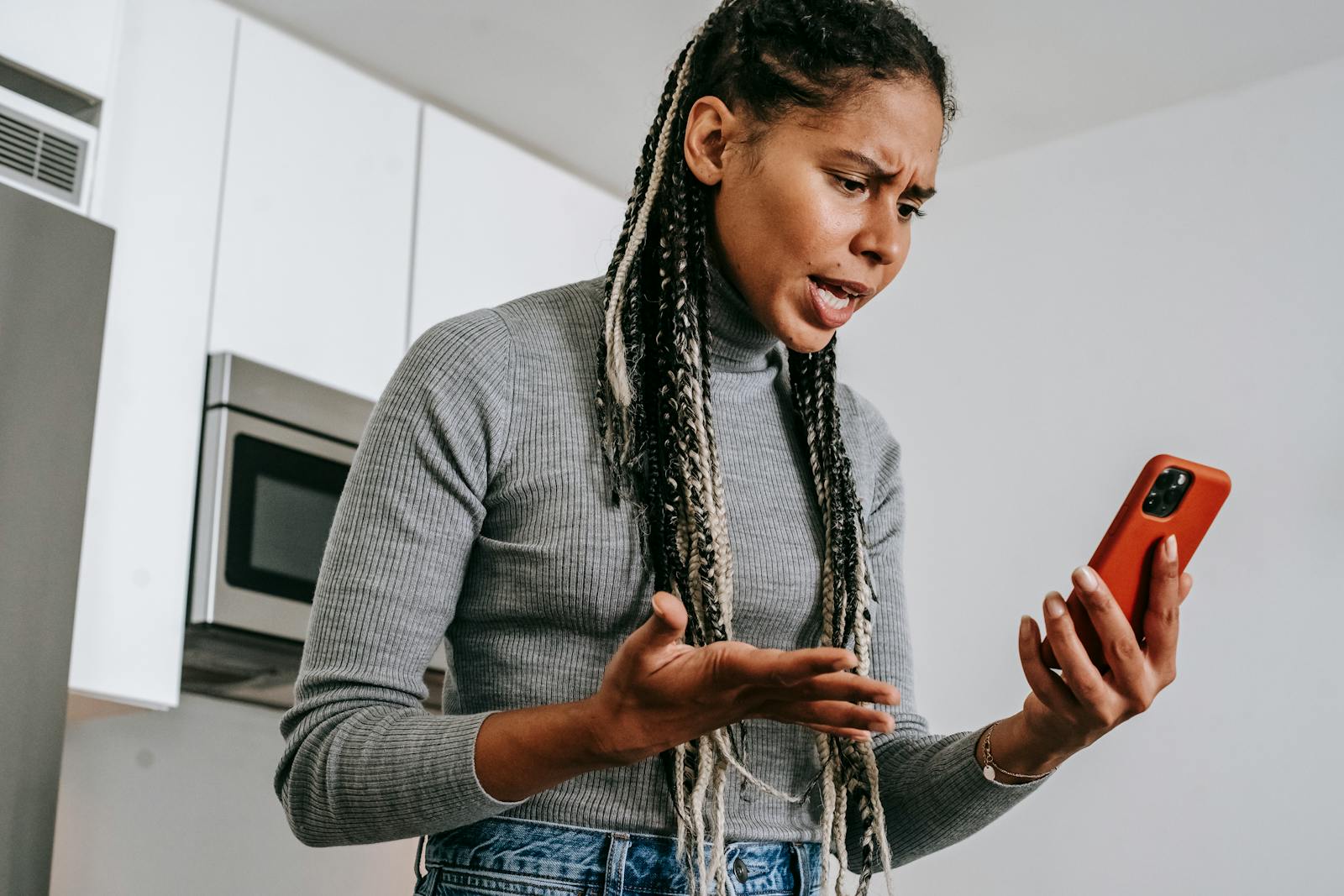
The phone lights up constantly. A friend’s meme gets a reply in forty seconds. A colleague’s scheduling question gets handled before the next meeting starts. But the text from someone close that asks, hey, how are you really doing? sits unread for three days, then unanswered for three more.
This is not laziness, and it is not disorganization. It is a specific kind of selectivity that most people don’t recognize in themselves until someone points it out.
The pattern hiding inside good manners
People who reply quickly to logistical texts are often genuinely considerate. They don’t want to leave a friend hanging. They don’t want to be rude. They know what a delayed reply feels like on the receiving end, and they refuse to be the cause of that feeling in someone else.
So they answer fast. Confirmations, jokes, links, calendar invites, restaurant suggestions. All handled.
Then a different kind of message arrives. Something softer. Something that doesn’t want information back, it wants them back. And the same person who replied to eight other texts that morning suddenly cannot find the words.
The delay is not avoidance of the sender. It is avoidance of the question.
Why emotional questions feel heavier than factual ones
A factual text asks for output. An emotional text asks for access. These are completely different transactions, even though they arrive through the same interface.
The psychologist Mark Travers has written about how people can be emotionally mature on the surface while remaining psychologically guarded about real closeness. They can articulate their feelings. They can communicate calmly. But the moment a conversation asks for something unresolved or messy, the machinery stalls.
Fast-replying to logistics is emotional maturity. Ignoring “how are you really?” is something else. It is emotional containment, dressed up as competence.
What the three-day delay is actually doing
The delay has a function. It gives the person time to prepare an answer that feels safe. By day three, the feelings the question stirred up have been processed, softened, edited. What gets sent back is not the truth of how they were doing when the text arrived. It is the truth they have now curated into something presentable.
This is selective disclosure in action. People share emotions they have already worked through. They avoid the ones that are still unresolved, tied to fear or rejection, or that would leave them exposed if the other person didn’t respond well.
Closeness grows not from talking about emotions but from sharing them before they are polished. The risk is what creates the intimacy.
A three-day delay is, in part, a strategy to remove that risk before answering.
Where the pattern comes from, and why the usual labels miss it
Most people who operate this way did not decide to. They learned it, early, in homes where different kinds of communication had different consequences. Logistical talk was safe. What time is dinner. Did you finish your homework. Where are my keys. These questions could be answered without risk. Emotional talk was not. It might be ignored, dismissed, mocked, or turned into a reason for someone else to feel burdened.
Children in those homes become fluent in the first register and cautious in the second. They grow into adults who are warm, responsive, reliable with facts, and quietly slow when feelings enter the conversation. As we’ve explored in a previous piece on people who say ‘I’m fine’ the fastest, this reflex is almost always built in childhood, when honesty about feelings turned out to be the slowest route to being heard.
Building on attachment theory, this maps closely onto what gets called a dismissive-avoidant style: people who see themselves as independent and self-reliant while being quietly dismissive of intimacy. They are not cold. They are not avoiding people. They are avoiding the specific moment where someone might need them to be emotionally reachable in real time. Logistics require presence. Emotional questions require availability. Those are not the same resource.
But it is tempting to stop at the label and move on, and that rarely helps. A 2025 piece in Psychology Today on why labeling partners ‘avoidant’ or ‘narcissistic’ tends to backfire makes the case that these categories, while descriptive, often flatten the specific history that produced the behavior. They turn a survival strategy into a character flaw. Most slow-responders to emotional texts are not avoiding intimacy in principle. They are avoiding a particular kind of exposure that once had a cost. The label tells you what the behavior looks like. It does not tell you what the behavior is for.
The particular shape of the three-day reply
When the reply finally arrives, it often has a distinct texture. It is longer than it needed to be. It opens with an apology for the delay. It summarizes a week’s worth of feeling into a tidy paragraph. It almost never asks a question back.
This is the polished version. The feelings have been processed, ranked, and filed. The other person is now receiving a report rather than a response.
The report is not dishonest. It is just late enough that honesty is no longer the same shape it was when the original question was asked. And it often means the real answer, the messy one, never gets shared at all. This connects to something I wrote recently about people who stay calm in every argument: composure, when it is built as a survival skill, always arrives a little after the truth would have.
Why it shows up with the closest people first
Here is the strange part. Casual acquaintances often get faster emotional replies than close friends or partners. A distant coworker asking how you’re holding up might get a short, honest sentence. A partner asking the same question might get three days of silence.
Closeness raises the stakes. The acquaintance doesn’t have the power to really see you. The partner does. And for someone whose early experiences taught them that being truly seen was risky, the person most equipped to see them is the person they most instinctively delay answering.
This overlaps with something we’ve explored before about people who find it easier to be needed than to be known. Being needed is logistical. Being known is exposure. The fast texter can do one of those with ease. The other one takes three days.
What actually shifts the pattern
The answer is not to reply faster. Forcing a quick reply to an emotional text usually produces something performative, a version of the feeling that has been rushed into acceptability. That is not intimacy, it is just speed.
What shifts the pattern is learning to send a small, honest placeholder. I saw this, I need a minute, I’ll come back to it. That sentence does two things at once. It acknowledges the sender. It also admits that the feeling is still forming.
Research on couples and communication suggests that what improves closeness is not the elegance of the answer but the reliability of the acknowledgment. A messy “I don’t know yet” told quickly beats a polished paragraph told late.
This is the skill that most fast-replyers never learned. They learned how to produce finished responses. They never learned how to show up mid-feeling.
The version that matters
My wife runs a company, and one of the things I’ve watched her navigate in building a team is the difference between people who respond and people who communicate. A fast reply is a response. Communication is something more specific. It is the willingness to say the true thing while it is still true, before it has been sanded into something easier.
The same distinction holds in personal relationships. Being responsive is a baseline of consideration. Being available is a different act entirely. It means letting someone catch you before you’ve composed yourself.
For someone raised to believe that composure is the price of being loved, this feels counterintuitive. But the people they love are not asking for a report. They are asking to be let in while the feeling is still in motion.
The small test
If you recognize this pattern in yourself, the next time a message arrives that asks how you are really doing, notice what happens in your body before you notice what you plan to type. There is usually a small tightening. A sense of needing to move away from the phone. That reflex is the pattern. Not the delay itself, but the flinch that precedes it.
The delay is not the problem to solve. The flinch is. And the flinch only softens when you discover, slowly, that the people asking can actually handle the unpolished answer. Most of them have been waiting for it the whole time.

That is what intimacy actually is. Not a better reply. A faster truth.

Photo by Alex Green on Pexels
