

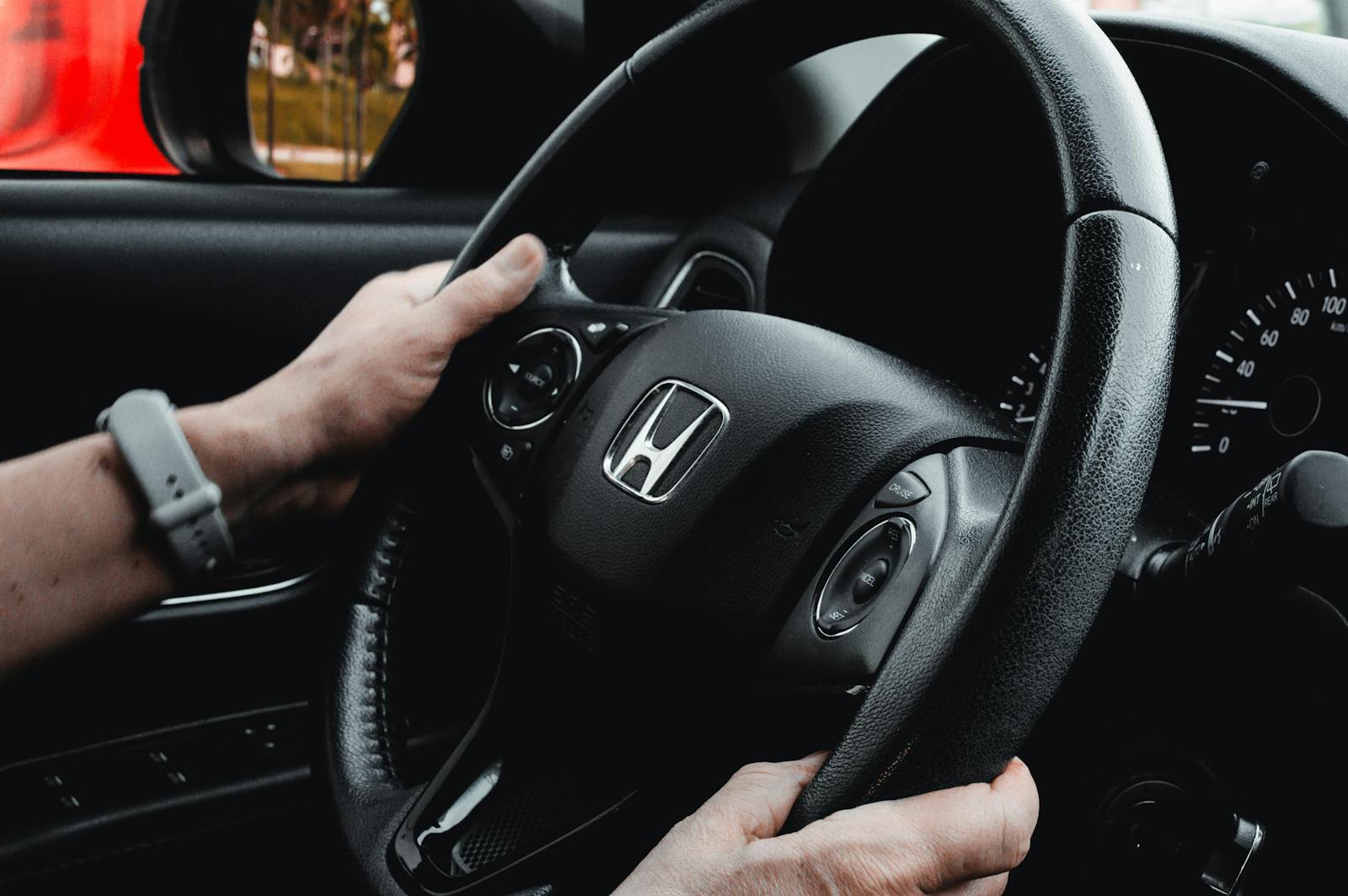
For years I told myself the half-tank rule was about prudence. Good drivers, I reasoned, don’t let things run down to fumes. It took a long stretch of therapy in my early fifties, around the same time I was learning that understanding depression doesn’t protect you from experiencing it, to admit the truth: I was not being cautious. I was managing an old fear about what happens when something runs out and somebody has to pay for it.
The half-tank habit looks like discipline from the outside. From the inside, it feels like prevention. You are preventing a specific scene, even if you cannot quite remember the original one.
The behaviour is rarely about the gas
People who refuse to let the needle slip below half almost never describe themselves as anxious. They describe themselves as practical, prepared, sensible. The story they tell is operational. Costco trip. Long commute. Snowstorms. The story underneath is older.
What I have seen, both in my own life and in the people I have studied in confined and high-stakes environments, is that resource-hoarding behaviours track back to households where running low on something predictably ended badly. The car running out of gas was not just inconvenient. It was the trigger for an argument that had been waiting all week for a reason to land.
A child who watched that pattern enough times learns something specific. Children learn something more specific than simple planning – they learn that when a meter hits zero, adults become unsafe.
Why the brain stores the rule, not the reason
Children are good at extracting rules from chaos. They are less good at remembering why they extracted them. By adulthood, the rule becomes a personality trait – you simply become someone who keeps the tank topped up. The fight in the driveway when you were nine has been filed somewhere you don’t visit.
This is consistent with the way hypervigilance functions as a learned, body-level response. In one widely shared thread, adults described listening for footsteps, doors, water in the pipes, cars in the driveway, scanning for threats they could no longer name. The half-tank rule is the same machinery, pointed at a fuel gauge.
The gauge is just easier to monitor than a parent’s mood.
Scarcity and conflict travel together
What makes resource anxiety stick is not scarcity alone. Plenty of children grow up with limited means and do not become adults who panic at a quarter tank. The variable is whether running out triggered conflict.
If the milk being gone meant a sigh and a trip to the corner store, the child learns that shortages are solvable. If the milk being gone meant a parent slamming a cabinet and another parent going quiet for two days, the child learns that shortages are dangerous. The shortage itself is almost incidental. The fight is the lesson.
Recent research finds that roughly two in five Australian adults report meaningful childhood adversity, with downstream effects on how they manage stress, conflict, and uncertainty for the rest of their lives. The numbers appear to be similar in other countries that measure childhood adversity, though data varies by region.
That is a lot of adults driving around with full tanks for reasons they cannot quite articulate.
The behaviour generalises
Once you notice the half-tank rule, you start seeing its cousins. The pantry that is always overstocked. The phone that never drops below 40 percent battery. The savings account with a buffer that is calculated not against any real expense but against a vague sense of catastrophe. The freezer with three backup loaves of bread.
None of these are pathological on their own. Many are useful. The tell is the emotional charge. If letting the bread run out makes you mildly annoyed, that is a preference. If it makes your chest tight, that is something else.
The mechanism is the same. A specific, controllable domain absorbs the anxiety that belongs to a larger, less controllable history.
The role of the witness child
One pattern I want to draw out, because it gets missed: the child who develops the half-tank rule is often not the child being yelled at. They are the child watching one parent yell at the other. Or watching one parent absorb the yelling in silence.
This is the witness position. Witnesses develop a particular kind of vigilance because they cannot intervene and cannot leave. What they can do is study the antecedents. They learn, with surprising precision, which conditions precede a fight: the bill arriving, the gauge dropping, the fridge looking empty on a Sunday night.
By twelve, they have an internal model of household triggers more sophisticated than most adults have of their own marriages. By thirty, that model is running in the background of every decision they make about resources. They are still trying to prevent the fight. The fight has been over for two decades.
Why intelligence does not protect you
I want to be honest about something. I am a researcher. I have read the literature on adverse childhood experiences, on hypervigilance, on the way conflict in the family of origin shapes adult behaviour. I divorced at 45 in part because I had spent two decades being more attentive to my work than to the person I lived with, and I still did not see the pattern in my own car habits until a friend pointed it out.
Knowing about something does not exempt you from it. The half-tank rule does not yield to insight alone. You can name it perfectly and still feel your shoulders drop when the gauge crosses below half on the way home.
What insight does is shorten the loop. You notice the feeling, you notice where it came from, you decide whether to act on it this time. Sometimes you still fill up. Sometimes you let it ride to a quarter tank and discover the world does not end. That is the work.
How current relationships change the meaning of old patterns
One of the more interesting recent findings on childhood adversity comes from research summarised in a Psychology Today piece on whether adult relationships can reshape memories of early trauma. Researchers at Michigan State found that when adults reported greater-than-usual support from their parents and lower household strain, they recalled fewer childhood adversities. Memory of the past was not fixed. It moved with the present.
According to research discussed in Psychology Today, when current relationships were going well, it appeared to soften people’s memories of the past, and when relationships were going poorly, the research suggested it intensified or brought to mind more painful recollections.
For someone with the half-tank rule, this matters in a practical way. If your current household is calm, if running out of milk produces a shrug and not a fight, the original threat starts losing some of its grip. The needle dropping below half stops feeling like a countdown. Not because you forgot. Because the present is no longer reinforcing the lesson.
The cost of the rule
Half-tank behaviour looks free. You are not hurting anyone, you are not even spending more money, you are just stopping at the pump twice as often. The cost is internal.
The cost is the small, constant tax of monitoring. It is the way you cannot fully relax on a road trip until you have seen a station in the last twenty miles. It is the way you cannot stop thinking about the fridge when you are trying to be present at dinner. It is the way “prepared” slowly becomes the only mode you know how to be in.
Vigilance gets misread the same way. We call it being responsible. The body knows it as something closer to a low hum of dread.
Distress tolerance is the underlying skill
What the half-tank rule is really about, at the level of mechanism, is low distress tolerance for uncertainty about resources. Research on Lebanese adults published in Nature has examined how distress tolerance mediates the link between childhood maltreatment and adult anxiety. The finding, in plain language: people who grew up in unstable environments often did not get to practise sitting with discomfort, because discomfort always escalated into something worse.
So as adults, they avoid the discomfort entirely. They keep the tank full so they never have to feel the small, manageable anxiety of seeing it run low. The avoidance works. It also keeps them from learning that they could tolerate it.
This is the trap. The behaviours that protect us from feeling old fear also prevent us from updating it.
What changes the pattern
Three things, in my observation. None of them are quick.
The first step is naming it accurately – not simply viewing yourself as careful, but recognizing you learned to do this because something specific happened in your household. Accuracy is harder than it sounds. Most of us prefer the flattering interpretation.
The second is small experiments. Letting the gauge slide to a quarter. Letting the bread run out. Noticing what you feel, not what you do. The point is not to abandon the rule. The point is to learn that breaking it does not summon the original fight.
The third is the relational piece, which the Michigan State research highlights and which is the hardest to manufacture on demand. Being in a current relationship, friendship, or household where running out of something is not a referendum on your character changes the texture of the old memory. It does not erase it. It contextualises it. Present-day safety can slowly reshape what felt non-negotiable.
What to do with this if you recognise yourself
You do not have to fix it today. You do not have to fix it at all. Plenty of people drive around with full tanks and live perfectly good lives, and the rule itself is not the problem.
The question worth sitting with is whether the rule is still serving the adult you, or whether it is still serving the child who first wrote it. If the answer is the child, you might consider, gently, that the child is not in charge of the car anymore. You are. And the fight you were trying to prevent ended a long time ago.
The needle can drop below half. Nobody is going to come home angry about it.
This is the part that always surprises people who do this work. The relief, when it comes, is not dramatic. There is no breakthrough scene. You just notice, one Tuesday, that you drove past the station at a third of a tank without flinching. And you keep driving.
That is what healing actually looks like, most of the time. A small, undramatic decision not to refill something. A quiet test of an old assumption. A growing sense that the original threat has expired and the rule can expire with it.
The body learns slowly. But it does learn. And the people who grew up listening for fights about resources eventually get to discover that silence, in adulthood, can mean nothing more dangerous than silence.
Photo by Ivett M on Pexels
