

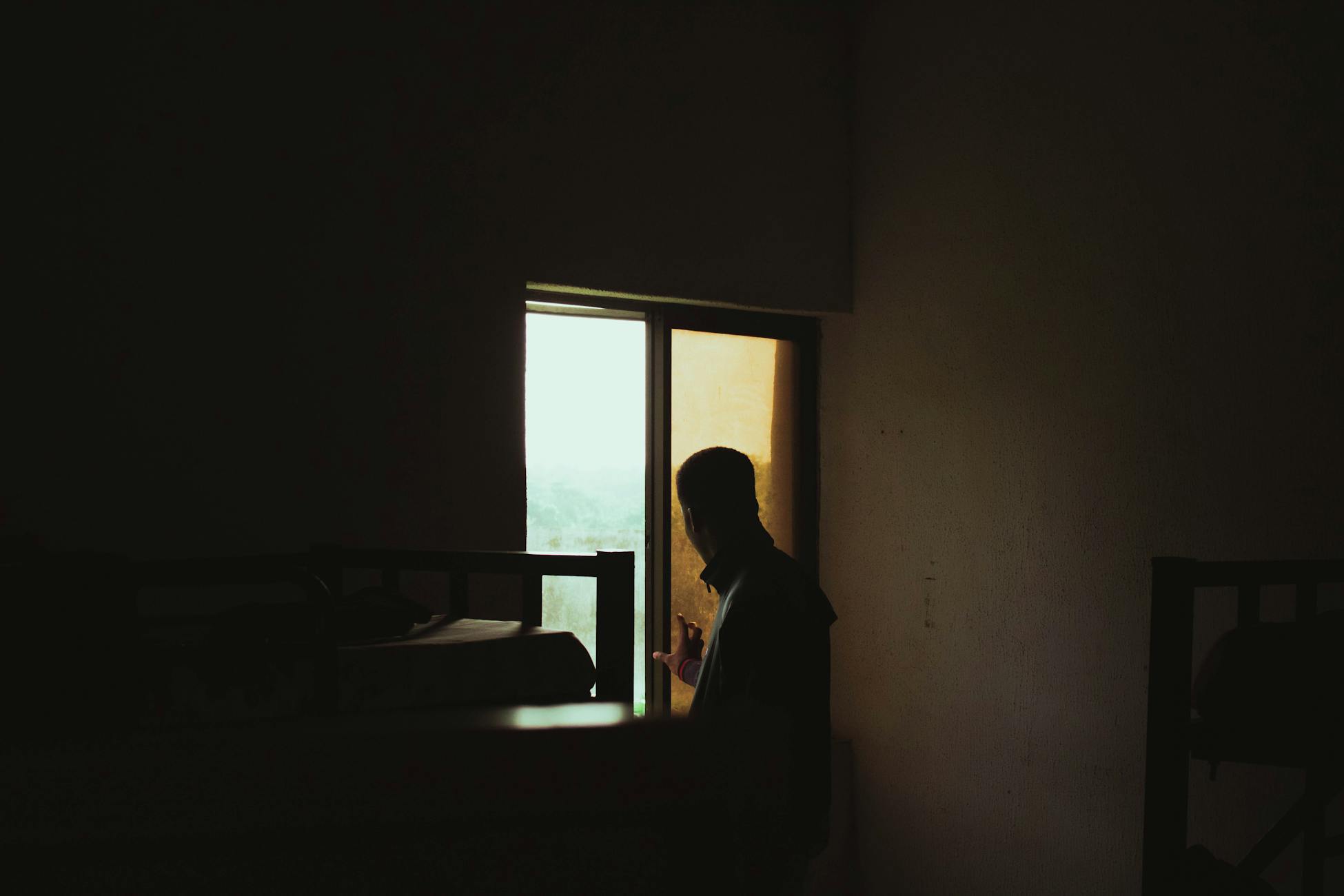
The most isolated person in any therapy-literate room is usually the one explaining their attachment style with the fluency of a TED speaker. They can tell you their childhood wound, their nervous system response, the specific kind of caregiver who shaped their adult patterns, and they can do it without their voice breaking, because the voice broke a long time ago and got rebuilt as a lecture. The articulation is the armor. The vocabulary is the wall. And what looks like the brave work of self-knowledge is often the most sophisticated form of staying alone we have ever invented.
I know this because I do it. I have done it on dates I do not remember being on. I have done it in my own marriage, narrating my avoidance to my wife with such clarity that she eventually told me she felt less like my partner and more like the studio audience for a one-man show about why I struggle to be a partner.
The conventional wisdom is that naming a feeling is the first step toward processing it. The vocabulary of mental health has filtered into ordinary speech with such success that twenty-something strangers at parties now describe themselves as anxiously attached the way an earlier generation might have described themselves as Capricorns. We are told this is progress. We are told the alternative is silence, repression, the man my father was, the men his father was, generations of throats closing around things that should have been said.
What nobody talks about is the second wall. The one that goes up after the first wall comes down. The one made entirely of language.
The diagnosis as performance
There is a specific cadence to it, and once you hear it you cannot stop hearing it. Someone tells you, with practiced ease, that they have a tendency to self-abandon in relationships because their primary caregiver was emotionally unavailable. They tell you they are working on regulating their nervous system. They tell you they have done the work. The sentences come out smooth, fully formed, the way a politician handles a question they have been asked four hundred times.
And you nod. Because what else can you do? They have told you something that, on paper, is intimate. They have disclosed. The transaction looks complete. But you walk away from the conversation knowing nothing about them you could not have learned from their bookshelf. You have not met them. You have met their cover letter.
Psychologists have a word for this, and it predates the wellness industry by about a century. Intellectualization is a well-established defense mechanism in the clinical literature, and it describes exactly this: the use of reasoning, abstraction, and analytical language to keep the felt experience of an emotion at a manageable distance. The feeling becomes a topic. The topic becomes a paper you have written in your head. The paper protects you from ever having to actually feel what the paper is about.
What’s new is not the defense mechanism. What’s new is that we have given it the moral aesthetics of healing. We treat the person delivering the polished diagnosis as if they have done something brave, when often they have done the opposite — they have found a way to talk about their pain that ensures nobody will ever touch it.
What the body wanted
I keep returning to a phrase I cannot improve on, which is that what most lonely people need is not insight but contact. Not understanding but holding. The body that has spent thirty years describing itself as dysregulated does not need another framework. It needs a hand on its back. It needs someone in the room who will not leave when the explanation runs out.
The science of human attachment is unglamorous in this regard. Physical proximity, repeated low-stakes contact, and non-verbal forms of attunement form the foundation of secure connection. None of those things are linguistic. None of them can be substituted with a more accurate description of why you struggle to receive them. Knowing why you flinch when someone touches your shoulder does not stop the flinch. It only gives the flinch a footnote.

I have written before about therapy language as a form of avoidance dressed in healing’s clothes, and the response I got most often was a kind of guilty recognition. People wrote in to say they had not realized they were doing it. They had thought they were being honest. They had thought the precision of their language about themselves was evidence of progress. What they discovered, on second look, was that the precision had become the whole event. They never moved past the diagnosis because the diagnosis felt like the destination.
The rumination trap
There is a strange and recent finding that complicates the standard story we tell about loneliness. Researchers at the University of Hong Kong reported in 2025 that ruminating about loneliness is more strongly associated with depression than the loneliness itself. Read that twice. The damage isn’t always being alone. The damage is the looped, articulate, self-aware monologue we run about being alone — the mental tape in which we explain to ourselves, with ever-increasing eloquence, what is wrong with our connections, what our caregivers failed to give us, what attachment pattern is currently running the show.
The articulation, in other words, is not neutral. It is not the harmless byproduct of trying to understand yourself. It is its own machinery, and at high enough volumes it produces the very thing it claims to diagnose. You ruminate yourself into a deeper version of the loneliness you started with, because the rumination is itself a form of being alone with yourself for too long.
This is the part that breaks the standard self-help narrative. We have been told that understanding precedes healing. That you cannot fix what you cannot name. There is something to this — naming is not nothing. But naming is also not enough, and at a certain point naming becomes the thing that prevents the next step. You have built such a sophisticated map of your interior that you have forgotten the map is not the place. You are still lost. You just have a beautifully annotated description of where.
The room where it doesn’t happen
I think a lot about a particular kind of room. It is the room where everyone has done some version of the work. Everyone has read the books. Everyone can speak the language. The conversations are full of holding space and capacity and boundaries, and the strange feature of these rooms is that despite all the disclosure, despite all the self-aware vocabulary, very little actual contact happens. People leave knowing each other’s frameworks but not each other’s faces.
I have been in those rooms. I have been the most fluent person in those rooms. I have walked out of meetings in which I narrated my interior with surgical precision and felt, in the elevator, a loneliness so complete it surprised me. I had performed intimacy. I had not had any. There is a real difference, and the body knows the difference even when the mind is too busy with its dictionary to notice.

This is part of what makes the most likable, most articulate, most emotionally fluent people the ones who often go home the loneliest. The skill that lets you describe your inner life beautifully is the same skill that lets you manage what other people see of it. You become very good at offering a version. The real thing stays untouched, partly because nobody can find it anymore, including you.
Why the language won’t save you
The Atlantic ran a useful piece a few years back arguing that attachment style is not destiny — that the categories are far less rigid than the social media version suggests, and that what changes attachment patterns is not insight but corrective experience. Repeated experiences of being met. Being held when you expected to be left. Being responded to when you expected to be ignored. The rewiring is relational. It happens in the body, between bodies. It does not happen on a page, no matter how lucid the page.
This is the part I had to accept about my own marriage. My wife did not need me to understand my avoidant patterns more thoroughly. She needed me to sit on the couch next to her without explaining why I was struggling to. She needed less commentary and more presence. The commentary, however accurate, was a way of staying outside the room while appearing to be in it. I was the narrator of our marriage. She wanted a husband.
I have come to believe that the people who can articulate their loneliness most precisely are often the ones who have spent the longest time finding ways to bear it alone. The vocabulary is a survival skill. It came from somewhere. It usually came from a childhood in which you had to explain yourself to be tolerated, in which feeling was not enough, in which the price of admission to your own family was a coherent account of why you were the way you were. You learned that articulation was protection. That if you could narrate your interior fast enough, nobody could use it against you, because you had used it first.
That skill keeps you alive. It also keeps you alone. Both things are true, and the second truth does not erase the first. It just means that, at some point, the skill that saved you starts costing you the thing it was supposed to protect. There are parts of us that were never safe to offer freely, and the language we built around those parts was built for good reason. But the language is not the part. The part is still in there, untouched, waiting.
What it would mean to stop explaining
I do not have a clean ending for this. I am 41 and I am still the person who, when something difficult happens, reaches first for the framework that will let me describe it before I have to feel it. I notice the reach now. That is the only progress I am sure of. I notice the moment my mouth opens to deliver a sentence about my interior that will keep my interior at a distance, and sometimes — not often, but sometimes — I close my mouth and let the silence do what silence does, which is to make room for someone to come closer if they want to.
The articulate lonely do not need better articulation. They need fewer words and more rooms. They need the experience of being received without having earned the reception through a beautifully constructed self-disclosure. They need someone to ignore the explanation and put a hand on their shoulder anyway.
The sentence I keep trying to say less often, in my marriage and in my friendships and in my own head: let me explain what’s happening for me right now. It is such a careful sentence. It sounds so much like progress. And it is, almost always, the last small move I make before disappearing again into the only place I have ever really lived alone, which is inside the part of me that knows exactly what is wrong and has not yet figured out how to be touched.
