

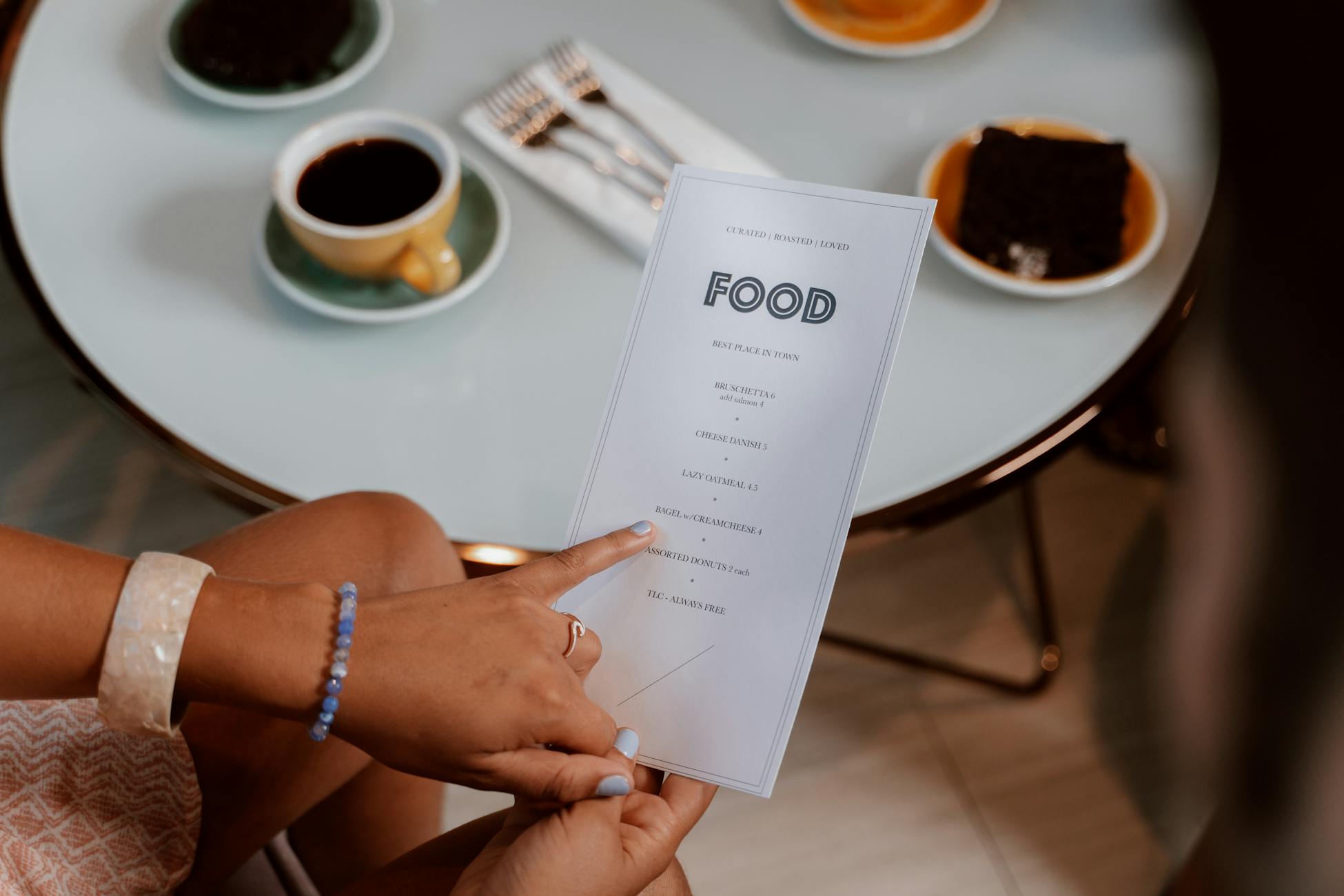
Marcus orders second-cheapest. He always orders second-cheapest. He is forty-one, a senior product manager at a company whose stock price he could quote without checking, and when the waiter at a steakhouse he did not pick reads the specials, Marcus is already scanning the right-hand column for the second-lowest number on the page. Not the lowest. The lowest signals desperation. The second-lowest signals restraint. He learned the difference before he learned to drive.
Most people assume this is just frugality, the kind of money-consciousness that fades once the paychecks get bigger. It doesn’t fade. The math his parents taught him at the dinner table — the silent calculation of what a meal out actually costs a household running on thin margins — has outlasted the conditions that produced it by twenty years. He earns six figures. He still cannot bring himself to order the ribeye.
This is the quietest inheritance of the lower middle class: a rule about menus that turned into a rule about rooms.
The Rule Was Never Really About Food
If you grew up in a household where the heating got turned down before guests arrived and turned up only after they left, you already know the texture of this. The rule about menus belonged to a larger curriculum. Don’t ask for seconds at someone else’s house. Don’t be the kid who needs the new sneakers. Don’t make your mother explain to the waitress why you changed your mind. The lesson wasn’t stated as a lesson. It was modeled, absorbed, ratified by the small sigh your father made when he opened the bill.
Children in these households learn to read the air. They learn that the menu is a document with two columns, and one of them is for other families. They learn to want within range. By the time they’re old enough to choose for themselves, the choosing has been pre-narrowed; the expensive options barely register as options. A friend once described it as a kind of internal redaction. The steak is on the page. She just cannot see it.
Researchers who study how money habits form trace this directly to childhood. The financial psychotherapist Vicky Reynal has argued that our adult relationship with money is essentially a record of what we watched our parents do with it, including what they refused to do, and what they apologized for doing. The refusals leave the deepest marks.
What Happens to the Body When the Bill Arrives
I grew up watching my parents run a dry cleaning business on margins so thin they were practically a rumor. We did not eat out often, and when we did, my mother would scan the menu with the same expression she used to read the ledger at the back of the shop: not browsing, auditing. She would tell me what was good. What was good was almost always between the third and fifth cheapest item. I did not understand at the time that she was doing me a kindness. She was protecting me from a freedom I could not yet afford.
The body remembers this kind of training before the mind does. Work on scarcity by behavioral scientists like Sendhil Mullainathan and Eldar Shafir has documented how a chronic sense of not-enough reshapes attention itself, narrowing what the brain even registers as available. A child raised inside that bandwidth doesn’t choose the cheaper option. The cheaper option is the only one their attention illuminated in the first place. The expensive ones existed in some other room, behind a door they were taught not to try.
This is part of why people from this background often describe the same physical sensation when a check is placed face-down on the table at a nice restaurant: a small, automatic flinch. Not because they cannot pay. Because the flinch was installed before payment was the issue. The nervous system is running a script written in a different decade, on a different income, by people who loved them enough to teach them to be careful.
How the Menu Rule Becomes a Room Rule
The thing nobody tells you is that the rule generalizes. A child who learns to order the second-cheapest entrée becomes an adult who orders the second-cheapest version of nearly everything: the apartment one notch below what they could comfortably afford, the car that won’t draw comment, the vacation that won’t require explaining. They are not cheap. They are calibrated. They have been trained to occupy a specific band of visibility, and stepping outside it feels — physically feels — like a violation of something more important than money.
Watch what happens when this person ends up in a room full of wealthier people. A work dinner. A wedding. A weekend at someone’s lake house. They do not relax. They run a continuous, low-grade calculation: what is appropriate to want here, what is appropriate to take, what level of enthusiasm signals gratitude without signaling that they have never seen a charcuterie board this large before. They defer on the wine selection. They insist they don’t need the bigger room. They wave off the second helping. They are not being polite. They are doing the menu rule, scaled up to the architecture.
The cost is mostly invisible. They will not be the person who looked uncomfortable. They will be the person who was "easy," "low-maintenance," "a great guest." What none of the wealthier people in the room will see is the small interior accounting that ran the entire evening. The continuous translation between what was offered and what could be accepted without owing something later. Refusing help in these settings is not modesty. It is risk management.
The Inheritance Nobody Lists in the Will
Money itself is only a fraction of what gets passed from parent to child. The Penn State research on how parents’ own childhood circumstances predict the financial decisions they make for their children decades later describes a kind of recursive inheritance: your grandfather’s anxiety about money becomes your father’s caution becomes your hesitation at a restaurant in 2025. The dollar amount changes. The posture does not.
This is part of what gets missed in discussions about class mobility. A person can move income brackets in a generation. The body’s relationship to those brackets takes longer. You can earn three times what your parents earned and still feel, in the deepest sense, that the dessert menu is for someone else. You can pay for the meal and still feel like a guest at it.

The children of these households often describe a particular kind of quietness in upscale settings. Not shyness exactly. A held breath. They have noticed something about the room that the people who grew up inside it cannot quite see: that there is a way of moving through expensive spaces that requires no internal calculation at all. The wealthier people are not doing math. They are simply ordering. The difference is so vast it almost feels like a different species of evening.
What the Rule Was Trying to Protect
It would be easy to read this as damage. A lot of writing about class trauma frames it that way — the parents got it wrong, the kid carries the wound, the work is to undo the lesson. I think that misreads what the lesson was for.
The menu rule was a piece of armor. Parents in the lower middle class understood something specific about visibility: that to want loudly, in public, when you couldn’t fully afford the wanting, was to make yourself available for a particular kind of humiliation. Ordering the most expensive thing on the menu wasn’t just expensive. It was a tell. It announced that you didn’t know how to be in the room. The rule was an attempt to teach their children to pass — not as wealthy, but as people who could not be embarrassed. It was love disguised as restriction.
The trouble is that armor doesn’t come off when the threat does. The same training that protected a nine-year-old from feeling exposed at a Sizzler in 1994 follows him into a corporate dinner in 2025, where nobody is going to embarrass him and the company is paying anyway. He still orders second-cheapest. The protection has outlived its assignment, and there’s no formal procedure for retiring it. There’s just the slow, private noticing of when it activates and what it’s actually responding to. Research on how socioeconomic background shapes children’s vigilance in unfamiliar settings suggests this scanning starts early and runs deep — long before the child could name what they were scanning for.
The Generation That Learned to Be Easy
You can spot the people who were raised this way in any room with a price ceiling above their childhood’s. They are the ones who say "whatever you’re having" when asked what they want to drink. They are the ones who insist they’re fine in the middle seat. They are the ones who, when handed a menu without prices at a friend’s wedding, get a brief flash of panic because the entire navigation system they were trained on has just been removed. I’ve written before about how love arrived with an invoice attached in households like this; the menu rule is the same invoice, just folded into the napkin.
They are also, for what it’s worth, often the easiest people to travel with, work with, share a meal with. The training produced real social fluency. It produced people who pay attention, who don’t make scenes, who know how to read what a host can actually afford to give. The cost is borne entirely by them, quietly, in the form of a low constant noise that never quite goes away. The thermostat stays a little lower than the room would like. The order stays second-cheapest. The room is fine. They are fine. Everyone is fine.
What I have noticed, watching friends in their thirties and forties begin to dismantle this, is that the freedom does not arrive all at once. It arrives in increments so small they barely register. The first time you order what you actually want. The first time you let someone pay for you without immediately calculating how to repay them. The first time the waiter reads the specials and you let yourself listen to all of them, including the one with the price that would have stopped your mother’s pen at the ledger.
None of this undoes the rule. It just stops obeying it once. The rule was designed to keep you safe in a room that no longer exists. Some afternoons, in the room you are actually in, you are allowed to forget it.
