

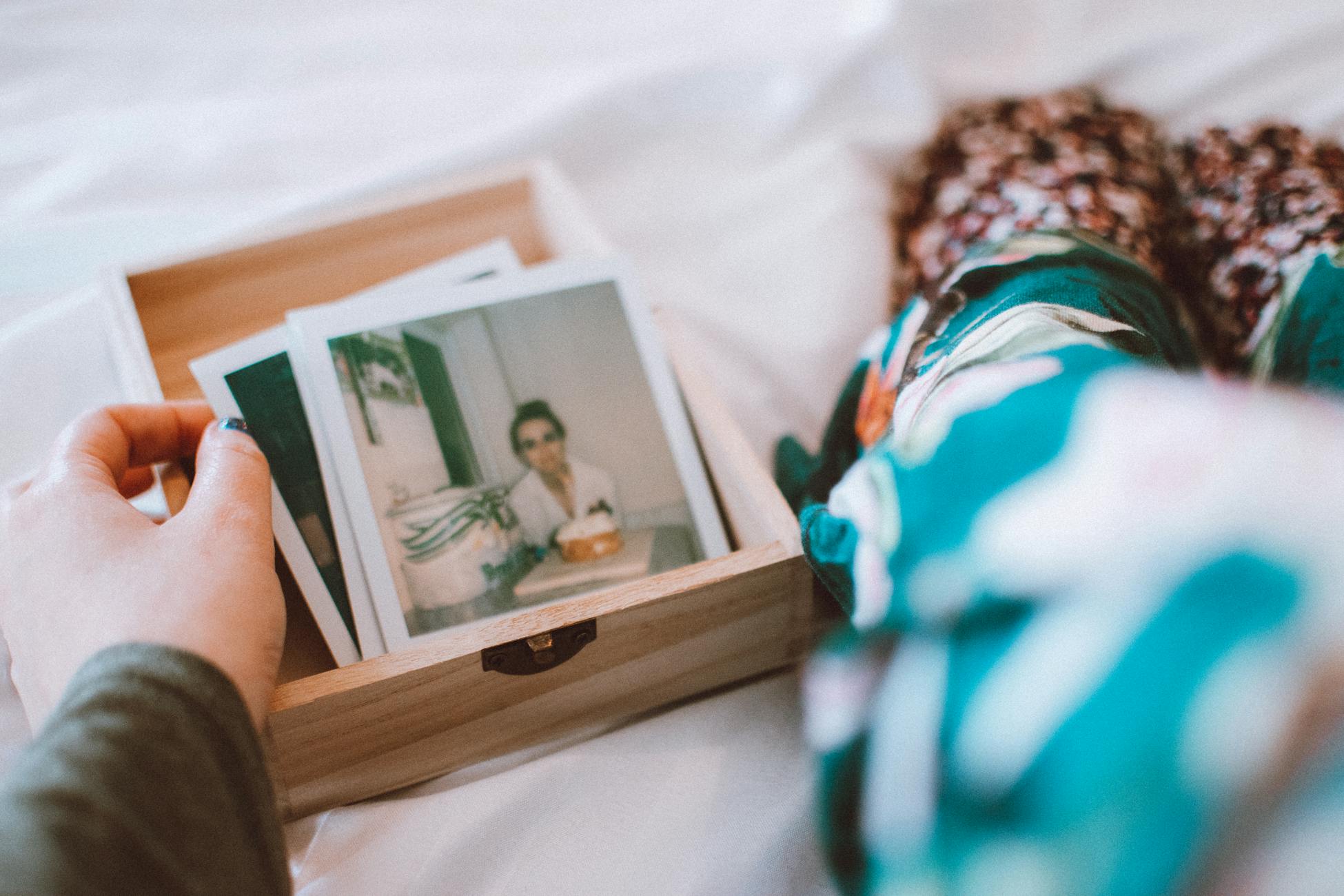
The shoebox lives on the top shelf of the closet in our second bedroom, behind a stack of tax returns I’ve been meaning to shred since the Obama administration. It’s a Reebok box, white and blue, the cardboard soft at the corners from being opened and closed for thirty-eight years. Inside are roughly four hundred photographs from 1987, the year I turned three. My wife asked me last weekend, with the careful neutrality immigration lawyers develop after years of asking people to part with documents they can’t replace, whether I had ever considered scanning them and throwing the box away. I said I would think about it. I have not thought about it. I have, instead, sat on the floor of that closet for the better part of two evenings, holding the box on my lap, and last night I finally understood what I have been protecting.
The conventional wisdom about why people can’t throw away old photographs is sentimental: nostalgia, attachment, the grief of time passing. That framing collapses when you actually look at what’s in the box. Most of the pictures are bad. Half of them are out of focus. There’s a series of about fourteen near-identical shots of a brown couch, presumably because someone in my family was learning to use the camera and didn’t realize the shutter was firing. There’s a thumb. There’s the inside of a lens cap. There’s a Polaroid of what I’m fairly sure is a pot roast.
These are not heirlooms. Nobody is going to want them when I’m gone. And yet I cannot bring myself to put them in the recycling, and last night, sitting on the closet floor at almost midnight, I figured out why.
They are the only proof I have that some afternoons happened at all.
The afternoons that no longer exist anywhere else
There is a photograph in the box of my mother and her sister sitting on a porch I have never seen in any other picture. They are laughing. There is a glass of something on the railing. The light is the specific late-summer gold that only exists between four and five-thirty in the Midwest in August. I do not know whose porch it is. I do not know what they were laughing about. I do not know who took the picture. My mother is no longer reliably able to tell me, and my aunt has been gone since 2011.
The photograph is the entire archive of that afternoon. There is no caption, no geotag, no metadata, no cloud backup. There is no Instagram story from a friend who happened to be there. There is no group chat where someone reminded others about that day at Linda’s because nobody was building a searchable record of their lives. The afternoon happened, and somebody pressed a shutter once, and that single frame is the entire surviving evidence that two sisters sat on a porch and laughed about something on an August day before I could form a memory.
If I throw the box away, that afternoon stops having ever happened.
This is not how photographs work anymore. My phone has 47,000 images on it. If I delete one, I have not erased a moment from history; I have removed one of approximately three hundred functionally identical pieces of evidence that the moment occurred. The afternoon is overdetermined. It is documented from four angles by three different people, geotagged, timestamped, captioned, reacted-to, archived in two clouds. The afternoon is not at risk of disappearing. The afternoon is at risk of never being looked at again, which is a different kind of erasure, but the proof of it survives.
What it meant when nobody was watching
Here’s what I keep coming back to. In 1987, my parents owned one camera. They bought film at the drugstore. They had to decide, before pressing the shutter, whether the moment was worth one of the twenty-four exposures on the roll. They had to drive the roll to a developer and wait a week and pay actual money to find out whether the picture had even come out. There was a real cost to documentation, which meant documentation was rare, which meant that when somebody did take a picture, they were making a small claim: this matters enough.
And critically — this is the part I sat with last night until my legs went numb — they were not making that claim for an audience. There was no audience. There was no platform. There was no possibility of a stranger seeing the photograph. The picture of my mother and aunt on the porch was taken for the people in the picture and the person taking it and possibly some grandchild who might, decades later, ask who that woman was. That was the entire intended viewership. Three or four people, across forty years.
I have spent most of my professional life thinking about how systems of documentation reveal what institutions actually value, and I missed the obvious thing about my own family’s archive: the photographs in the shoebox are the last record I have from a time when my family was not performing for anyone. Including themselves. Including each other. Including the future.
That is what I am protecting. Not the photographs. The pre-performance era they document.
The hoarding question, honestly asked
I should be honest about something. The behavior I’m describing — refusing to discard old objects with limited objective value, attributing private significance to things nobody else would want — is on the spectrum of what clinicians call hoarding behavior. I am not pathologizing myself; one shoebox does not a disorder make. But the underlying psychology is worth taking seriously, because the pattern of difficulty parting with possessions often involves experiencing the items as extensions of self and memory — not symbolic of the past but materially constitutive of it. The object is not a representation of the afternoon. The object is the afternoon, in the only form the afternoon now exists. To throw it away is not to lose a souvenir. It is to perform a kind of erasure on a piece of one’s own history.
A 2024 study on treatment for hoarding behavior found promising results from a ‘sensory CBT’ treatment strategy — essentially, having patients work with the sensory experiences associated with possessions, including confronting the fear that without the object, the past will not have happened.
This is also, I notice, why the behavior often begins in childhood or adolescence, in households where children may have experienced particular stressors or where the past felt unstable.
The asymmetry of generations
My wife is four years younger than I am. The earliest photographs of her exist in roughly the same medium as mine — drugstore prints, faded, scattered across her parents’ albums. But the earliest photographs of any child she might know now exist as digital files, taken by parents who were already, in 2010 or 2015, performing parenthood for an audience of relatives and acquaintances on Facebook. The photograph of the child on the swing is taken with the swing-photo genre in mind. It is composed. It is captioned. It is shared.
This is not a complaint about parents on social media. This is an observation about evidence. The photograph of my mother on the porch in 1987 has a quality the swing photograph cannot have, which is the quality of being unwitnessed. Nobody was watching except the person with the camera. The laugh on her face is not a laugh-for-the-camera. It is a laugh that the camera caught.

Almost no images produced after about 2007 have this quality. Even the candid ones are candid in a self-aware way. Even the ones taken without the subject’s knowledge were taken by someone who knew, in the back of their mind, that the image might be shared. The performance has become so ambient we no longer register it as performance. It is just how images get made now.
The shoebox is the last archive I have from before the performance became total. Once I throw it away, every image I own of anyone in my family will have been taken with some awareness of an eventual viewer. This is what I could not articulate until last night. I am not keeping pictures. I am keeping the last evidence of a way of being.
The afternoon as a unit of measurement
I’ve written before about how children of the 1980s learned to read adult moods through ambient cues — the slam of a door, the silence between two people in a kitchen, the way someone set down a glass. Those cues were data because nothing else was. There was no record of the conversation, no text thread to refer back to, no voicemail that could be replayed. You read the room because the room was the only document.
The same is true of the photographs. The shoebox is full of rooms that no longer exist, captured by people who were not trying to capture anything except a feeling that the moment deserved one frame of film. There is a picture of my father holding a beer at a barbecue, looking at someone off-camera with an expression I have never seen on his face in any other context. Whoever he was looking at is not in the photograph. I do not know who it was. I never will.
That picture is the entire surviving record of whatever was happening between him and that person on that afternoon. If the picture goes, the afternoon goes. There is no backup. There is no copy. There is no cloud.
The trouble is that this is true of almost every afternoon that happened to anyone before about 2005. The undocumented past is enormous. Most afternoons of most lives are simply gone. The photographs in the shoebox are not unusual because they survived; they are unusual because somebody pressed a shutter at all, on one of the four or five afternoons per year that anyone bothered. The default state of an afternoon in 1987 was: it happened, and then it was over, and nothing remained except whatever the people who lived it managed to remember.
What I am actually keeping
So I am not throwing the box away. I am also not, as my wife gently suggested, scanning everything and digitizing it, because the digital file is not the same object. The digital file is a representation. The print is the artifact — the physical thing that was in the room when the afternoon was happening, the object my mother held in her hand at the drugstore counter when she picked up the developed roll and said oh, that one came out nice.
I am keeping the box because it is the only evidence I have, and the evidence I have is already almost nothing. Four hundred photographs cover, optimistically, four hundred minutes of a year that contained 525,600 of them. The shoebox is not a comprehensive archive. It is a sample so small it barely qualifies as a sample. Throwing it away would not free me from the past. It would just make the past slightly more lost than it already is.
And maybe that is the honest version of what I figured out on the closet floor. Most of what happened to the people I love is gone. The afternoons are gone. The conversations are gone. The light on the porch is gone. What’s left fits in a Reebok box on a closet shelf, and when I’m gone it will probably end up in a landfill, and that will be the end of it. But not yet. Not while I can still open the lid and find a photograph of two women laughing on a porch in August, taken by someone who wasn’t trying to prove anything to anyone, on an afternoon that exists nowhere else on earth.
The box stays.
