

The most emotionally attuned adults in any room are usually the ones who learned, before the age of ten, that adult moods could change the weather of an entire house. They will tell you it’s a strength. Their bosses will praise it. Their friends will call them perceptive. What none of them are saying out loud is that this skill was not chosen. It was installed.
Most of the cultural conversation about the 1980s focuses on the iconography — the cordless phones, the latchkey afternoons, the shoulder pads, the Atari. Nostalgia has flattened that decade into a soundtrack. The conventional wisdom holds that kids of the 80s were resilient, independent, free-range in ways modern children are not, and that this produced a generation of self-sufficient adults who learned to entertain themselves and figure things out. That framing is not wrong. It is just incomplete in a way that matters.
What it leaves out is the radar. The thing those children were doing while they were riding bikes until streetlights came on and microwaving their own dinners. They were reading the adults. Constantly. With a precision most of them have never named.
The signals every kid learned to decode
The cigarette was a barometer. You could tell from the rhythm of it — slow drags meant tired, fast ones meant something had happened at work, a fresh one lit off the last one meant don’t ask about dinner yet. The brand of smoke in the air carried information about which parent was home, which mood had arrived with them, and how the next two hours were likely to go.
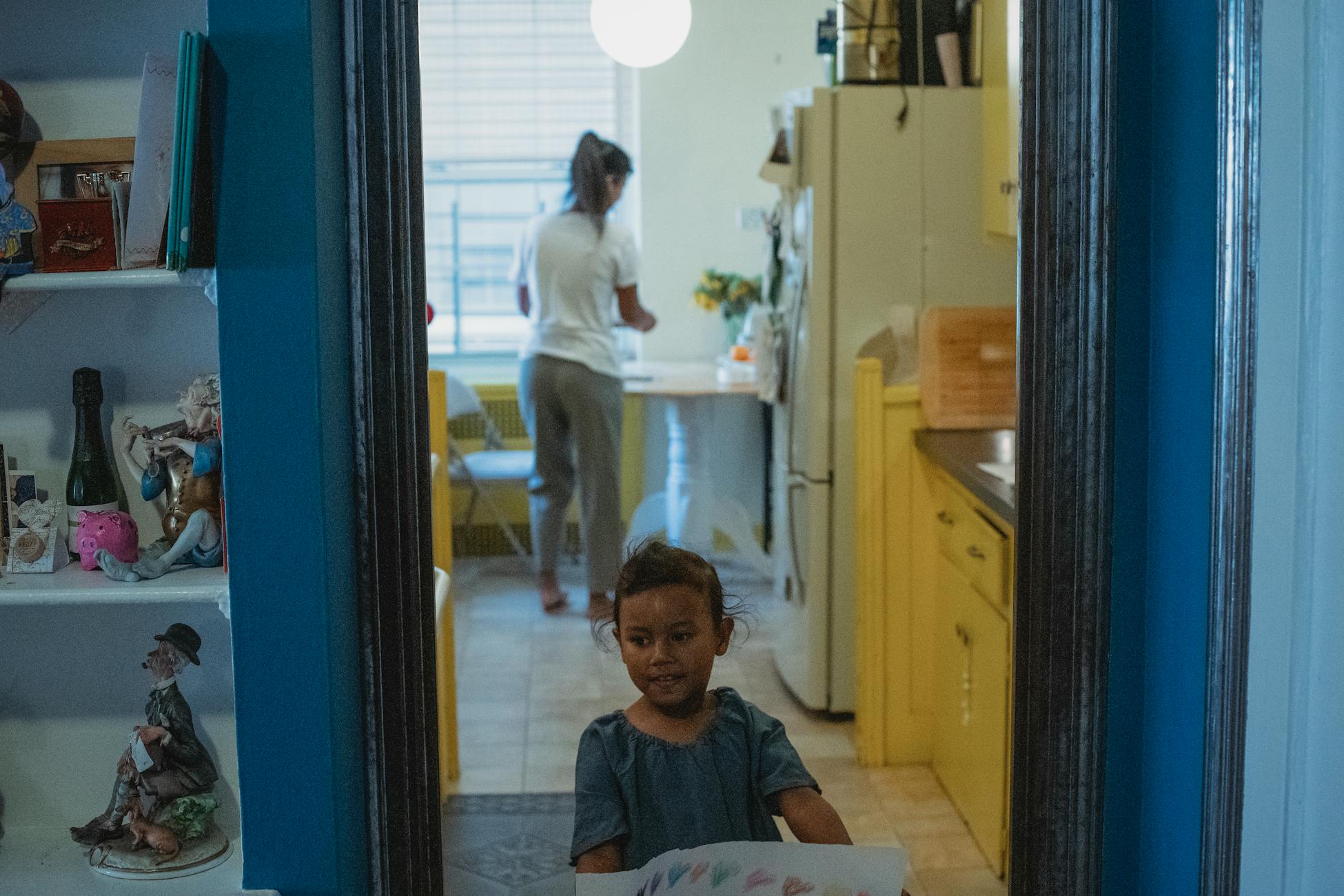
Kitchen silences had textures. There was the silence of someone reading the paper, which was safe. There was the silence of someone who had just gotten off the phone with a relative, which was not. There was the silence of two adults who had been arguing before you walked in, which was the most dangerous of all because it required you to act as if you hadn’t noticed while simultaneously adjusting everything about your behavior to match what you had noticed.
And the front door. The front door was a whole language. The speed of the key in the lock. Whether the door was pushed shut or allowed to swing. Whether keys were set on the counter or thrown. Whether the briefcase landed soft or hard. By age seven, most children of that decade could tell you within ninety seconds of a parent’s arrival what kind of evening was coming. They did not consciously know they were doing this. They just knew where to be, and what voice to use, and whether to ask about the permission slip now or wait until Saturday.
This is what psychologists now call nervous system dysregulation when it shows up in the adult version. In the child, it had a different name. It was just paying attention.
Why the radar got installed in the first place
The 1980s were a particular cocktail. Divorce rates had peaked. Economic anxiety from the recessions of the early decade had not fully receded. Adults still smoked indoors, still drank at dinner with a regularity that would horrify a contemporary pediatrician, and still operated under a parenting model that did not include the language of emotional attunement. The phrase "how did that make you feel" was not yet in heavy domestic rotation. Children were expected to be fine. The adults had problems. The kids were supposed to read the room.
And they did. With staggering accuracy. Research on adverse childhood experiences has tracked, over the last two decades, the long-term physiological consequences of growing up in households where the emotional weather was unstable enough to require constant monitoring. The findings are not subtle. The body keeps running the program long after the threat is gone.
That last part is the part nobody warned them about.
To the child, hypervigilance felt like a useful skill. It got you through dinner. It told you when to disappear into your room and when it was safe to ask for a ride to the mall. It made you, in many cases, the favorite — because you were "easy," because you "never gave us any trouble," because you "just knew." The praise reinforced the system. The system grew teeth.
The operating system, thirty-five years later
Fast forward to the conference room. The dinner party. The first date. The Slack channel. The 80s kid is now in their late thirties to mid-fifties, and the radar has not been turned off. It cannot be. It was wired in before they had a self to wire it into.
Watch one of them in a meeting and you will see it. They register the boss’s mood within the first eight seconds of the call. They notice when a colleague’s tone has shifted. They can tell when a client is unhappy before the client knows they are unhappy. They are often the ones managing the emotional temperature of the room without anyone, including themselves, acknowledging that this is a job they are doing.
The trouble is that the same apparatus that reads other people so accurately is almost completely useless for reading the self. I’ve written before about how children who grew up monitoring a parent’s mood often become adults whose interoception is broken — they can detect a sigh through a closed door but cannot detect their own exhaustion until they are already sick. The dial is calibrated outward. It was never set up to point in.
This is the operating system. It is why so many people in their forties describe a chronic, low-grade depletion they cannot account for. They are running a real-time threat assessment on every social environment they enter, and the assessment was designed for a 1987 living room, not a 2024 open-plan office. The threats are different. The radar does not know that.
What the radar gets wrong
Here is what the kids of the 80s, now grown, are still doing. They walk into rooms and scan. They notice who is annoyed. They adjust. They modulate their voice based on whose attention they need. They preempt. They apologize early. They are exquisitely attuned to disappointment in others, and almost completely numb to their own.
The radar gets a lot right. It also gets one big thing catastrophically wrong: it treats every irritated colleague, every sharp text from a friend, every silent partner across the dinner table as if they were a parent in 1986 about to make the next two hours unsafe. The nervous system does not know the difference. It just runs the program. Family interaction patterns, the research suggests, get encoded long before language and persist long after the original family is gone.
Which means a forty-two-year-old man can find himself, in a meeting about quarterly projections, monitoring his director’s facial expressions with the same hyperfocus he used to monitor his father’s keys in the lock. He will not know he is doing this. He will think he is being professional. He will be exhausted by 3 p.m. and not know why.

The cost of being good at it
The cruelty of this system is that it works. The radar produces results. People who run it tend to be successful in fields that reward emotional attunement — management, sales, therapy, hospitality, journalism, teaching. They are often described as gifted with people. They are. They paid for the gift in a currency they did not know they were spending.
What they spent was access to themselves. Childhood emotional neglect, even of the soft, ambient, nobody-meant-any-harm variety that defined a lot of 1980s households, leaves a particular signature in adulthood: a person who is fluent in everyone else’s emotional language and a stranger to their own. They can identify your feelings in a sentence. They cannot identify their own in a week.
Some of them figure this out at forty. Some at fifty. Some never. The ones who do figure it out usually describe the same disorienting experience: realizing that the skill they were most praised for is also the thing that has been quietly costing them their life. That the "sensitivity" that made them the family confidant, the company peacemaker, the friend everyone calls in a crisis, was never sensitivity in the romantic sense. It was a survival adaptation that outlived its original threat by three decades and kept running anyway.
What recognition costs and what it gives back
This is not an essay with a fix. There isn’t one, exactly. You cannot uninstall an operating system that was loaded before you had the password to your own machine. What you can do — and this is what the people who get to fifty with their nervous systems mostly intact tend to do — is start naming what the radar is doing in real time. Noticing that the tightness in your chest at the team meeting is not about the team meeting. Noticing that the urge to apologize before anyone has expressed displeasure is information about 1986, not about now. Noticing the way you still scan a room before entering it, and asking, just once, what exactly you are scanning for.
The cigarette smoke is gone. Most of the kitchens have been remodeled. The front doors of those houses belong to other families now, or to nobody, or to the slow process of watching parents age into people who no longer hold any of the weather they once held. The threats those rooms contained, real or imagined, have largely dissolved.
The radar has not. It is still scanning. Still cataloguing. Still adjusting the volume of its host’s voice based on whose footsteps it hears in the hallway. The work, if there is work, is teaching it that the war is over. That the door closing now is just a door. That the silence in the kitchen now is sometimes just silence. That the person it has spent forty years protecting is allowed, at last, to be the one being read.
