

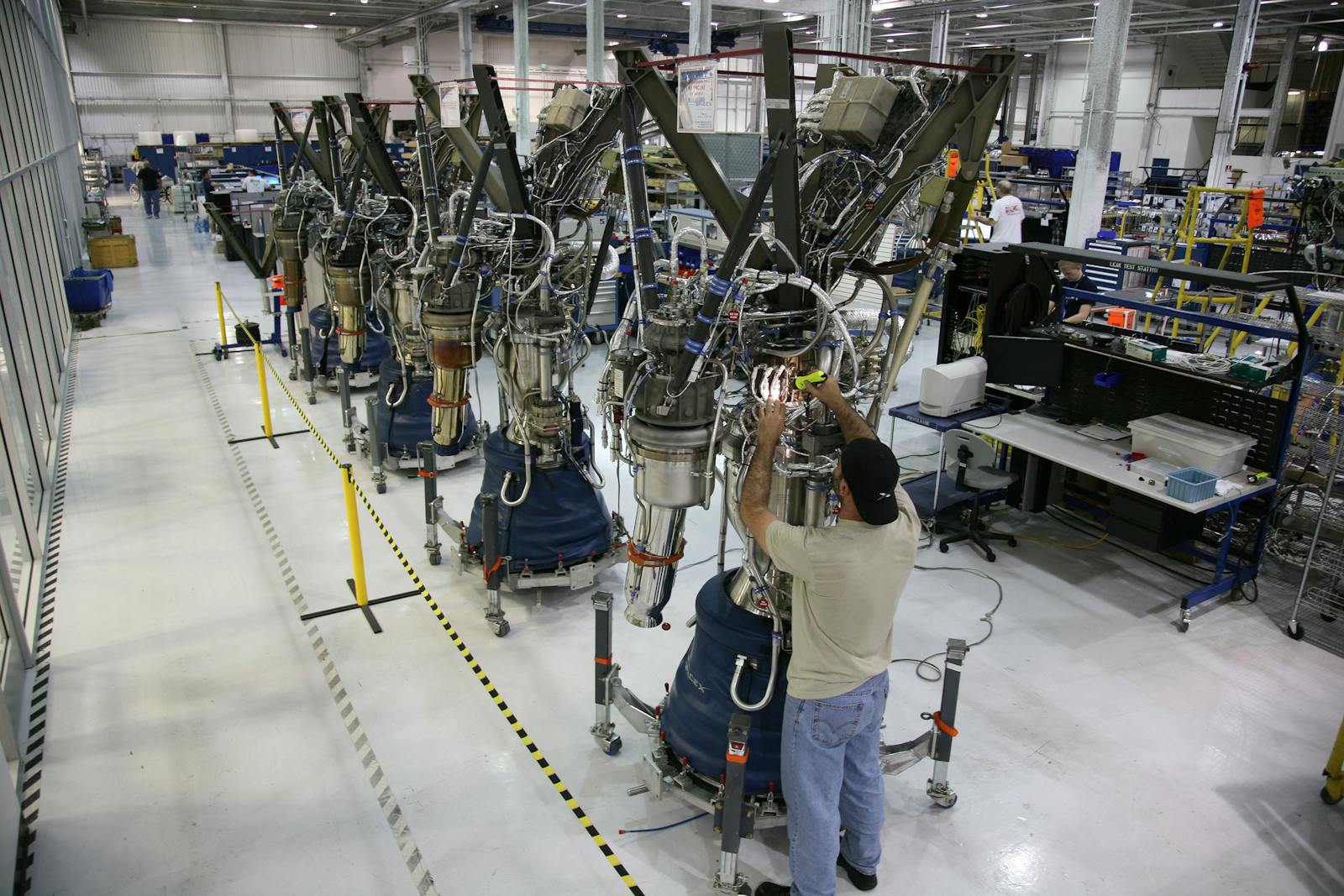
NASA has moved to raise the ceiling on its Commercial Lunar Payload Services contract from $2.6 billion to $4.2 billion, a 61% jump that signals the agency intends to buy far more robotic Moon landings than its current cadence supports. The increase, disclosed in a procurement filing on SAM.gov, is the contractual scaffolding for an ambitious new flight rate: nine landings in 2027 and ten in 2028, in service of NASA’s Moon Base initiative.
That target is not primarily a budget story or a policy story. It is an industrial story. Going from two lunar landings a year to ten in thirty-six months is a manufacturing problem, and the contract ceiling raise is meaningful only to the extent that CLPS providers can transform themselves from bespoke spacecraft shops into build-to-print production lines. Everything else — the funding, the politics, the science manifest — is downstream of whether that industrial transition actually happens.
The math behind the contract modification tells the story plainly. According to SpaceNews, NASA has awarded task orders worth less than $2 billion across the life of CLPS so far. At the recent pace of roughly two task orders per year, the original $2.6 billion ceiling would have just barely been exhausted by the contract’s 2028 expiration. Lifting the cap to $4.2 billion buys headroom for a different program entirely, one where landers fly monthly rather than semi-annually.
From bespoke missions to build-to-print production
The CLPS program, awarded as an indefinite-delivery/indefinite-quantity vehicle, currently has eligible U.S. companies competing for task orders. Each task order has historically funded what could be described as a somewhat bespoke lander, tailored to its specific payload manifest. That model works at two missions per year. It does not work at ten.
The shift NASA is asking for is industrial, not just financial. Going from custom-built spacecraft to standardized, repeatable production is the same transition the launch industry made over the past decade, and it carries the same engineering implications: tighter supply chains, frozen interfaces, payload accommodations defined by published specs rather than negotiated mission-by-mission.
Eddie Seyffert, director of civil space at Blue Origin, framed the response directly during a panel at the Lunar Surface Innovation Consortium spring meeting, describing the company’s approach as a move toward standardized, build-to-print production sized to NASA’s anticipated demand. Ben Bussey, chief scientist at Intuitive Machines, speaking on the same panel, identified supply chain readiness as the binding constraint on cadence, and predicted that higher flight rates would force convergence across the lander fleet on common interfaces and components.
What Joel Kearns is actually buying
Joel Kearns, deputy associate administrator for exploration in NASA’s Science Mission Directorate, was asked about the procurement filing during an April panel and said he was not familiar with the specific document. His framing of the underlying need was nonetheless explicit: the agency is targeting a roughly monthly cadence of lunar surface deliveries to support Moon Base, and is pursuing near-term procurement options in parallel with the CLPS 2.0 follow-on competition.
Two things are happening in parallel. NASA is expanding the existing CLPS contract, which expires in 2028, to absorb near-term demand. It is simultaneously preparing a follow-on vehicle, CLPS 2.0, with a sources-sought notice issued in January gathering industry input on the acquisition strategy, according to GovCon Wire. The contract ceiling raise is essentially a bridge, designed to keep the procurement pipeline flowing while the agency negotiates the architecture of the next decade.
The cadence problem
The numbers expose a gap between contractual intent and demonstrated capability. Two CLPS landers flew in 2025, one each from Firefly Aerospace and Intuitive Machines. Up to four are projected for 2026, with Astrobotic, Blue Origin, Firefly, and Intuitive Machines all on the manifest, though slides shown at a NASA Ignition event indicated only two landings were firmly on the books for that year.
Going from four to nine in a single calendar year (2027) requires more than additional contract authority. It requires that landers currently in early integration today be on the pad inside roughly 24 months. The Intuitive Machines IM-5 award, announced at Ignition, is not projected to launch until 2030, per Aviation Week’s reporting. That gap between award and flight is the cadence problem in miniature.
It is also a reminder that lunar landing remains an unforgiving engineering problem. Intuitive Machines’ first Nova-C mission reached the surface but tipped over on a hard landing. Firefly’s Blue Ghost touched down successfully and returned data that has already forced revision of fifty-year-old thermal models of the lunar interior. Each mission teaches the next, but the learning curve does not bend just because a contract ceiling rose.
Industrial capacity is being built ahead of the orders
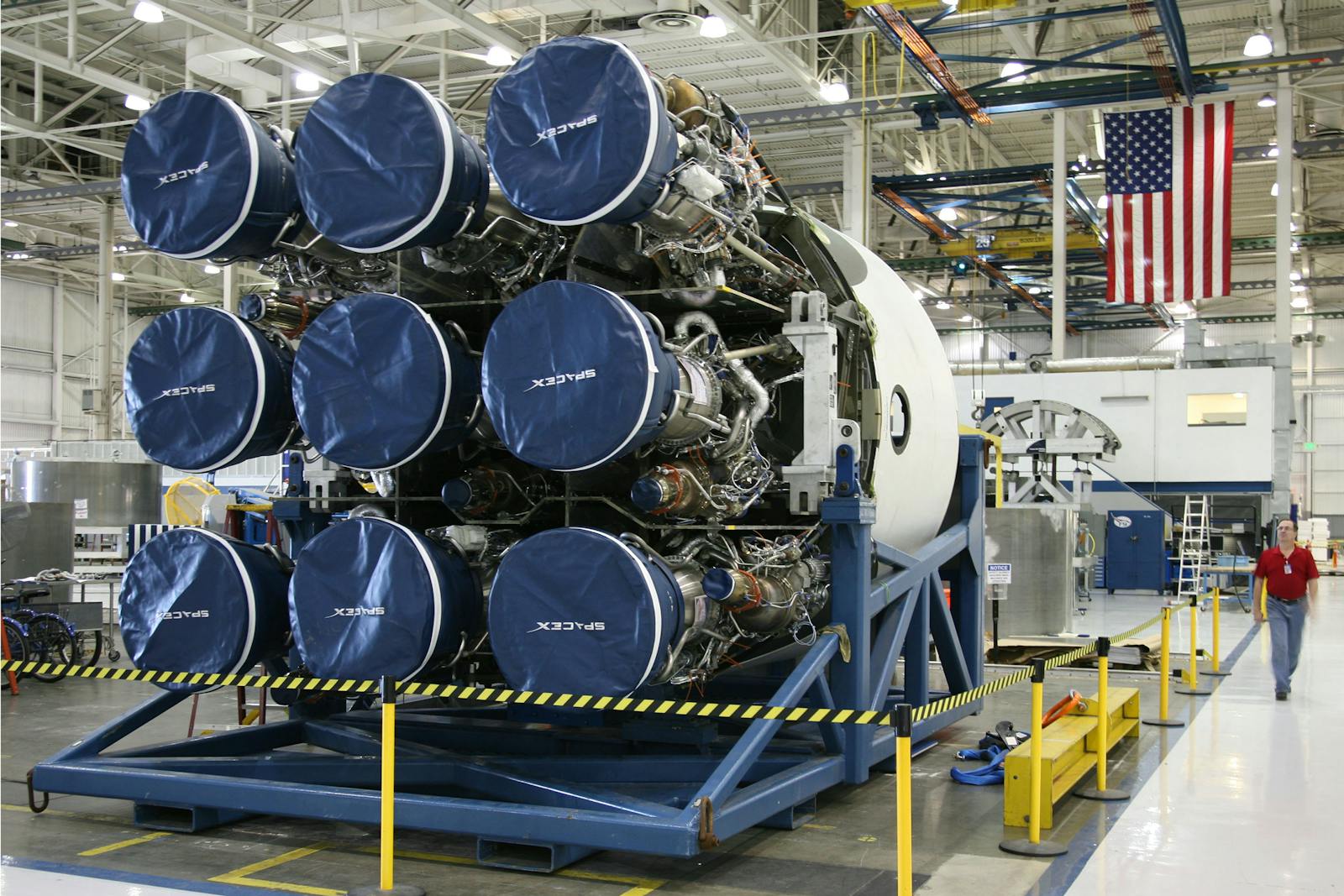
The CLPS providers are scaling facilities now, on the assumption the orders will follow. Firefly has reported that Blue Ghosts 2, 3, and 4 are in production, with expanded clean room space sized to hold up to eight spacecraft simultaneously. Blue Origin’s Lunar Plant 1 in Florida occupies significant square footage dedicated to lander manufacturing. The first Blue Moon Mark 1, named Endurance, has completed thermal vacuum testing at Johnson Space Center, with the second Mark 1 already in component manufacturing for the VIPER rover delivery in 2027.
Astrobotic has indicated its facilities are designed to support multiple concurrent lander development programs. The basic infrastructure exists. The question is whether NASA’s task order flow arrives at a rate that justifies keeping it staffed and tooled.
Standardization as the lever
Monthly landings, the target Kearns named, is a manufacturing rate, not a mission rate. Achieving it requires the lander to become more like a satellite bus and less like a science instrument: a stable platform with defined mass, power, thermal, and mechanical interfaces that payloads accommodate, rather than the other way around. Bussey’s prediction of standardization, and Seyffert’s commitment to build-to-print, both point at the same operational truth. You cannot fly ten landers a year if each one requires bespoke integration analysis.
This is the same logic that governs any high-cadence space program. SpaceX did not reach weekly Falcon 9 flights by hand-tuning each vehicle. CLPS providers are now being asked to make the same transition, on a compressed timeline, for hardware that has to survive a propulsive landing on a body where roughly half of recent attempts have failed in some way.
The budget context nobody is naming
The CLPS expansion arrives at an awkward moment. The same agency proposing monthly lunar landings is simultaneously absorbing proposed cuts that would dismantle significant portions of its science pipeline, and Artemis itself has slipped, with the crewed landing now targeting 2028 rather than the earlier dates. Robotic CLPS missions are cheaper than crewed flights, which is part of the appeal: they let NASA show progress on Moon Base while the human program negotiates its own delays.
The contract ceiling raise is therefore a hedge as much as a commitment. If the funding materializes and the providers deliver, NASA gets a robotic infrastructure on the lunar surface in advance of the crew. If either falters, the agency has at least preserved the option.
But the central question this contract modification poses is not financial. It is whether four American companies can, in roughly twenty-four months, complete the same industrial transition that took the launch sector a decade — converting hand-built spacecraft into production articles on a frozen design. The factories are up. The contract ceiling is up. What remains is the harder work: the interface freezes, the supplier qualifications, the parts commonality decisions being made on engineering whiteboards this quarter. That is where the 2027 manifest will be won or lost, and it is the only place it can be.
Photo by SpaceX on Pexels
