

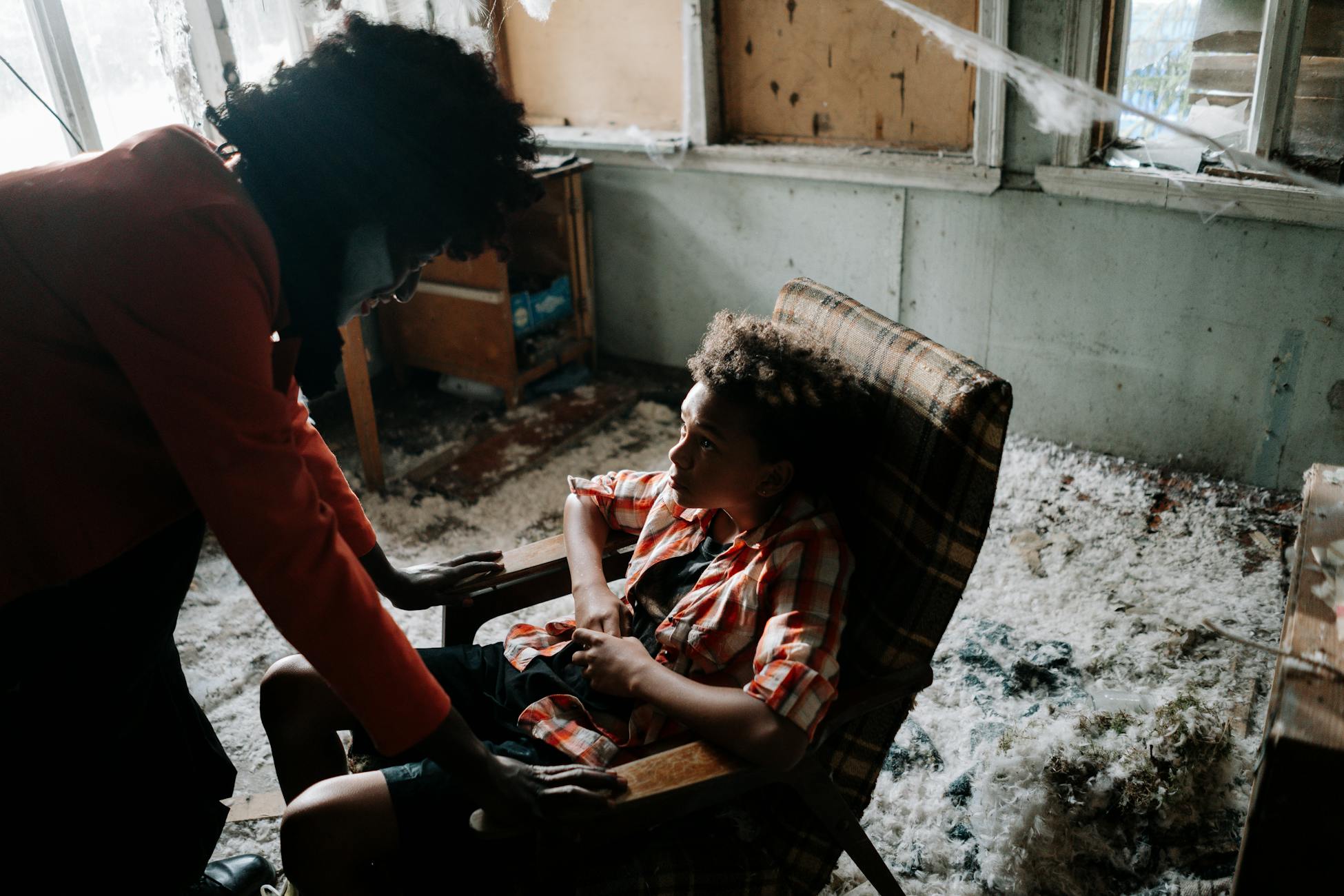
David, a forty-three-year-old structural engineer I’ve known since college, can tell you within three seconds of his wife answering the phone whether her morning meeting went well, whether she’s hungry, whether something her sister said is still sitting in her chest. He does this without thinking about it. He has done it his entire life. What most people don’t know about David — what I only learned over a long dinner about his father — is that he developed this skill the same way other children learned to ride bikes: by needing to. His father drank. The footsteps on the basement stairs at 6:47 each evening sounded different depending on what kind of day it had been at the plant, and David, the oldest of three, learned to translate the cadence before his father reached the landing. Heavy and even meant safe. Heavy and uneven meant disappear. Light and quick meant something almost worse, the manic cheerfulness that always preceded a tantrum about something nobody else had noticed.
He calls it intuition now. His wife calls it being thoughtful. His coworkers call him the one who reads the room. None of them know that what looks like a personality trait is actually a piece of equipment installed in a child who didn’t have the option of installing anything else.
The misreading we’ve inherited
The conventional wisdom on empathic men treats them as a softer subspecies — gentler temperament, lower testosterone, maybe a more artistic disposition, the result of supportive mothers and emotionally available fathers who modeled tenderness. The framing is too generous. It assumes empathy is a flower that grows in good soil. For a meaningful percentage of the empathic men I know, that’s not the origin story at all. The soil was bad. The flower grew anyway, because something in the household required a child to be exquisitely tuned to the emotional weather of an adult who could not be predicted.
This matters because we keep telling these men they are lucky. We keep framing their attentiveness as a gift their wives and friends benefit from, as though the capacity arrived in the mail. The men themselves often nod along, because the alternative — looking directly at where the skill came from — is harder than accepting the compliment.
What the research is starting to say
Developmental psychologists have spent decades trying to map what happens to children raised in unpredictable homes, and the picture that’s emerging contradicts a lot of older assumptions. A new developmental theory out of Iowa State argues that our memory and perception of trauma isn’t fixed at the moment of impact — it evolves, shifts with new cognitive equipment, gets re-encoded as the person grows. Which means the boy who learned to read his father’s footsteps doesn’t simply carry that skill forward unchanged. He refines it. He generalizes it. By thirty he can read his boss, his wife, his friend’s marriage, the mood of a dinner party. The hypervigilance becomes craft.
Researchers studying adverse childhood experiences and emotional intelligence have started naming this directly. Children exposed to certain kinds of household stress — parental substance use, unpredictable anger, the specific combination of a volatile parent and a household that pretended otherwise — often develop emotional intelligence scores higher than peers raised in stable homes. Not because suffering is good for you. Because reading other people accurately was, at one point, the difference between a calm evening and a bad one.
The research on ACEs has been clear for a while that these experiences track with adult mental health difficulties. What’s less talked about is the parallel finding: the same children often develop interpersonal radar that adults envy. Both things are true. The radar is real. So is the cost of having needed it.
The specific architecture of these households
The houses I’m describing weren’t always violent. Often they weren’t violent at all. What they were was unpredictable in a particular direction — the adult mood was the weather, and the weather determined what the children were allowed to want, say, ask for, or feel. In one house it was a father whose work stress translated into withering sarcasm at the dinner table on Tuesdays but not Wednesdays. In another, a mother whose depression meant the seven-year-old learned to say I’m not really hungry when there wasn’t food in the fridge, sparing her the shame of having to admit it. In a third, a father whose drinking was theoretically a secret but whose footsteps on the stairs told the truth.
The boys in these houses developed a specific cognitive habit. Before speaking, they ran a calculation: what does this person need to hear right now in order for the next ten minutes to go okay? They got good at it. They got so good at it that the calculation became invisible to them — it stopped feeling like a calculation and started feeling like personality.
I’ve written before about children who grew up monitoring a parent’s mood for safety, and the asymmetry that develops in them between outward attunement and inward awareness. Empathic men raised in these conditions often display the same split. They can name what their wife is feeling before she can. They cannot tell you, with any reliability, what they themselves are feeling. The instrument was calibrated to face outward. Turning it around takes years, and most of them never do.
Why this gets confused with personality
There’s a useful distinction in the trauma literature that almost nobody outside therapy rooms has heard of. Researchers have started separating personality from trauma coping strategies, arguing that we routinely mistake the second for the first. The man who is reliably gentle, attentive, conflict-averse, and tuned to others’ needs is read as that’s just who he is. But personality and survival strategy can produce identical surface behaviors for entirely different reasons, and the distinction matters because one is durable and the other is exhausting to maintain.
Genuinely empathic-by-temperament men exist. Some boys are born with high baseline sensitivity to emotional cues, and grow up in homes that nurture rather than exploit it. They tend to look the same on the outside as the boys who developed the skill under duress. The tell is internal. Temperamentally empathic men can turn the dial down. They can be in a room without scanning it. The boys who developed empathy as a survival adaptation often cannot. Their nervous systems are still on the staircase, still translating the footsteps, even when the staircase is forty years and a thousand miles away.
What gets missed when we praise the wrong thing
The cultural script around emotionally attuned men right now is congratulatory. We’ve spent enough decades complaining about emotionally unavailable fathers and partners that any man who can sit with a feeling, name it, and respond to it gets framed as a kind of evolutionary upgrade. The compliment isn’t wrong. The framing is incomplete.
What it misses is that a meaningful number of these men are not flourishing. They are working. The attentiveness that looks effortless from outside is, on the inside, a continuous low-grade scan that started in childhood and never stopped. They get tired in ways their partners don’t see. They go quiet at parties not because they’re introverted but because they’ve been reading every face in the room for two hours and their processor is hot. They struggle to identify what they want for dinner because the muscle they have most developed is the one that asks what do you want for dinner, and the muscle that knows their own preferences atrophied in childhood from disuse.
A study on how boys respond when their masculinity feels threatened found that aggression often emerges as a learned protective response rather than an innate trait. The interesting inverse, less studied but visible everywhere, is the boys who learned the opposite lesson — that any expression of their own needs invited disaster, so they routed all that energy into managing the people around them. Two boys in two houses, both reading the room, one taught to dominate it and the other taught to soothe it. Same vigilance. Different output.
The kindness that costs something
I think often about a friend whose father was a high-functioning alcoholic — the kind nobody outside the family knew about, the kind who held a senior job and was respected at his church and was, in the privacy of the house, completely unpredictable from one evening to the next. My friend, now in his late forties, is one of the kindest men I’ve ever met. He listens with a quality of attention that makes people feel briefly more interesting than they are. His marriage is good. His friendships are deep. He has, by every external measure, made it.
He told me once, after a few drinks, that he doesn’t know what he likes. Not in any deep philosophical sense — he means it literally. He doesn’t know what music he prefers when nobody’s around. He doesn’t know what food he’d order if he weren’t checking what the table was getting first. He has spent so much of his life as an instrument tuned to other people’s frequencies that his own signal has become hard to locate. He laughed when he said it. The laughter was the part that stayed with me.
This is the cost that doesn’t show up in the studies and rarely shows up in the marriages, because the wives of these men are usually getting the best version of someone else’s childhood adaptation. The work being done on adult children and the parents who shaped them is starting to acknowledge that the legacy of an unpredictable parent isn’t just fear or anger — it’s a particular kind of competence that the adult never quite learns to put down.
What changes when a man sees this
Not much, immediately. Recognition isn’t repair. The men I know who have done this work — who have looked at their attentiveness and seen the staircase underneath it — describe the realization as more disorienting than freeing at first. The empathy doesn’t go away. They don’t want it to. It’s genuinely useful, and the people in their lives genuinely benefit from it. What changes is the relationship to it. They start to notice when they’re scanning a room they don’t need to scan. They start to notice the fatigue. They start, very slowly, to ask themselves what they want before they ask anyone else.
The boy who learned to read footsteps doesn’t stop being able to read footsteps. He just begins, sometime in his forties, to notice that the house is quiet now. That nobody is coming up the stairs. That the skill he built to survive a specific evening in 1987 has been running, uninterrupted, for thirty-six years. And that he is allowed, finally, to put it down for a few hours at a time, even if he has to learn how.
If you know a man like this, the kindest thing isn’t to praise his attentiveness. It’s to ask him, occasionally, what he wants. And to wait, without filling the silence, while he tries to remember.
