| . |  |
. |
| . | |
. |


 By Issam AHMED Washington (AFP) July 7, 2021
A record-breaking heat wave that hit the western United States and Canada at the end of June would have been "virtually impossible" without human-caused climate change, according to an analysis by a group of leading climate scientists. The World Weather Attribution group said that global warming, caused by greenhouse gas emissions, made the heat wave at least 150 times more likely to happen. Pacific Northwest areas of the two countries saw temperatures that broke records by several degrees, including a Canadian record of 49.6 degrees Celsius in the village of Lytton, which was subsequently mostly destroyed in a wildfire. "There's absolutely no doubt that climate change played a key role here," Friederike Otto, a climatologist at the University of Oxford said during a press conference discussing the findings. To investigate whether climate change played a role, the scientists analysed historical observations and computer simulations to compare the climate as it is today, after about 1.2 degrees Celsius (2.2 degrees Fahrenheit) of global warming since the late 1800s, with the climate of the past. They found the observations were so extreme they lie far outside the range of historically observed temperatures. But with the climate of today, it was estimated the event could take place once in a thousand years. Looking into the future, if the planet were to warm by two degrees Celsius (3.6 degrees Fahrenheit) -- which could happen as early as the 2040s at the current rate -- heat waves like these would occur every five to ten years and be around a degree Celsius (1.8 degrees Fahrenheit) hotter. - Two theories - The heat wave meant that last month was the hottest June on record in North America, according to data released by the European Union's climate monitoring service on Wednesday. The death toll isn't yet known but is thought to run into the hundreds. The researchers suggested two broad explanations for how climate change made the stunning heat more likely. The first was that, while climate change made the event more likely to occur, it remains an extreme outlier. In this explanation, pre-existing drought that deprived the area of evaporative cooling, together with a slow-moving high pressure system in the atmosphere called a "heat dome," were supercharged by climate change. According to this theory, without the influence of climate change, the peak temperature would have been about 2 degrees C (3.6 degrees Fahrenheit) lower. The second hypothesis is more dire: that the climate system has crossed a threshold where a small amount of overall global warming is now causing a faster rise in extreme temperatures than has been observed so far. "Everybody is really worried about the implications of these events because this is something that nobody saw coming that nobody thought possible," said co-author Geert Jan van Oldenborgh of the Royal Netherlands Meteorological Institute. "We feel that we do not understand heat waves as well as we thought we did," he said, adding it might mean that such temperatures are also possible at other high latitude locations such as northern Europe, the rest of the US, China and Japan. This meant that adaptation plans need to be designed for temperatures well above the range witnessed in the past, the team warned.
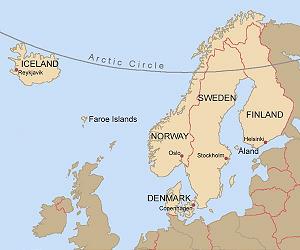
Heatwave hits Nordic countries, 34C recorded in Arctic Stockholm (AFP) July 5, 2021 Meteorologists across the Nordic countries have registered near-record temperatures over the weekend, including highs of 34 degrees Celsius (93.2 degrees Fahrenheit) in some places, news agencies reported Monday. The latest figures came after Finland's national meteorological institute registered its hottest temperature for June since records began in 1844. Kevo, at the far north of Finland, recorded heat of 33.5 degrees Celsius on Sunday, the hottest since 1914 when authorities registered 34.7 ... read more
|
|||||||||||||
| The content herein, unless otherwise known to be public domain, are Copyright 1995-2026 - SpaceDaily. All websites are published in Australia and are solely subject to Australian law and governed by Fair Use principals for news reporting and research purposes. By using our websites you consent to cookie based advertising. If you do not agree with this then you must stop using the websites from May 25, 2018. Privacy Statement. Additional information can be found here at About Us. |


 del.icio.us
 Digg
Digg Reddit
 Google







