| . |  |
. |
| . | |
. |


 by Staff Writers Dresden, Germany (SPX) Apr 06, 2020
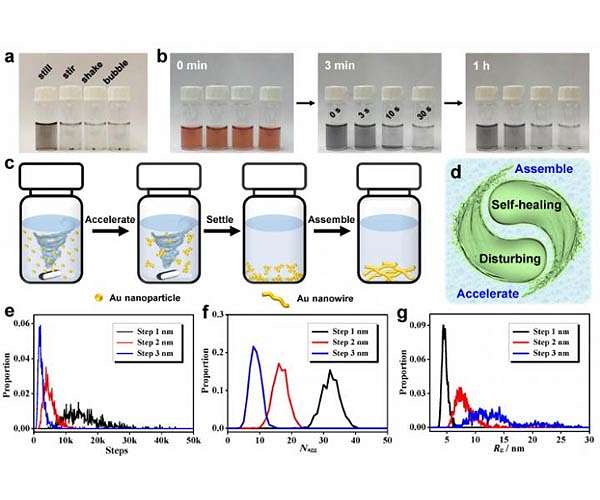
Electrocatalysis is one of the most studied topics in the field of material science, because it is extensively involved in many important energy-related processes, such as the oxygen reduction reaction (ORR) for fuel cells, the hydrogen evolution reaction (HER) for green hydrogen production, and the oxygen evolution reaction (OER) for metal-air batteries. Noble metal aerogels (NMAs) emerge as a new class of outstanding electrocatalysts due to the combined features of metals and aerogels. However, the development of these porous materials has yet been impeded by the sluggish fabrication methods, which require several hours to even several weeks. In addition, the unique optical properties of noble metals, for instance the plasmonic resonance, have so far been ignored in NMAs, limiting their potential high performance in electrocatalysis. Ran Du from China is an Alexander von Humboldt research fellow working as postdoc in the physical chemistry group of Professor Alexander Eychmuller at TU Dresden since 2017. Together, they recently revealed an unconventional self-healing behaviour in noble metal gels, which is rare in the solely inorganic gel systems. On this basis, a counter-intuition method was developed for tremendously accelerating the gelation speed. Their pioneering findings were published in the renowned journal Matter. Ran Du and his team developed an unconventional and conceptually new strategy for rapid gelation: a counter-intuitive disturbance-promoted gelation method. The in situ introduction of a disturbing field during the gelation greatly facilitates mass transportation and induces accelerated reaction kinetics. Upon removal of the disturbing field, the resulting gel pieces can re-assemble to a monolith in light of the self-healing property. In this way, the transportation barrier in presence of traditional gelation methods is overcome, leading to a gelation within one to ten minutes at room temperature without affecting the microstructures of gels. This is two to three orders of the magnitude quicker than traditional approaches. The mechanism was also supported by Monte Carlo simulations. Notably, the disturbance ways can be expanded to shaking and bubbling, and the method is applicable to various compositions, such as gold (Au), palladium (Pd), rhodium (Rh), gold-palladium (Au-Pd), gold-palladium-platinum (Au-Pd-Pt), and morphologies, for example the core-shell structure or homogeneous structure. Moreover, Ran Du took advantage of the combined optic and catalytic activities of noble metals: "We also were first to demonstrate the photoelectrocatalytic properties of NMAs by using ethanol oxidation reaction (EOR) as a model reaction, displaying an activity increase of up to 45.5 % by illumination and realizing a current density of up to 7.3 times higher than that of commercial palladium/carbon (Pd/C). Thus we pioneered the exploration of photoelectrocatalysis on NMAs opening up new space for both fundamental and application-orientated studies for noble metal gels and other systems."

World Centric announces new World Centric leaf fiber lids Rohnert Park, CA (SPX) Mar 30, 2020 World Centric told Terra Daily that it has launched its new World Centric Leaf fiber lid collection for hot and cold cups & bowls. Made from unbleached plant fiber, the new collection replaces the use of conventional, petroleum-based plastic lids to provide a truly 100% compostable solution for foodservice operators. World Centric is introducing the World Centric Leaf fiber lids at the 2020 International Restaurant & Foodservice Show of New York, with availability nationwide starting in March 2020 ... read more
|
|||||||||||||
| The content herein, unless otherwise known to be public domain, are Copyright 1995-2026 - SpaceDaily. All websites are published in Australia and are solely subject to Australian law and governed by Fair Use principals for news reporting and research purposes. By using our websites you consent to cookie based advertising. If you do not agree with this then you must stop using the websites from May 25, 2018. Privacy Statement. Additional information can be found here at About Us. |

 del.icio.us
 Digg
Digg Reddit
 Google






