|
 |
 |
 |
 |
 |
 |
 |
 |
 |

| . |  |
. |
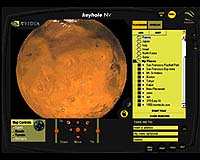
Beagle 2 Landing Site In 3D
As the time for Beagle 2 separation approaches a 3D representation of the landing site is available for download. Keyhole is a revolutionary software product that enables computer users to interact with a 3D model of a planet directly on the own PC. By hosting imagery and geographic feature data on the Internet, and streaming information out only as requested by the user, Keyhole lets users navigate an enormous database -- over 7 terabytes in size for the Earth version. Keyhole has many sources for its data, especially satellites for difficult to reach regions. Keyhole NV is the consumer version designed for NVIDIA graphics cards that lets users interact with a detailed Earth model, and switch to Mars anytime they want. Users can tilt the view; turn on the terrain to show mountains, canyons, valleys, and other landscape features; overlay roads and feature information; and save locations in Placemarks. Keyhole literally puts a planet in your hands, or at least on your desktop.
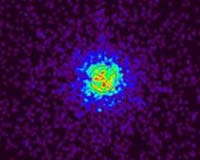
Paris - Dec 17, 2003 - Another ESA mission is turning its gaze towards Mars. This recent image was taken by the X-ray observatory XMM-Newton. All bodies in our Solar System, including planets such as Earth and Mars, emit X-ray radiation. As far as we know, there are several possible sources of this radiation. One of the main sources is thought to be 'fluorescence emission'. X-rays from the Sun hit atoms of elements such as oxygen in the atmosphere of the planet, and this radiation is re-emitted as so-called 'characteristic' radiation which identifies those specific elements. This image from XMM-Newton, recorded as part of a study by Dr K. Dennerl (Max Planck Institute for Extraterrestrial Physics, Garching, Germany) shows X-ray fluorescence emission from the atmosphere of Mars, mainly from oxygen. All of these emissions tell us something about the interaction of radiation with the planet's atmosphere and its environment. The study of Mars in X-ray wavelengths brings together the work of two very important ESA missions XMM-Newton and Mars Express. Both are crucial to our understanding of our nearest planetary neighbour, demonstrating the coherence of the ESA Science programme. X-ray view of Mars. Credits: Courtesy Dr Pedro Rodr�guez Pascual, XMM-Newton SOC, VilSpa, Madrid, Spain. Related Links Keyhole 3D Mars Express XMM-Newton overview SpaceDaily Search SpaceDaily Subscribe To SpaceDaily Express  Mars Is Just Around The Corner
 Paris - Dec 11, 2003
After a journey of 400 million km, ESA's Mars Express is now approaching its final destination. On 19 December, the spacecraft is scheduled to release the Beagle 2 lander it has been carrying since its launch on 2 June.
|
|
| ||||||||||
| The content herein, unless otherwise known to be public domain, are Copyright 1995-2016 - Space Media Network. All websites are published in Australia and are solely subject to Australian law and governed by Fair Use principals for news reporting and research purposes. AFP, UPI and IANS news wire stories are copyright Agence France-Presse, United Press International and Indo-Asia News Service. ESA news reports are copyright European Space Agency. All NASA sourced material is public domain. Additional copyrights may apply in whole or part to other bona fide parties. Advertising does not imply endorsement, agreement or approval of any opinions, statements or information provided by Space Media Network on any Web page published or hosted by Space Media Network. Privacy Statement All images and articles appearing on Space Media Network have been edited or digitally altered in some way. Any requests to remove copyright material will be acted upon in a timely and appropriate manner. Any attempt to extort money from Space Media Network will be ignored and reported to Australian Law Enforcement Agencies as a potential case of financial fraud involving the use of a telephonic carriage device or postal service. |