|
 |
 |
 |
 |
 |
 |
 |
 |
 |

| . |  |
. |
|
MARSDAILY.COM SPECIAL REPORT NASA To Reveal New Evidence For Water On Mars Washington - June 20, 2000 -
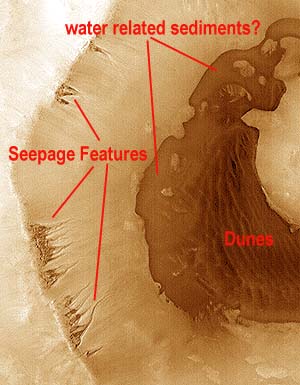
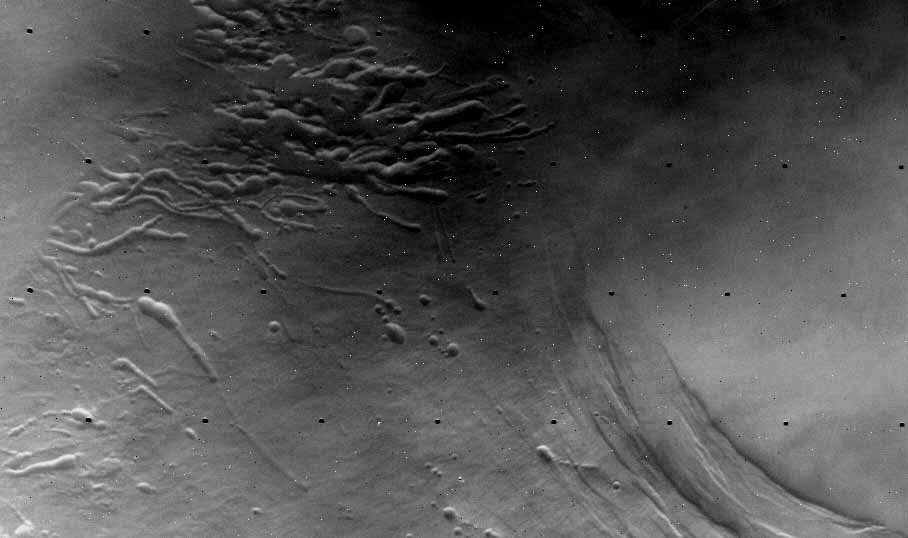
Speculation on the Internet has been running wild since late Monday when word came of a special White House briefing by NASA of something new that has been found on Mars. After discounting the usual wild ideas of winking faces and what not, the money appears to be on some sort of discovery relating to water at a low point in the Valles Marineris where the atmospheric pressure of Mars may be high enough to allow standing water. Meanwhile, NASA Watch is reporting that a paper is under preparation by members of the MGS Mars Orbiter Camera (MOC) team for submission to Science magazine. NASA Watch further reports "Informed sources within NASA suggest that the article may be concerned with water ice and the Valles Marineris region of Mars." Additional speculation has focused on outgassing or volcanic processes being observed over an extended period. Although Mars still has the potential for volcanic activity the planet is largely cooled with only occasional eruptions.
  Does Mars Leak
by Johann Helgason Reykjavik - June 10, 2000 - It is generally accepted that early in its history immense floods of water resulted in substantial erosional landforms being created across Mars. However, what happened to this water remains a mystery. Possible Mars Shoreline Found 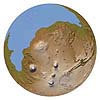 Providence - December 9, 1999 - In an article to be published in Science magazine Dec. 10, 1999, Brown University planetary geologist James Head and five colleagues present topographical measurements which they say are consistent with an ocean that dried up hundreds of millions of years ago. The measurements were taken by the Mars Orbiter Laser Altimeter, an instrument aboard the unmanned spacecraft Mars Global Surveyor which is circling the planet.
Surveyor Finds No Trace Of Ancient Oceans On Mars San Diego - October 1, 1999 -  After extensive imaging surveys via the Mars Global Surveyor now in orbit of possible shorelines previously identified by Viking, the conclusion of scientists at Malin Space Science Systems and JPL is that Mars probably never had a large body of liquid water - constituting an ocean - in the low lands of the Martian northern hemisphere.
Iowa Looks To Mars For Water Iowa City - September 8, 1999 -  University of Iowa professor and space physicist Don Gurnett has won a $4 million NASA contract in collaboration with JPL to develop and use radar in a search for underground water on Mars. The UI investigation is part of an international project aboard the European Space Agency's (ESA) Mars Express spacecraft scheduled for launch in 2003. Formally known as Mars Advanced Radar for Subsurface and Ionospheric Sounding (MARSIS), the joint Italian-U.S. project includes the University of Rome and NASA's Jet Propulsion Laboratory and Co-Investigator Gurnett at the University of Iowa.
|
|
| |||||||||
| The content herein, unless otherwise known to be public domain, are Copyright 1995-2016 - Space Media Network. All websites are published in Australia and are solely subject to Australian law and governed by Fair Use principals for news reporting and research purposes. AFP, UPI and IANS news wire stories are copyright Agence France-Presse, United Press International and Indo-Asia News Service. ESA news reports are copyright European Space Agency. All NASA sourced material is public domain. Additional copyrights may apply in whole or part to other bona fide parties. Advertising does not imply endorsement, agreement or approval of any opinions, statements or information provided by Space Media Network on any Web page published or hosted by Space Media Network. Privacy Statement All images and articles appearing on Space Media Network have been edited or digitally altered in some way. Any requests to remove copyright material will be acted upon in a timely and appropriate manner. Any attempt to extort money from Space Media Network will be ignored and reported to Australian Law Enforcement Agencies as a potential case of financial fraud involving the use of a telephonic carriage device or postal service. |